

Key Takeaways
- A Dopp kit is a toiletry bag. Nothing functional separates the two, and the three formats sold under the name differ far more than the names do.
- The word came out of a leather workshop and spread through military issue, which is why it still carries an expectation about material and build that the plain term does not.
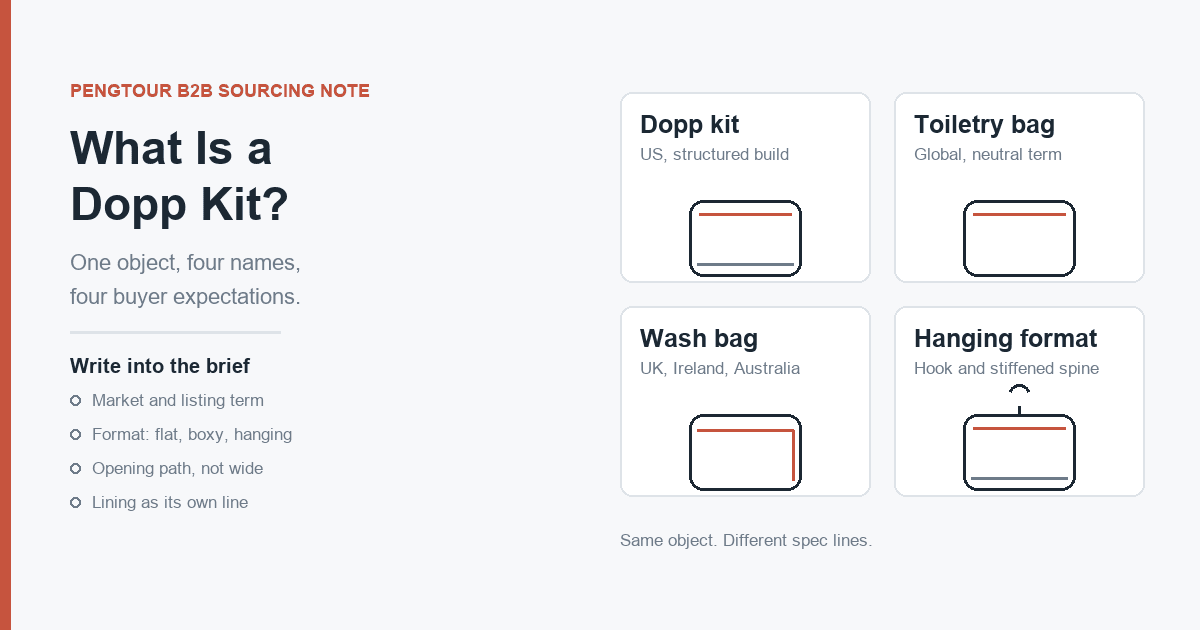
- Four regional names describe the same object. Picking the wrong one for your market costs you search traffic and sets an expectation your product may not meet.
- Each name pushes a different set of spec lines: base structure, opening path, hanging hardware, internal organisation.
- Write the name, the format, the opening and the lining as four separate lines in your brief. They are four separate decisions.
The Short Answer
A Dopp kit is a small case for grooming items, carried when you travel. Toothbrush, razor, shaving cream, deodorant, the things that normally sit on a bathroom shelf. That is the whole definition, and any page telling you the term marks a different product is usually selling one.
What makes the word worth a page is that it is not neutral. "Toiletry bag" describes what the object does. "Dopp kit" carries a second layer: a US-centric term, historically male, with an implied standard of material and construction. A soft nylon pouch does the same job but rarely gets listed under the name, and there is a reason for that.
For a brand building a private-label line, this matters at the brief stage. The name you put on the listing tells the shopper what to expect, and that expectation turns into spec lines: whether the bag needs to stand up on its own, how wide the opening has to be, whether a hook is required, and whether the lining needs to be a separate decision from the outer fabric.
Where the Name Comes From, and Why the Dates Disagree
The account repeated across trade writing runs roughly like this. Charles Doppelt, a leather worker who emigrated from Germany to Chicago in the early twentieth century, made and sold zippered toiletry cases under a shortened form of his surname. The US Army bought large quantities during the Second World War, servicemen took the word home with them, and a brand name turned into a common noun in the way that happens with a handful of other household words.
The details do not hold up evenly. Sources place the founding anywhere from 1919 to the mid-1920s. Some say the patent came in 1919, some say the design was produced in 1926. Trademark records cited in public summaries show filings in 1980 under Samsonite, a cancelled registration in 2003, and a later reacquisition in 2017. None of that changes what the word means today, and none of it is a specification you can build to.
The lesson for a buyer is narrow but useful. Treat the history as common usage rather than documented fact, and do not write a founding date into your own packaging copy. The durable part of the story is not the year. It is that the term began with leather goods and reached general use through military distribution, and the material expectation attached to the word comes straight out of that history.
Four Names, and Where Each One Is Used
|
Name |
Where it is common |
What it signals |
When to use it on a listing |
|
Dopp kit |
United States |
Men's grooming, structured build, leather or a material standing in for it |
US listings where the build justifies the expectation |
|
Toiletry bag |
Global |
The plainest term, no material or gender implied |
Default choice for international listings and B2B catalogues |
|
Wash bag |
UK, Ireland, Australia |
Neutral, any material, no gender implied |
UK and ANZ listings; also the safest term in mixed-market catalogues |
|
Sponge bag, ditty bag, amenity kit |
Narrower usage |
Sponge bag is older British; ditty bag came from sailors' small-item bags; amenity kit usually means a supplied kit rather than an empty one |
Avoid unless the brief specifically calls for it |
Two of these carry traps. "Sponge bag" reads as dated in most current listings and can make a new product look old. "Amenity kit" describes something handed out by a hotel or an airline, so an empty bag sold under that name reads as mislabelled. If you are writing one product description for several markets, use "toiletry bag" as the base term and let the market page carry the local word.
What Each Name Adds to the Brief
The name is not decoration. Each one pulls a different set of decisions into your specification, and leaving them implicit is the most common cause of a first sample that comes back wrong.
|
Signal carried by the name |
Spec line it forces you to write |
What to confirm before sampling |
|
Compact zippered pouch |
Closure length and pull type, whether there is a flat base, depth of the single compartment |
How full the bag is at its intended contents, not its maximum |
|
Boxy or self-standing form |
Base insert or stiffener, panel seam placement, whether it stands when half empty |
Whether the retail photo needs it to stand unaided |
|
Wide-opening access |
Zip path: top only, or three-sided across the full width |
Bottle heights, and whether items need to stay upright |
|
Hanging format |
Hook type and load path, reinforced spine or back panel |
Where it hangs in use, and what the hook carries when loaded |
|
Internal organisation |
Mesh pocket versus elastic loops, fixed or removable section |
Which items must be separated, and which can share space |
Pengtour's sewn-bag range includes toiletry bags, and structures of this kind can be evaluated or developed for a project: a compact zippered pouch, a boxy or self-standing form, wide-opening access, a single main compartment, internal pockets, mesh or elastic organisation, a hanging hook, a handle, and removable sections. Which of those apply, and in what combination, comes out of project review rather than a fixed configuration.
If you want the format decision written out against contents and packing rather than naming, the men's toiletry bag guide covers how a toiletry bag idea becomes an RFQ a factory can price.
The Material Expectation Behind the Word
Because the term began in leather and spread through leather kits, a shopper reading "Dopp kit" pictures leather or something with equivalent substance. Put the same word on a lightweight polyester pouch and the listing promises something the product does not deliver, which shows up in returns and reviews rather than in the sample.
That does not mean a synthetic programme cannot use the word. It means the build has to carry it. Structure in the panels, a lining that feels considered, hardware that does not read as cheap, and a closure that runs smoothly under load. Those decisions cost money in different places, so it is better to settle them on paper than to discover them in a review section.
Material and lining choices are confirmed per project. Do not assume a given fabric is stocked, and do not assume any performance claim comes attached to a material choice. If your market requires a specific test or certification, that can be arranged for the order, with scope, standard, timeline and cost agreed before the order is placed. Pengtour does not publish a claim of certification for these products.
For the lining as its own line item, see lining material options for custom bags. For the opening, see closure and zipper options. Both are separate decisions from the outer fabric, and both are cheaper to settle before sampling than after.
Turning the Name Into Sampling Inputs
A naming decision that stays in the marketing deck never reaches the sample. Write it down as lines the factory can price.
Start with the market and the listing term, because that sets the expectation the build has to meet. Then the format: flat pouch, boxy, or hanging. Then the opening, as a path rather than an adjective, so the zip length and the gusset depth are both defined. Then the lining, as its own material decision. Then hardware, hook type, and logo method.
The hanging format deserves one extra note. A hook plus a reinforced spine adds cost, weight and packed depth, and it is the format where the first sample most often comes back with a hook that cannot carry the loaded bag. The checks for that are specific, and they are covered in the hanging toiletry bag sample checks. If your programme is a flat kit, those checks are not your problem, and writing them in anyway just adds cost.
Reference material helps more than adjectives here. A reference sample, or photographs showing the intended opening and the intended contents, settles more in one round than three rounds of description. Where a programme spans several sizes, say which items appear in every size and which appear in only some.
What to Confirm Before the First Sample
- Target market and the term that will appear on the listing, packaging and hangtag
- Format: flat pouch, boxy or self-standing, or hanging
- Dimensions derived from the bottles and tools actually being sold with it
- Opening path, given as a zip route and a gusset depth, not as "wide"
- Lining, written as a separate material line from the outer fabric
- Hardware: hook type, pull type, and what the hook carries when the bag is loaded
- Logo method and placement, since it interacts with fabric and panel choice
- Reference sample or photographs, including the intended contents in place
- Packing method, because flat-packed and boxed units fail in different places
Pengtour's production team brings 13 years of experience to sewn bag programmes, custom toiletry bags among them, and the men's toiletry bag formats page shows one current structure. Third-party testing your market requires can be arranged for the order. Scope, standard, timeline and cost are confirmed before the order is placed. Material and lining options, minimum quantities, sample timing and pricing are project-specific and are confirmed during quotation rather than assumed.
How Pengtour Reviews a Custom Toiletry Bag Project
The review starts from the programme rather than the bag style: which market the bag sells into, what the listing calls it, and what the contents are. That order matters, because the name sets an expectation and the contents set the dimensions, and a format chosen before either one is usually the format that gets revised.
From there the structure options above are evaluated against the brief. A compact zippered pouch, a boxy or self-standing form, wide-opening access, a single main compartment, internal pockets, mesh or elastic organisation, a hanging hook, a handle, and removable sections are options that can be evaluated or developed. They are not a standard configuration, and the final structure follows project requirements and review.
Material and lining are treated as separate lines, because they fail separately. Hardware and hook load are checked against the loaded bag rather than the empty one. Where a buyer needs a test for a specific market, that is arranged as part of the order and agreed in advance.
FAQ
Is "Dopp kit" still a protected brand name?
Public trademark summaries show a long history of filings, a cancelled registration, and a later reacquisition, and the term is used generically across retail today. Treat trademark status as a question for your own counsel in your own market rather than as settled by an article. This page describes naming and specification practice, not legal status.
Can one bag carry different names in different markets?
Yes, and it usually should. The same SKU can go out as a Dopp kit on a US listing and a wash bag on a UK one, provided the build meets the expectation set by whichever word you use. Keep the hangtag and packaging consistent with the listing term, since a mismatch there is what generates returns.
How do you stop a soft kit from collapsing when it is half packed?
A soft case with no structure folds in on itself once it is partly empty, so contents pile up and access gets worse. The fix is a base insert or a panel stiffener rather than a heavier outer fabric, and it should be a written spec line so the sample can be checked against it. Decide it early, because it affects the panel pattern.
Does a hanging hook have to be metal?
Not necessarily, but the hook is the part that fails first when it is underspecified, and fabric loops tend to slip or tear under a loaded bag. Confirm the hook material, the attachment method and the load it has to carry, then check it on the loaded sample rather than the empty one.
Should the lining be specified separately from the outer fabric?
Yes. They fail in different ways and they are bought differently. A bag can have an outer fabric chosen for print and hand feel and a lining chosen for wipe-down and containment, and writing only one material line means the factory picks the second one for you.
Ready to turn a naming decision into a build you can price? Request a quote with your market, format and contents list, and we will come back with structure options and what needs confirming before sampling.