

A pet carrier size is not decided by a weight label or a size name such as S, M or L. Two pets of the same weight can need very different interior space, so a brand or private-label buyer should start from the animal's body, not from a marketing size band.
For a sourcing team, the useful version of "what size carrier do I need" is a specification. The pet's body length, standing height and body width become usable interior dimensions, then a doorway route, then structure choices, then a sample check. A manufacturer can quote and pattern that specification. A vague size request cannot be patterned reliably.
This article covers the measurement-to-sample route for a custom pet carrier. If you are selecting a manufacturer after the specification is defined, use the separate pet carrier manufacturer selection guide. For how the frame, shell, mesh and hardware carry load, see the custom pet carrier engineering breakdown.
Start With the Pet, Not the Bag
Weight is a screen, not a size. A long, low pet and a compact, tall pet may weigh the same but occupy different shapes. A broad chest can matter even in a light animal. A dense adult cat may fit a space that a lighter but longer animal does not.
Record these fields before any size discussion:
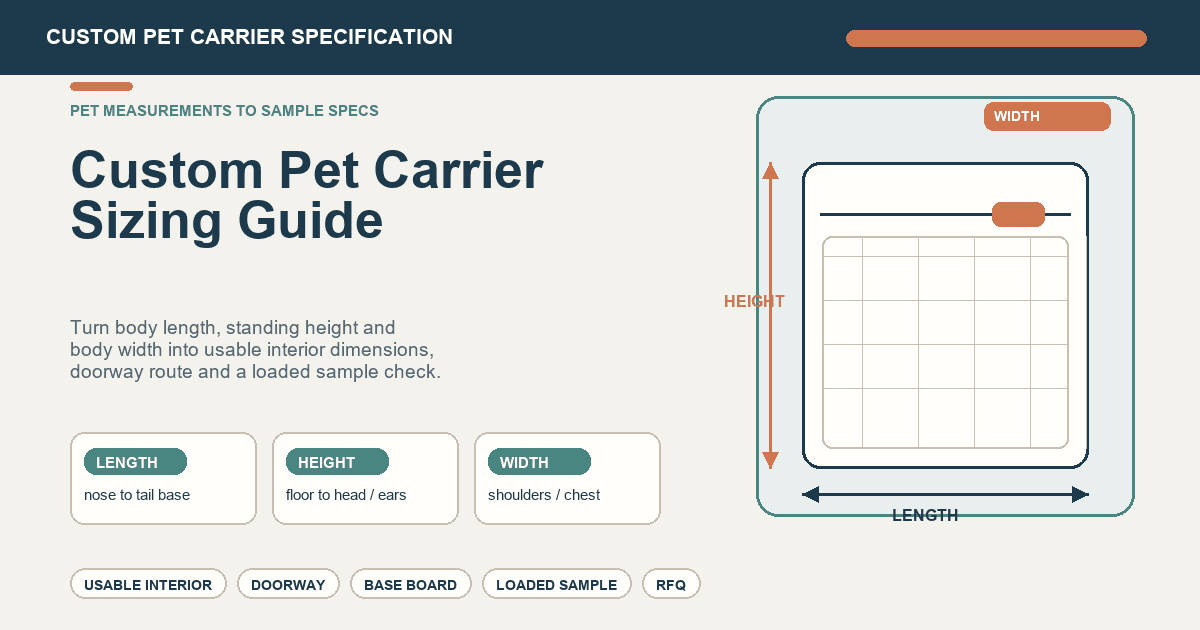
- Body length: nose tip to tail base, measured along the back, not around the body and not to the tail tip.
- Standing height: floor to the top of the head or the natural upright ear tips, whichever is higher.
- Body width: the widest comfortable point, usually shoulders or chest.
- Weight: a recent scale reading, used only as a supporting check.
- Resting posture: the space the pet uses when lying naturally.
Measure with the pet standing naturally on a level surface. Do not force a pose, press ears down or fold the body to make a measurement fit. Record the date and units, and re-measure a growing pet before ordering and before travel.
The reference points vary by method. Some guides use the tip of the nose, others the base of the neck. Confirm which method a manufacturer expects before the numbers are locked into a pattern. This article uses nose tip to tail base.
Turn the Measurements Into Usable Interior Dimensions
A listed length, width and height may describe the outside of the bag, including seams, padding, a rounded roof or space the pet cannot use. Before the measurements become a spec, decide which dimension set the factory will confirm.
Three dimension sets should stay separate in the RFQ:
- Exterior dimensions: the bag's outside footprint for shipping, shelving and airline or vehicle limits.
- Interior usable dimensions: the space inside the end walls, under the roof and across the base the pet can actually use.
- Doorway net dimensions: the clear opening the pet passes through, which can be smaller than the compartment width.
Interior length is the usable distance along the base inside the end walls. Interior width is the usable distance across the base, including any narrower section that limits turning. Interior height is clearance above the installed pad to the inside of the roof, checked at the position the pet's head would occupy.
The pet's measured numbers are inputs to these interior numbers, not the finished values. The finished clearance depends on the project: whether the pet must stand, turn and lie down, how the carrier is carried, whether a pad or liner sits under the pet, and how much movement the buyer wants inside the closed bag. There is no single universal buffer number that fits every project. The required clearance should be written as a project decision, not assumed.
A soft-wall carrier adds another check. When the top or sides can compress under a seat or when lifted, the interior height can change in use. Ask the factory to confirm the usable height with the bag closed and the intended pad installed, in the carrying position, not just as a flat fabric measurement.
For an expandable carrier, the resting expanded space does not prove the folded transport fit. Define the interior in the closed, transport position. See the custom expandable pet carrier guide for how expansion changes usable space.
Define the Doorway and Entry Route
A carrier can be roomy inside and still hard to use if the opening is too small or placed where the pet will not enter. Compare the doorway height and width with the pet's body and the way it prefers to enter.
Write the entry route into the spec, not just the doorway size:
- Opening direction: top, front, side or dual entry.
- Doorway clear height and width, measured to the zipper or frame, not to the outer edge.
- Whether the pet enters head-first, is lowered from the top, or is guided from the side.
- Whether the zipper path, frame edge or a folded flap reduces the clear opening in use.
A front door works for many animals; a top opening can simplify lowering a small pet into the enclosure. Dual entry gives an option, but every zipper or latch still needs inspection. The choice is a handling decision for the product design, not a claim that one door style is universally calmer or safer.
Record the entry and removal sequence the finished product should allow. If the pet must be removed in a hurry, the same doorway needs to work in reverse without catching on the frame.
Decide What the Structure Does to the Space
Interior numbers are only meaningful after the structure is defined. Several choices reduce or change usable space:
- A base board stiffens the floor but raises the pad and reduces interior height.
- A pad or liner takes height, so the clearance should be checked with the intended pad installed.
- A sloped or curved roof may be tall at the center but low where the pet's head sits.
- Sloped side walls, wheel wells, storage pockets and frames can reduce the floor width even when the exterior looks generous.
- Mesh and opening panels can flex, so the closed shape matters more than the flat pattern.
Ask the factory to state where each interior measurement is taken and whether the structure changes it under load. If the pet's measured length or height already equals the advertised interior number, there is unlikely to be meaningful clearance once the structure is added.
The structure review for a pet carrier is project-specific. The pet carrier engineering breakdown covers how the frame, shell, ventilation and hardware interact; this article only defines how those choices affect the size numbers.
Write the Numbers Into a Tech Pack and RFQ
A clear measurement package is what separates a quotable project from a guess. Before sampling, put the following into the request:
- Pet type and reference dimensions: body length, standing height, body width, weight.
- The posture requirements: stand, turn, lie down, or a supported seated posture for a specific carrier format.
- Required interior usable dimensions and the position each is measured from.
- Required doorway clear dimensions and the intended entry route.
- Pad, base board, liner and any structure that occupies interior space.
- Carrying method and whether the top or sides must hold shape in use.
- Reference photos, an existing sample or a Tech Pack where available.
- Any acceptance criteria for the first sample.
A full document format is covered in the bag Tech Pack sourcing guide. The pet-carrier fields above feed into that wider document; this article does not replace it.
Do not send only a weight and a breed name. A manufacturer cannot pattern an accurate interior from those two fields alone.
Review the Loaded Sample Before Approval
The first sample is where the size numbers get tested. Use an ordinary, practical sequence rather than a formal laboratory test:
- Empty-bag visual inspection: check the shape, seams, zipper, mesh panels, base and pad against the spec.
- Load the actual pet or a realistic substitute with similar dimensions and weight.
- Ordinary carrying in the intended position.
- Normal zipper and opening or closing.
- Entry and removal in the intended sequence.
- Re-check the interior fit, doorway and loaded shape after handling.
Compare the loaded result against the approved sample and confirmed requirements. Look for the pet being pressed against the roof, unable to turn, caught at the doorway, or the bag deforming so the interior shrinks in use.
An ordinary loaded check is not a formal load, escape, durability or safety test. It does not prove weight capacity, escape resistance, ventilation performance or airline acceptance. Those conclusions need a defined test method, sample quantity and recorded result. The general approval record format is in the custom bag sample approval checklist.
How Pengtour Approaches This Specification
Pengtour is an OEM and ODM manufacturer of custom EVA cases and sewn bags for overseas B2B buyers. For a pet carrier project, the team can review the pet's dimensions, the intended carrying method, the mesh and opening structure, the base support and the target market, then turn those inputs into a sample-ready specification.
The size and structure always stay project-specific. The production team can evaluate options such as opening direction, internal layout, base board, pad, mesh panels, zippers, handles, straps and reinforcement once the pet measurements and use conditions are confirmed. Sample development and quotation details are confirmed separately for each project.
If you have a pet product range to develop, send the measurement package above through custom pet carrier bags or start a custom soft bag development conversation, and request a project-specific quote with the dimensions and sample criteria attached.
Frequently Asked Questions
Should I measure a pet standing or sitting?
Follow the method the manufacturer requires. Standing measurements are commonly used for body length and overall height because they compare more consistently with the carrier's listed space. If the finished product supports a seated or curled posture, record that posture separately instead of forcing a standing number.
Where does the tail-base measurement end?
It ends where the tail joins the body, not at the tail tip. Confirm the product diagram because brands define reference points differently, and some measure from the base of the neck instead of the nose tip.
Can a soft carrier be slightly smaller than the pet's height?
Do not assume flexibility makes an undersized carrier appropriate. Compare the usable interior height in the closed, carried position, and remember that compression under a seat or when lifted can reduce the space further. Ask the manufacturer to confirm the closed shape, not just the flat fabric height.
What if a listing only gives exterior dimensions?
Ask for the usable interior dimensions with the pad installed and the bag closed. Exterior dimensions alone do not reveal wall thickness, taper, base board, frame or the space the pet can actually use.
Is the pet's maximum weight a safety rating?
Not necessarily. A weight range may be a recommendation or listing language, not an independent test result. Treat it as a screen, verify the interior dimensions separately, and ask for the test method and record behind any structural claim.