

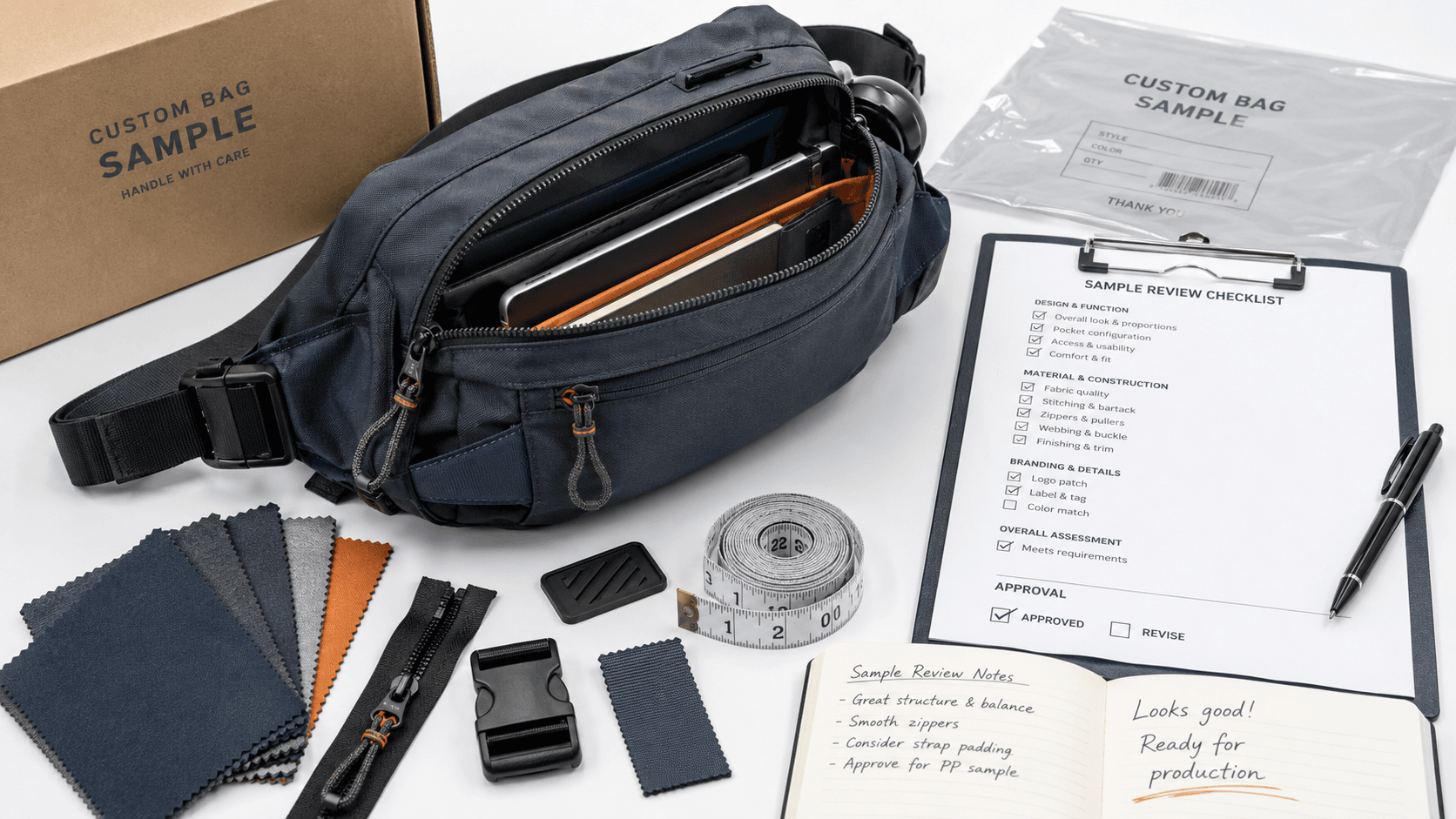
Before approving a custom functional bag sample for mass production, review the physical sample, real loading experience, bag structure, zipper path, stitching, binding, stress points, straps, materials, colors, logo effect, accessories, packaging, and final approval records. This checklist is mainly for the final revised sample or pre-production sample used before production approval. Photos and videos can support communication, but they should not replace the physical sample or complete technical specifications.
Answer Summary
A custom bag sample approval checklist should help buyers confirm whether the sample matches the approved project requirements before production begins. The review should cover the bag empty and loaded, the construction details, material and color matching, branding, packaging, revision records, and written sign-off. If key dimensions, structure, materials, logo process, accessories, stress points, or packaging fit change, another sample confirmation may be needed.
Key Takeaways
-
Use this checklist mainly for a final revised sample or pre-production sample, not for replacing early design development.
-
Review the bag with the intended product or realistic contents inside.
-
Keep the approved physical sample and final specification materials together as production references.
-
Treat visual and use checks separately from laboratory testing, formal QC, or zero-difference guarantees.
What Sample Is Being Approved?
Sample approval can mean different things at different stages. An early development sample may still need design, structure, material, or cost review. A revised sample checks whether earlier comments were corrected. A final pre-production sample is usually closer to the version that will guide the next production stage.
This checklist focuses on the final revised sample or pre-production sample that buyers review before giving production approval. At that stage, the buyer is no longer only asking whether the idea is possible. The buyer is checking whether the physical sample, written specifications, drawings, material and color confirmations, packaging requirements, revision comments, and approval records are aligned.
For an EVA-specific approval reference, review the custom EVA case sample approval checklist after confirming the general sample-stage records.
For a case-specific approval reference, review golden sample approval for custom EVA cases before releasing production.
For custom sewn bags, the customer-approved physical sample and final specification documents can be used together as the main production reference and confirmation benchmark for a project. That does not mean mass production can be promised to have zero difference from the sample. It means the approved sample and written records should be clear enough to guide the next production stage.
For a broader view of how sampling fits into the full project path, buyers can also review Pengtour's sampling and production workflow.
Custom Functional Bag Sample Approval Record
A checklist is more useful when it becomes a record. Before sign-off, buyers should record what was approved, what needs revision, and which reference document controls each decision.
| Approval field | What to record | Reference to check |
|---|---|---|
| Project name | Buyer project, bag type, or internal item name | RFQ or project file |
| Sample ID and version | Sample number, version, or revision round | Sample label or shipment note |
| Review date and reviewer | Who reviewed the sample and when | Buyer-side approval record |
| Specification version | Current specification sheet, Tech Pack, or drawing version | Latest approved document |
| Material and color status | Outer fabric, lining, webbing, color match, and component color notes | Material swatch, color confirmation, or project file |
| Logo and branding status | Logo file, size, placement, process, label, and visual effect | Artwork file and sample |
| Packaging status | Individual packaging, packing method, and product condition after packing | Packaging requirement or packing sample |
| Decision | Approved, approved with revision, revise and resubmit, or rejected | Written buyer confirmation |
| Revision comments | Exact changes requested and whether another sample is needed | Revision record |
| Final written approval | Confirmation that the sample and applicable specifications are approved | Email, approval form, or agreed written record |
Photos and videos can help show visible details such as shape, logo placement, packaging appearance, or a small revision. They are still auxiliary references. They do not replace the physical sample when the buyer needs to confirm loading, opening, carrying, zipper feel, or hand feel.
Custom Functional Bag Sample Approval Checklist
Buyers reviewing custom functional bag categories such as toiletry bags, medical bags, sports bags, electronics organizers, tool bags, first aid kit bags, or travel organizers should adapt the checklist to the actual product use.
| Approval item | Approve | Revise | N/A | Comments / reference |
| Overall dimensions and proportion | ☐ | ☐ | ☐ | Drawing, size table, or product sample |
| Real product loading and access | ☐ | ☐ | ☐ | Product model, loading test, or use scenario |
| Empty and loaded bag shape | ☐ | ☐ | ☐ | Front, side, bottom, and filled view |
| Opening size and opening angle | ☐ | ☐ | ☐ | Product access requirement |
| Main compartment, pockets, dividers, mesh, and elastic bands | ☐ | ☐ | ☐ | Structure drawing or Tech Pack |
| Zipper path, curve, pull direction, and smoothness | ☐ | ☐ | ☐ | Empty and loaded sample handling |
| Stitching, seams, binding, symmetry, and flatness | ☐ | ☐ | ☐ | Physical sample and photo notes |
| Stress points, handles, shoulder straps, backpack straps, and webbing | ☐ | ☐ | ☐ | Intended carrying method |
| Outer fabric, lining, webbing, zippers, buckles, and hardware | ☐ | ☐ | ☐ | Material and component confirmation |
| Color matching across fabric, lining, webbing, and accessories | ☐ | ☐ | ☐ | Approved swatch or color reference |
| Logo position, logo effect, labels, and instructions | ☐ | ☐ | ☐ | Artwork file and branding requirement |
| Individual packaging and carton packing method | ☐ | ☐ | ☐ | Packaging specification |
| Final sample, specifications, revision comments, and written approval | ☐ | ☐ | ☐ | Approval record |
The table is not a laboratory test report or a universal QC standard. It is a buyer-side sample approval tool. Specific material model, GSM, thickness, Pantone color number, allowed color tolerance, zipper or buckle specification, logo process, label requirement, packaging material, carton parameter, and performance test standard should be confirmed for the actual project.
Physical Bag Checks
Start with fit and handling. Load the real product, or realistic contents with similar size and weight, into the sample. A bag can look acceptable when empty but become too tight, too soft, bulky, unstable, or difficult to access when filled.
Check the overall size, width, height, depth, visual proportion, handle drop, strap length, bottom stability, and shape after loading. If the end user needs to insert or remove the product quickly, review the opening size and opening angle as carefully as the outer dimensions.
For duffel projects, the duffel bag dimensions and fit guide explains how to separate exterior size, usable space, opening clearance, and loaded fit.
Then review the sewn structure. The main compartment, pockets, dividers, mesh sections, elastic bands, and accessory positions affect how the bag will be used. Zipper path and smoothness should be checked with the bag loaded, especially around curves and filled corners.
Stitching, seams, binding, stress-point reinforcement, handles, shoulder straps, backpack straps, webbing, and connection structures should be reviewed through visual inspection and ordinary handling. These are practical sample-use checks. They should not be described as formal load-bearing, abrasion, waterproof, or life-cycle testing unless project-specific test evidence exists.
For a component-level explanation of waterproof zipper and overall bag waterproofing, review the related guide before treating sample-use checks as waterproof testing.
Materials, Branding, Components, and Packaging
After the bag body is reviewed, confirm the details that affect appearance, branding, usability, and packing. For a custom sewn functional bag sample, the buyer should check outer fabric, lining, color matching, webbing, zippers, buckles, metal hardware, logo position and effect, labels, instructions, individual packaging, and carton packing method.
General sample review can include appearance, hand feel, color coordination, installation position, operation smoothness, print or stitching clarity, and the product condition after packaging. For example, check whether the lining color works with the outer fabric, whether the zipper pull is easy to operate, whether the logo remains visually acceptable when the bag is filled, and whether the packaged bag becomes compressed in an unwanted way.
Some details must stay project-specific. Material model, GSM or thickness, Pantone color number, allowed color tolerance, zipper and buckle brand or specification, logo process and tolerance, label regulatory content, packaging material, carton parameters, and performance test standards should be confirmed for the actual project.
If the sample review raises questions about fabric choice, Pengtour's guide to material selection for functional bags can be useful background reading. The final approval should be based on whether the submitted sample matches the confirmed project requirements.
Physical Sample, Photos, Videos, and Documents
Photos and videos can speed up sample communication, but each format has limits.
Use the physical sample when reviewing hand feel, loading experience, opening angle, zipper smoothness, carrying balance, strap comfort, product access, or repeated ordinary opening and closing. These checks depend on handling, not only appearance.
Use photos, videos, or updated documents to support visible details or lower-risk revisions when the buyer accepts that method. They may help show logo placement, packaging appearance, color coordination under a given lighting condition, a revised seam area, or an updated label position.
| Review item | Physical sample recommended? | Photo/video/document support | Notes |
| Real product loading and access | Yes | Limited | Handle the loaded bag where possible |
| Hand feel and stiffness | Yes | Limited | Photos cannot fully show feel or flexibility |
| Zipper path and smoothness | Yes | Video may help | Check with the bag loaded |
| Logo position and visual effect | Usually helpful | Yes | Confirm final artwork and process separately |
| Material and color coordination | Usually helpful | Photos may help | Exact color tolerance must be project-specific |
| Small low-risk revision | Depends on scope | Yes, if accepted | Use updated files, photos, videos, or agreed methods |
| Final specification package | No physical handling needed | Yes | Written documents must be clear and current |
When Should Buyers Request a Revised Sample?
Not every change requires a completely new sample, but major changes should be treated carefully. If key dimensions, overall structure, material, color, logo process, major accessories, load-bearing structure, or packaging fit changes, another sample confirmation may usually be needed.
Lower-risk small changes may be confirmed through updated documents, photos, videos, or another agreed method if the buyer accepts that approach. Revision count, cost, resampling method, and timing should be evaluated by revision scope, material availability, and project requirements. Buyers should avoid assuming every revision is free, every change has a fixed timeline, or revised details never need reconfirmation.
| Review result | Possible next action | Typical use case |
| Sample approved | Confirm final sample and applicable specifications in writing | No critical changes remain |
| Approved with document update | Update the specification sheet, drawing, or approval record | Low-risk text, packaging note, or documentation correction |
| Small revision confirmed remotely | Confirm by updated file, photo, video, or agreed method | Buyer accepts that physical resampling is not necessary |
| Revised sample recommended | Adjust and review another sample | Structure, material, color, logo, accessory, stress point, or packaging fit changes |
| Sample not approved | Rework the sample plan before moving to production | Core function, fit, structure, or branding is not acceptable |
Sample Approval Process Before Mass Production
Use the checklist as a decision path, not as a formality.
Step 1: Confirm the Review Scope
Identify whether the sample is an early development sample, revised sample, or final pre-production sample. Confirm the bag type, intended contents, use scenario, and current specification version before reviewing details.
Step 2: Test the Physical Bag With Real Contents
Load the intended product or realistic contents into the sample. Review dimensions, capacity, opening, access, zipper path, carrying balance, bottom stability, and shape when the bag is empty and filled.
Step 3: Check Construction, Materials, Branding, and Packaging
Review structure, stitching, binding, stress points, straps, outer fabric, lining, components, color matching, logo effect, labels, instructions, individual packaging, and carton packing method.
Step 4: Compare the Sample With the Approval Record
Compare the physical sample with the specification sheet, Tech Pack, drawings, material and color confirmations, logo files, packaging requirements, dimensional tolerance, inspection requirements, and revision comments. If the sample and documents do not match, clarify the approved version before sign-off.
Step 5: Decide the Approval Result
Record whether the sample is approved, approved with document updates, needs remote confirmation, requires another sample, or is not approved. Before moving to production, buyers should provide written confirmation for the final sample and applicable specification materials.
What Buyers Should Send Pengtour for Review or Quotation
After reviewing the sample, prepare a clear project package. Useful materials may include the approved sample status, specification sheet or Tech Pack, drawings, product photos or videos, material and color confirmations, logo files and logo-effect comments, sample modification notes, packaging requirements, dimensional tolerances, inspection requirements, quantity target, and written approval or pending questions.
Buyers only need to provide the project information required for sample review, revision evaluation, and production quotation. Confidential drawings, files, or communication records should be shared only through the agreed project communication method. The goal is to give the factory enough accurate information to evaluate structure, materials, workmanship requirements, packaging, revision scope, and production readiness. Buyers can submit sample approval notes and RFQ details when they need Pengtour to review a revised sample, new specification package, or production quotation.
FAQ
Is a photo or video enough to approve a custom bag sample?
Photos and videos can support communication, especially for visible details or low-risk revisions accepted by the buyer. They should not replace the physical sample when buyers need to evaluate loading, hand feel, opening, zipper smoothness, carrying experience, or product fit. They also do not replace complete technical specifications.
What is the difference between an approved sample and final specifications?
The approved sample is the physical reference for shape, handling, workmanship, and appearance. Final specifications record the technical details that should guide production, such as dimensions, materials, colors, logo files, structure notes, packaging requirements, tolerances, and inspection requirements. They should be kept aligned before approval.
When does a custom bag sample need to be remade?
A revised or remade sample may be needed when key dimensions, structure, materials, colors, logo process, major accessories, stress points, load-bearing structure, or packaging fit changes. Small low-risk changes may sometimes be confirmed through updated documents, photos, videos, or another agreed method, depending on the project.
Can sample approval replace mass-production QC or laboratory testing?
No. Sample approval helps define the production reference, but it is not the same as mass-production QC or laboratory testing. Visual checks and ordinary use checks should not be described as verified abrasion, waterproof, load-bearing, lifetime, environmental, or transportation test results unless project-specific evidence exists.
For production-stage checkpoints after sample approval, use Pengtour's custom bag quality control checklist for sewn functional bags.
How Pengtour Supports Custom Bag Sample Review
Pengtour can help review custom sewn functional bag sample comments together with the supporting production references: the approved sample, specification sheet or Tech Pack, drawings, material and color confirmations, logo files, packaging requirements, revision comments, dimensional tolerance, inspection requirements, and written approval records.
If the sample review finds a structure, material, packaging, or branding issue, Pengtour can record the comments, confirm the revision direction, update related specification materials, and adjust or remake the sample depending on the revision scope and project requirements.
If you are reviewing a custom sewn functional bag sample before mass production, you can review Pengtour's customization options, browse relevant custom sewn functional bags, or request a project-specific quote with your sample approval notes and specification materials.