

Packaging gets decided late in most custom bag projects. The bag is sampled, the price is agreed, and then someone asks how the units should be packed. By that point the answer is usually whichever default the factory already runs, and every departure from that default turns into a change to a confirmed order.
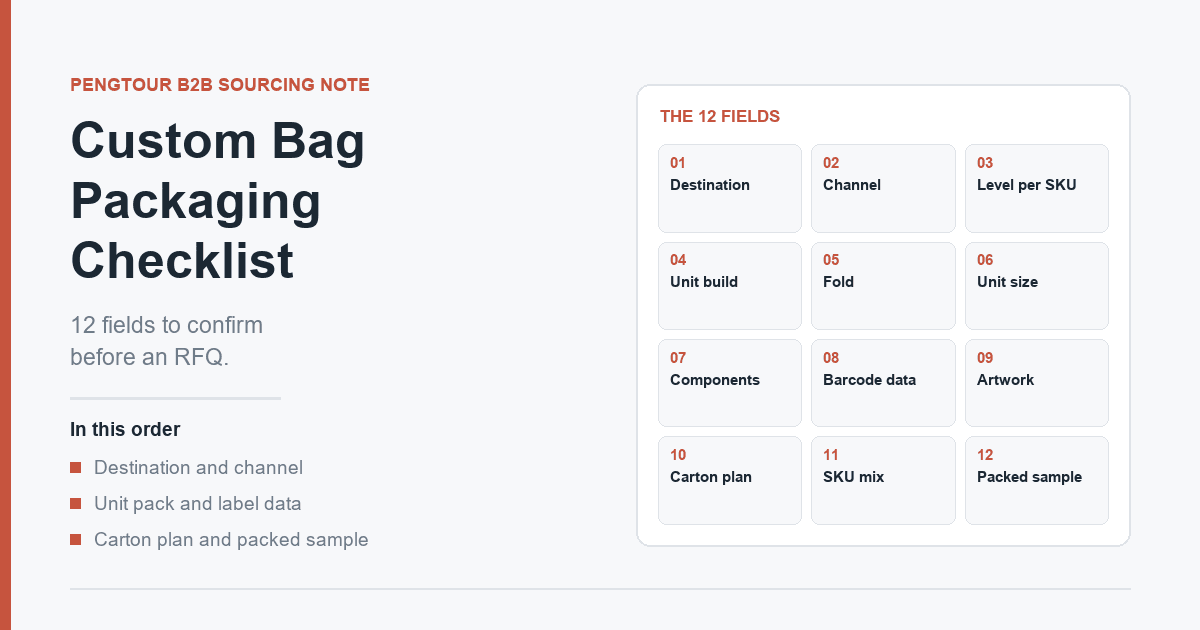
The order that avoids this is short. Decide where the bags are going, pick one packaging level per SKU, write the unit-pack spec, settle who owns the data printed on the label, plan the cartons, then approve a packed sample built from real finished bags. Those decisions produce the twelve fields at the end of this page. Skip any of them and the gap gets filled by someone who has never seen your channel.
Start With the Destination, Not the Bag
Four destinations behave differently, and they pull the same bag's packing in four directions.
A bulk importer takes cartons into a warehouse and breaks them down for its own customers. It usually needs a protective bag per unit, a marked carton, and very little else.
A fulfillment operation receives cartons and ships single units. It needs a unit that a picker can lift and label without opening, which means a scannable label on the outside and a bag that survives handling on its own.
A retail shelf needs a barcode the till can scan and a unit that can be shelved without assembly. That normally means a printed box or a header card, plus a size that fits a shelf depth.
An event or gifting program distributes to named recipients. It needs units grouped per recipient and cartons that can be opened and counted without a repack.
The usual mistake is describing the bag in three paragraphs and the destination in four words. "For US retail" is not a destination description. The questions that produce a usable answer are narrower: who opens the carton, do they re-ship individual units, will a unit be scanned, and does anything get discarded before the end customer sees the product. Write those answers down, then add the packaging inputs to the custom bag design brief so packing sits with the rest of the product spec instead of arriving after it is signed off.
Choose the Packaging Level Before You Compare Prices
|
Level |
What is usually inside |
Fits when |
|
Bulk export |
Individual protective bag, master carton, shipping mark |
An importer or distributor packs for its own customers |
|
Individual |
One unit per bag, protection at corners and hardware, unit label |
Direct-to-consumer or fulfillment work |
|
Branded |
Printed bag or sleeve, hangtag, insert card, tissue |
Launch, press, showroom, gift program |
|
Retail-ready |
Printed box with barcode and shelf information |
Store shelf or boxed gift set |
Unit prices from two different levels are not comparable. A bulk-packed pouch and a boxed pouch are different products, with different freight, different handling and a different packing line. Comparing them line by line is how a project picks on price and renegotiates on scope two weeks later.
One phrase deserves a question rather than a nod: standard export packing. It describes a starting point, not a specification. Ask what is actually inside it. Which bag material, whether there is a wrap, whether a hangtag is included, what is printed on the carton, and whether the unit is sealed. A factory that answers in detail has a spec. A factory that repeats the phrase has a default.
Write the Unit-Pack Specification
Six lines do most of the work: folded or flat, which panel faces out, where protection goes, what sits inside the bag versus outside, the closed dimensions of one unit, and how the pack is closed.
Folding is not a packing preference. A structured bag with a firm base and piping will crease along the base if it is pressed flat through a long sea transit. A soft pouch takes the same fold without a mark. Hardware stored against coated fabric for six weeks can leave a pressure mark, so it needs a wrap or a position of its own. A hangtag tied to the handle is seen before the bag is opened, while the same tag placed inside is found later. Placement belongs in the spec, not in a message to the packing line.
The chain buyers most often miss runs from the closed unit to the money. Closed unit dimensions decide how many units fit a carton. Units per carton decide the carton count. Carton count decides freight volume and warehouse cost. Twenty millimetres of extra unit thickness, multiplied across a few thousand pieces, shows up as an extra crate on the loading list.
Control the Data on the Label and the Artwork
Split the responsibility in two and most of the arguments stop.
The buyer owns the data: the barcode number registered to that specific SKU, the wording the market requires, warnings, composition or care text where applicable, translations, and whether the label changes per channel.
The factory owns the application: placement, size, material, print method, and getting the label to stay on through transit.
A factory can print what you send. It cannot confirm that your barcode is registered to the right product, and it cannot confirm that your wording satisfies the rules of the market you sell into. Those are the buyer's call, or the buyer's compliance adviser's. A supplier that offers to guarantee them is offering something it does not control.
Name the files so a packing line can tell them apart. Put product, market, language and revision in the filename. The same hangtag for one pouch sold in two languages is two versions, and a file called hangtag-final-final.pdf is a version nobody can audit. Send one file per version, with the revision written inside it.
Plan the Master Carton and the Allocation
The carton fields are short and every one of them gets confirmed per order: units per carton, carton dimensions, carton weight, the content and position of the carton mark, whether cartons carry one SKU or several, the pallet pattern, and the destination.
Exact carton size, carton weight and packing quantity are confirmed for each order rather than fixed. Any figure quoted before those are known is an assumption, and assumptions about carton weight travel straight into a freight quote.
Then build the allocation sheet: SKU by colour by destination, with a carton count in every cell. Without it a shipment arrives as forty cartons of one colour and three of another, or cartons that mix two colours because nobody said not to. If mixed cartons are allowed, the carton mark has to say so, otherwise the receiving warehouse opens every carton to find out.
A cost note that belongs here rather than with pricing: a box adds cube. When freight volume is tight, compare a protected unit in a bag and carton against a boxed unit before committing, because the box can cost more in space than it does in material.
Approve a Packed Sample, Not a Photo of Packaging
A packed sample uses actual finished bags and the complete component set, one sample per packaging version. An empty bag with a hangtag laid on top is a mood board.
Check the sample in the order the packing line will work. Contents and orientation first, opened and closed once by hand. Then the fold you specified, with the panel you named facing out. Then protection at the points you named, not somewhere in the bag. Then label and hangtag position against the drawing, and the barcode scanned with an actual scanner rather than judged by eye. Finally the carton mark against the destination and the carton count against the allocation sheet.
Record photographs for each version, the spec sheet with its revision, and a written approval. Photographs are support material. They do not replace the written spec, because a photo cannot tell a packing line how much wrap to add next time. Those packing checks sit alongside the rest of the bag sample approval checklist, and what a particular approval package contains varies by project.
Write Down What Re-Opens the Approval
Approval is not permanent. Certain changes send packaging back to the sample stage: packaging dimensions, packaging material, barcode or SKU data, carton quantity or carton mark, destination or channel, and any artwork revision that changes what a customer reads.
Smaller changes, a wording adjustment on an insert card for example, may be confirmed with updated documents or a photograph if the buyer accepts that route. Where the line falls depends on the scope of the change, not on how close the ship date is.
Keep a version log, six columns wide: version, what changed, which SKU and market it applies to, who approved it, the date, and the document reference. Repeat orders start from the last approved version. Without that log, the third order quietly loses the tissue paper and nobody notices until the first customer opens a parcel.
Check Before Shipment, and Know What the Check Is Not
A packaging inspection compares the shipment against your approved spec. Depending on the project it may cover the protective bag, inner box and master carton, product quantity, carton quantity, barcode, product label, shipping mark, instruction card, cleanliness, carton condition, product orientation and protective wrapping.
The issues that come up are consistent: an incorrect quantity, a wrong label, a missing barcode, a damaged carton, insufficient protection, an incorrect packing direction, mixed products, or the wrong shipping mark.
None of it is a transport test. If a channel or a customer asks for drop, vibration or compression data, that needs an agreed method and a recorded result, arranged as a separate item. Watching a carton survive a handling trial is a useful observation and not that record. The final comparison belongs with the rest of the quality control checklist for custom bags, where packing is one line among many.
The Twelve Fields
These are the fields that decide whether a packaging quote is accurate. Send them once, in one file, in the order below.
|
Field |
What to send |
What it affects if missing |
|
1. Destination and receiving party |
Country, city, who opens the carton, whether units are re-shipped |
Packing level and carton mark |
|
2. Channel |
Bulk import, fulfillment, retail shelf, event |
Unit pack and label set |
|
3. Packaging level per SKU |
One level named for each SKU |
Price comparison |
|
4. Unit pack construction |
Bag type, wrap, corner and hardware protection |
Protection and cost |
|
5. Fold and orientation |
Folded or flat, which panel faces out |
Creases and carton count |
|
6. Closed unit dimensions |
Size and weight of one packed unit |
Carton count and freight volume |
|
7. Components and placement |
Hangtag, insert, label, and inside or outside |
Packing rework |
|
8. Barcode and SKU data |
File, placement, and who registered the number |
Unscannable units |
|
9. Artwork files and revision |
One file per version, revision marked |
Wrong print |
|
10. Units per carton and carton mark |
Quantity, mark content, mark position |
Receiving delays |
|
11. Mixed or single SKU cartons |
Allowed or not, and how the carton is marked |
Warehouse rework |
|
12. Packed sample requirement |
How many, which versions, who signs off |
Approval without a reference |
Where a field is genuinely open, mark it open with a date instead of leaving it blank. An empty cell invites a default. A line that reads "carton quantity to be confirmed once unit pack dimensions are fixed" tells everyone which decision is still owed and who owes it.
How Pengtour Reviews Packaging Requirements
For custom sewn bag projects, the packaging options that can be evaluated start with the unit: an individual polybag, protective wrapping, a printed polybag, an inner box, a colour box, a kraft box or a custom printed box. Above the unit sit the master carton, the shipping mark, the barcode label, the product label, the instruction card and the hang tag. Which combination suits a project depends on product dimensions, product weight, retail requirements, e-commerce requirements, shipping method, target market, branding and budget.
Exact packaging size, carton quantity and carton weight are confirmed for each order. Sample development can include packaging confirmation, and a functional bag sample review can cover labels, instructions, individual packaging and the carton packing method. If packaging fit changes, another sample confirmation may usually be needed depending on the scope of the change. Packaging inspection can be set against the approved spec, and third-party inspection or test arrangements can be discussed as separate items.
Three things this page does not claim. Packaging does not by itself make a shipment acceptable to a marketplace, a retailer, a warehouse or a customs authority, because those rules are set by the receiving side and they change. No environmental property is claimed for any packaging option unless a project carries the material and the documents for it. No test result is claimed without an agreed method and a recorded outcome. Buyers supply the current channel requirements and we pack to a written spec.
Our range of custom sewn functional bags covers the toiletry, cosmetic, jewellery, first aid, medical, sports, travel and electronics organiser formats this checklist applies to. To have a packaging plan reviewed against the bag you are developing, send the bag and packaging requirements for review with the twelve fields above, and we will confirm what can be quoted now and what stays open.
FAQ
Can one bag style use different packaging versions in the same order?
Yes, and it is common when one style serves a retail channel and a promotional program. Each version needs its own version number, its own approved packed sample and its own carton mark. If the two versions share a carton, the carton has to be marked with both SKUs and their quantities, or the receiving warehouse opens every carton to sort it.
Does custom packaging change the MOQ?
It can, for two reasons. Printed or boxed components may carry their own minimum run at the packaging supplier, and each additional version adds a separate set-up before packing starts. The effect depends on the component, the number of versions and the order quantity, so it is confirmed per project rather than quoted as a rule. Our guide to how packaging affects the MOQ calculation covers the rest of that calculation.
Do we have to design the hangtag and label artwork ourselves?
The layout can be built from your text and logo, and placing a barcode or a warning panel is straightforward mechanical work. The content is not ours to invent. The wording a market requires, the composition text and the barcode number registered to the SKU all come from the buyer. Send the text and the data, then treat the layout as something to approve rather than something to delegate.
Can packaging be changed after the order is placed?
It can be discussed, and whether it is practical depends on where the order sits. A change made before packaging components are ordered is a document update. A change made after printed components are produced reopens cost, timing and possibly the packed sample. Changes to dimensions, material, barcode or carton quantity are the ones most likely to require another confirmation.
Key Takeaways
- Fix the destination and the packaging level before comparing prices, because quotes from different levels are not the same product.
- The closed unit's dimensions decide the carton count, and the carton count decides freight volume, so pack size is a cost decision rather than a finishing detail.
- The buyer owns barcode numbers, market wording and warnings; the factory owns placement, material and print. Write the split down or the gap gets filled by assumption.
- A packed sample built from real finished bags, approved in writing with its revision, is the only reference a packing line can work from.
- A factory packing check compares a shipment to your spec. It is not a transport test, and no visual check produces drop or vibration data.