

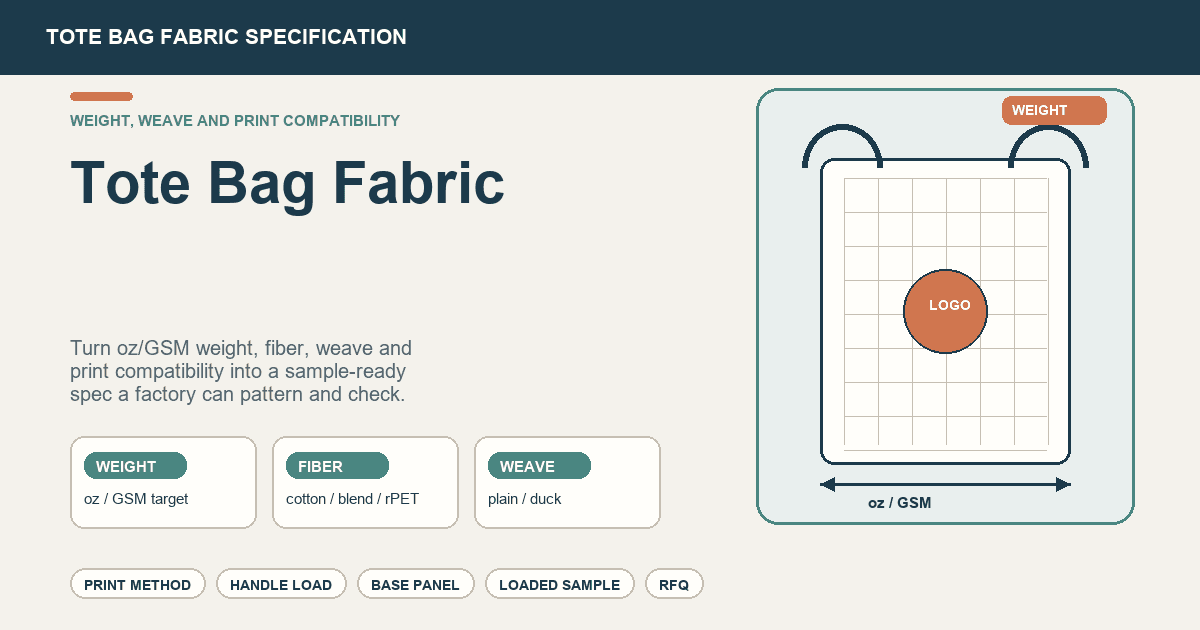
A tote bag starts as a fabric decision, but most buyers stop at a single number such as "12 oz canvas" or "400 GSM." That number does not tell the factory how the bag will feel, how a printed logo will hold, or whether the handles will pull through the fabric under a full load. A sourcing team needs the fabric written as a specification, not as a marketing label.
This article turns tote fabric into the fields a manufacturer can pattern, sew and check. It covers weight, fiber and weave, then print compatibility, then how fabric meets the handle and base, then the sample check that closes the loop. If you need the wider canvas type comparison, see the canvas fabric types guide. If your question is mainly about the handles, see the tote bag handle guide.
Separate Weight From the Rest of the Spec
Fabric weight is measured two ways. In the United States it is ounces per square yard (oz), and elsewhere grams per square meter (GSM). They describe the same fabric at different units, but they do not tell the whole story by themselves.
A simple conversion helps you and the factory talk about the same cloth. One ounce per square yard is about 33.9 GSM, so a 10 oz canvas is roughly 340 GSM and a 12 oz canvas is roughly 407 GSM. Confirm the exact number with the supplier rather than rounding it into a pattern.
Weight is only one of three things that decide how a tote behaves. The other two are the fiber and the weave. A 12 oz cotton canvas and a 12 oz polyester fabric will fold, print and age differently even though the number is identical. Keep the three separate in the spec:
- Weight: oz or GSM, and which unit the factory confirms.
- Fiber: cotton, polyester, a cotton-polyester blend, or a recycled content.
- Weave: the construction that gives the cloth its grip, drape and stiffness.
Write the weight as a target, not as a promise of durability. A heavier cloth is not automatically stronger; it is denser and stiffer. A lighter cloth is not automatically weak; it is easier to fold and ship. The weight that fits depends on what the bag will carry and how it will be carried.
Match Weight to the Use, Not to a Thicker Feels Better Rule
The right weight follows the intended load and the brand promise, not a guess that heavier always wins.
A promotional or event tote that holds a program, a water bottle and a small gift can sit in a lighter range. A retail tote a customer reuses for groceries or books needs more body so it holds its shape and its handles do not strain at the seams. A heavy-use tote for tools or bulky items needs a dense cloth and, more importantly, reinforcement at the stress points.
Ask the factory to confirm the weight range it actually works with regularly. A very heavy canvas is harder to sew: needles break more often, folded edges are harder to keep flat, and the finished bag costs more to ship. A very light cloth collapses and makes a brand feel cheap even before the seams give way. The useful target is the lightest cloth that still survives the expected carry load with the chosen reinforcement.
Record the expected load in the RFQ, not just the weight. The load drives the material choice; the material number is the output.
Choose Fiber and Weave Before the Number Locks
Cotton canvas is the common starting point for retail and bookshop totes. It prints well, softens with use and has a natural grip. Duck canvas is a tighter plain weave; it is denser and more abrasion-resistant for the same weight class, and it suits tool or workwear-style bags. A cotton-polyester blend softens wrinkling and adds some quick-dry behavior, but synthetic fiber changes how ink sits. Polyester and recycled polyester are lighter and fold flat, but they are slick and may need a coating or a specific ink for the logo to hold.
The weave matters as much as the fiber. A tight duck weave resists abrasion better than a loose plain cotton weave of the same weight. When a supplier says "duck canvas," confirm whether they mean single-fill or double-fill, because the two behave differently.
Ask the supplier to state the fiber blend ratio, the weave construction and the finishing. Dye lot and shrinkage matter when the bag must match a brand color across a repeat order. These fields belong in the spec before the weight is finalized, because a weight number without a fiber and weave is not a complete instruction.
Check Print Compatibility Before the Fabric Is Chosen
Fabric and print method are one decision, not two. The cloth you pick either accepts the artwork cleanly or it does not.
A smooth, tightly woven cotton takes fine screen-printed detail well. A loose or textured weave shows the fabric through the ink. A slick polyester surface can reject standard inks and may need a coating or a different method. Recycled fiber batches can vary, so ink adhesion should be confirmed on the actual batch rather than assumed.
State the print method and the artwork format with the fabric:
- Method: screen printing, heat transfer, or another process the supplier confirms.
- Artwork: a vector file at a resolution the supplier specifies, with the color target named.
Make the fabric and the print method agree in the same RFQ. If the logo needs a smooth print surface, that points toward a tighter weave and a compatible weight. If the fabric is chosen first and the print method second, the two can contradict and the sample will show it.
Write How Fabric Meets the Handle and the Base
Fabric strength is only part of the story. The point where the handle attaches to the body is where a tote fails, so the fabric spec must carry that load path.
The handle type, its anchoring length and the attachment method decide how the load spreads into the cloth. A narrow strap pulling on a small stitch area concentrates force. A wider attachment area spreads it. The base and the gusset depth change how much the bottom panel carries, and a structured or reinforced bottom shifts load away from the side seams.
Put these together in the spec:
- Fabric weight, fiber and weave.
- Handle type and how it attaches to the body.
- The reinforcement at the handle attachment point.
- The base construction and whether it is reinforced or structured.
- The intended carry load, so the factory can check the whole path.
A fabric that is strong on paper still fails if the handle pulls through it. The spec must describe the load path, not just the cloth.
Turn the Fabric Into a Sample-Ready Spec and RFQ
The point of all these decisions is a sample a factory can pattern, sew and check. Send the fields together instead of one at a time.
The RFQ should carry:
- Tote type: open-top or with a closure.
- Dimensions: height, width and gusset depth, unfolded.
- Handle: drop length, type and attachment.
- Fabric: fiber, weave, weight target in oz or GSM, and lining if any.
- Load: what the bag will carry and how it is carried.
- Print: method, artwork and color target.
- Sample expectation: whether a photo sample, a physical sample or a pre-production sample comes first.
Write "confirm options" for any field you have not decided, rather than leaving it blank. A blank field makes the supplier guess, and a guess costs you either money or time.
For the wider document that turns all these fields into a factory instruction, see the bag Tech Pack sourcing guide.
Check the Fabric on the Sample, Not Just on Paper
A spec is a promise until the sample proves it. The fabric needs to be checked the way a buyer checks it, not the way a catalog describes it.
An ordinary sample review covers the fabric by touch and by load. Look at the cloth, then load the bag with a realistic set of contents, carry it the way a customer would, open and close it, take the items out and check it again. Watch the handle attachment and the seams while the bag is loaded. A loose stitch or a pulling thread under load will only get worse in bulk.
For the record that ties this check to the general sewn-bag approval flow, see the custom bag sample approval checklist. For how the seams and reinforcement are reviewed, see the custom bag stitching reinforcement guide.
This ordinary loaded review is not a formal durability, tensile or wash test. If the project needs a defined test or an acceptance standard, name it in the RFQ so it is quoted and agreed, rather than implied.
How Pengtour Approaches Tote Fabric
Pengtour is an OEM/ODM manufacturer of custom EVA protective cases and sewn bags for overseas B2B buyers. For a custom tote bag, the team can review the fabric weight, fiber, weave, finish, color, print method, handle attachment and base construction against the project requirements, then carry the decision into pattern development and sampling.
The work moves from your fabric intent to a sample you can hold and load. If you are developing a custom sewn bag, the route starts through the custom soft bag development path.
FAQ
What is the difference between oz and GSM?
Both measure fabric weight. Oz means ounces per square yard and is used mostly in the United States. GSM means grams per square meter and is used internationally. One ounce per square yard is about 33.9 GSM, so a 10 oz canvas is roughly 340 GSM. Confirm the exact conversion with the supplier.
Is a heavier tote fabric always stronger?
Not always. A heavier cloth is denser and stiffer, but strength also depends on the fiber, the weave and the reinforcement at the handle and seams. A dense duck weave can be more abrasion-resistant than a loose plain weave of the same weight. Choose the lightest cloth that survives the expected load with the right reinforcement.
Does fabric weight change how a printed logo looks?
Yes. A smooth, tightly woven cotton takes fine print detail well, while a loose or textured weave shows through the ink. A slick polyester surface can reject standard inks and may need a coating or a different method. Confirm ink adhesion on the actual fabric batch.
What should I confirm with the supplier about tote fabric?
Confirm the fiber blend ratio, the weave construction, the finish, the weight target in oz or GSM, the dye lot and any shrinkage, and whether the supplier regularly works with the weight you need. Also confirm the print method and artwork format at the same time.
What should I check on a tote fabric sample?
Check the cloth by touch, then load the bag with realistic contents, carry it the way a customer would, open and close it, remove the items and check the handle attachment and seams while loaded. This ordinary loaded review is not a formal durability or wash test; name any defined test in the RFQ.
Next Step
A tote fabric spec removes the guessing from sourcing. Send your intended use, target dimensions, handle preference and fabric intent to request a project-specific quote, and the team can turn it into a sample-ready specification.