

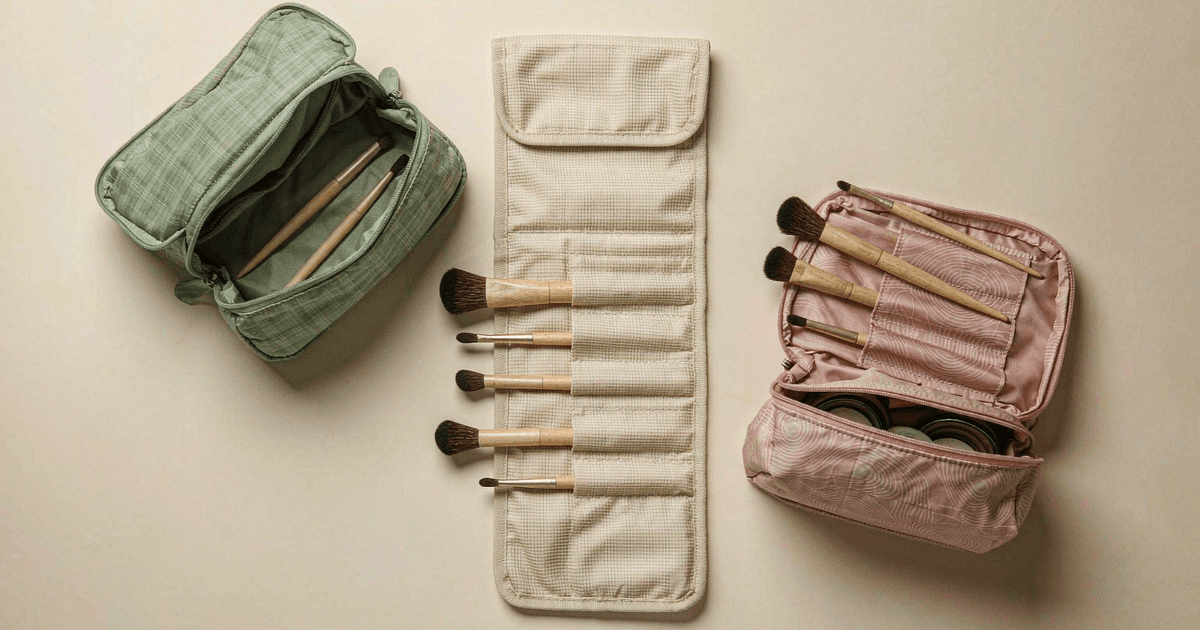
A brush can fit inside a makeup bag and still be awkward to store. Its handle may disappear into a deep pocket, its head may catch under a flap, or the pouch may close only when other products press against it.
To store makeup brushes, start with clean, fully dry tools and a clean storage area. At home, choose a holder or drawer with space for the brush heads. For travel, compare a separate brush pouch, an unfolding brush roll and a dedicated section inside a makeup bag. The useful choice depends on the brushes you carry and how you want to take them out.
For beauty brands developing an organizer, these everyday differences become design inputs: the brush set, storage orientation, opening format and separation from other cosmetics.
Key Takeaways
- Home storage and travel storage have different space and access requirements.
- A pouch keeps brushes together; a roll can give individual handles defined positions; an integrated panel keeps tools with the rest of the kit.
- Check the widest brush head as well as the longest handle. A brush count alone says little about fit.
- Judge a travel organizer when it is packed and closed, then open it and remove the brushes.
- Follow the care instructions for both the brushes and their container. A closed pouch is a storage option, not a drying method.
Start With Where the Brushes Will Be Used
A holder on a dressing table stays in one orientation. A pouch in a suitcase may be turned sideways and packed beside other items. The same arrangement can behave differently in those two settings.
For daily use at home, an upright holder makes handles easy to select. Leave room between heads rather than wedging a large powder brush between several smaller tools. If you prefer a drawer, check its closed height and arrange the brushes so their heads do not catch under the drawer above.
A covered holder may suit a surface where brushes would otherwise remain exposed. Check that the lid clears the tallest brush and that you can reach the inside for cleaning. A cover alone does not establish hygienic or protective performance.
For travel, ask a different question: what happens when the organizer closes and goes into another bag? Loose access at the dressing table matters less if the brush head is bent by the packed contents.
If you are choosing the whole organizer rather than just its brush storage, compare the broader makeup bag types first. Then select the brush section around the format you actually plan to carry.
Compare a Brush Pouch, a Brush Roll and an Integrated Section
These are structure choices, not a ranking from basic to premium. A simple pouch can suit a small routine better than a large organizer with unused compartments.
|
Storage Format |
When It May Be Useful |
Main Trade-Off |
What to Look At |
|
Separate zippered pouch |
Moving the same brush set between different bags |
Loose tools may gather at one end |
Opening width, internal depth and contact after closure |
|
Unfolding brush roll |
Seeing individual brushes laid out together |
It needs space to unfold, and filling changes its rolled size |
Handle-pocket fit, flap position and the filled roll |
|
Integrated brush panel or section |
Keeping brushes with a complete makeup kit |
Brush space shares the bag with bottles and palettes |
Contact with the main compartment when the bag closes |
A Separate Pouch Is Easier to Move Between Bags
A removable pouch lets you transfer brushes without repacking the rest of your cosmetics. It can also be taken to a work surface while the main bag stays elsewhere.
The compromise is control inside the pouch. In one open compartment, short handles and narrow tools may collect beneath larger brushes. A long pouch can fit a long brush while making a much shorter brush harder to retrieve.
Open it with your intended set inside. Can you see the tool you want? Can you remove it by the handle? Check the opening and zipper path as well as the empty pouch dimensions.
A Brush Roll Trades Compact Closure for an Open Layout
A brush roll unfolds to reveal a row of tools, often with separate handle pockets and a flap over the brush-head area. That layout may suit someone who wants to see several tools before choosing one.
It also needs a suitable place to unfold. A narrow hotel shelf may offer less working space than a dressing table. Once the roll is filled, large heads can make it bulkier than its flat appearance suggests.
Check where each handle pocket ends, where the head begins and where the flap falls. Then close the filled roll gently. If closing it pulls the flap across the brush heads or forces them against each other, review the layout rather than tightening the closure further.
A roll with more pockets is not automatically more useful. Pocket shape and the actual brush mix determine how much of that layout you can use.
An Integrated Section Keeps the Kit Together
A brush panel inside a makeup bag can keep tools visible when the bag opens. It also reduces the number of separate pieces to carry.
The important trade-off appears at closure. A panel that looks spacious while open may meet the tops of bottles or the edge of a palette once the lid folds down. Check this with the main compartment loaded normally.
A flap may provide a physical divider between the brush area and other contents, depending on its coverage and construction. It should not be assumed to contain a cosmetic leak or make the organizer waterproof.
For the remaining bottles, powders and small tools, use a separate plan to organize the rest of a makeup bag. Brush storage is one part of that layout, not a reason to squeeze every product into the same section.
Choose Around Brush Shape, Not Just Brush Count
Two sets described as ten brushes can need very different storage. One may contain mostly slim eye brushes. Another may include broad powder heads, angled tools and thick handles.
Lay out the set before choosing a container. Look at the longest complete brush, the widest head, the thickest handle and the shortest tool. These four examples often reveal more than a total count.
Leave the brush heads in their natural shapes while checking fit. If the only way to close a pouch is to flatten a head or force a handle diagonally across another brush, consider a different layout or a smaller packed set.
For a roll or panel, pay attention to which part of the brush is held. A pocket may locate the handle while leaving the head free, but its position must work with the individual brush. A short handle in a deep sleeve can be difficult to grasp; a thick handle can change how a soft panel lies.
These are ordinary fit observations. They do not establish impact resistance, long-term shape retention or a tested level of protection.
Keep Storage Care Separate From Brush Care
Follow the brush maker's washing and drying instructions before putting tools away. Store them fully dry, and follow the container's own care directions as well. A lining described as wipe-clean should still have an agreed cleaning method; that description does not mean every detergent or cosmetic remover is suitable.
Look inside the pockets, beneath flaps and around seams when checking the container. Those areas may be harder to reach than a flat outer surface. If access for cleaning is important, include it in the choice between a fixed panel and a removable pouch.
For container care, see the guide to cleaning a makeup bag. Brush fibers, adhesives and handles may have different care requirements from the bag around them.
For Beauty Brands: Turn the Storage Choice Into a Product Brief
Start with the customer routine. Does the user transfer a few brushes between bags, unfold a working set on a table, or carry all cosmetics in one organizer? That decision gives a clearer starting point than asking for a generic brush compartment.
|
Brief Input |
What the Brand Should Provide |
Why It Matters |
|
Representative brush set |
Photos, quantities and actual samples or accurate dimensions |
Shows differences hidden by a simple brush count |
|
Storage format |
Separate pouch, roll or integrated section |
Establishes how the user opens and accesses the tools |
|
Brush positions |
Intended orientation and handle/head locations |
Helps identify deep pockets and contact points |
|
Other packed contents |
Bottles, palettes and tools used alongside the brushes |
Reveals shared-space pressure when the bag closes |
|
Care expectations |
Proposed cleaning method and material requirements |
Keeps cleanability a review item rather than an unsupported promise |
|
Branding and packaging |
Artwork, placement and intended packed presentation |
Allows construction and folding requirements to be reviewed together |
Keep this brief focused on the storage behavior. The wider Tech Pack can hold the full material, construction and version details. There is no universal pocket size or fixed allowance that suits every brush set.
How Pengtour Can Support a Cosmetic Organizer Project
Pengtour can evaluate custom sewn cosmetic organizer projects from buyer samples, photos, dimensions, structure notes or a Tech Pack. Possible internal options may include pockets, elastic loops, brush sections and removable organizer sections, subject to material, manufacturing and sample review.
One anonymized cosmetic organizer sample review illustrates why position matters. Small makeup items sank into a deep storage area and were difficult to see and remove, even though the overall capacity was sufficient. The layout was adjusted with separate sections to give those items more defined positions. This was a small-item organization case, not a brush-protection test.
For a brush-focused project, the same review principle means checking actual tools or size-accurate substitutes in the proposed layout. Depending on the project, revisions may involve pocket depth, brush-section length, opening access or separation from the main contents. Final feasibility and approval remain project-specific.
Explore Pengtour's custom sewn functional bags for the broader product direction. For a specific project, send the intended brush set, storage format, other contents and branding requirements to request a cosmetic organizer review.
Frequently Asked Questions
Can I Store Different Types of Brushes Together?
Yes, provided the arrangement suits their different shapes. Check how angled, broad and narrow heads sit beside one another, and keep each handle accessible. Mixed sets may need different pocket widths or a combination of held and open storage rather than identical slots.
How Should I Store Expensive Makeup Brushes?
Choose around the brush maker's care instructions and the shape of each tool. Price alone does not tell you whether a pouch, roll or panel will fit. Review the individual heads and handles instead of assuming a costly brush needs a particular case format.
Can I Use the Same Pouch for Brushes and Sponges?
You can assess a shared container, but give the sponge its own space and follow its care instructions before storage. A pocket sized for a brush handle may compress a sponge or make it difficult to remove. For a branded set, include the actual sponge in the layout review.
Does a Covered Brush Section Make the Whole Bag Waterproof?
No. A covered section is an organizational feature. Water or leakage performance depends on the materials, seams, closures and complete construction, with evidence required for any specific claim. Treat those requirements separately from brush layout.