

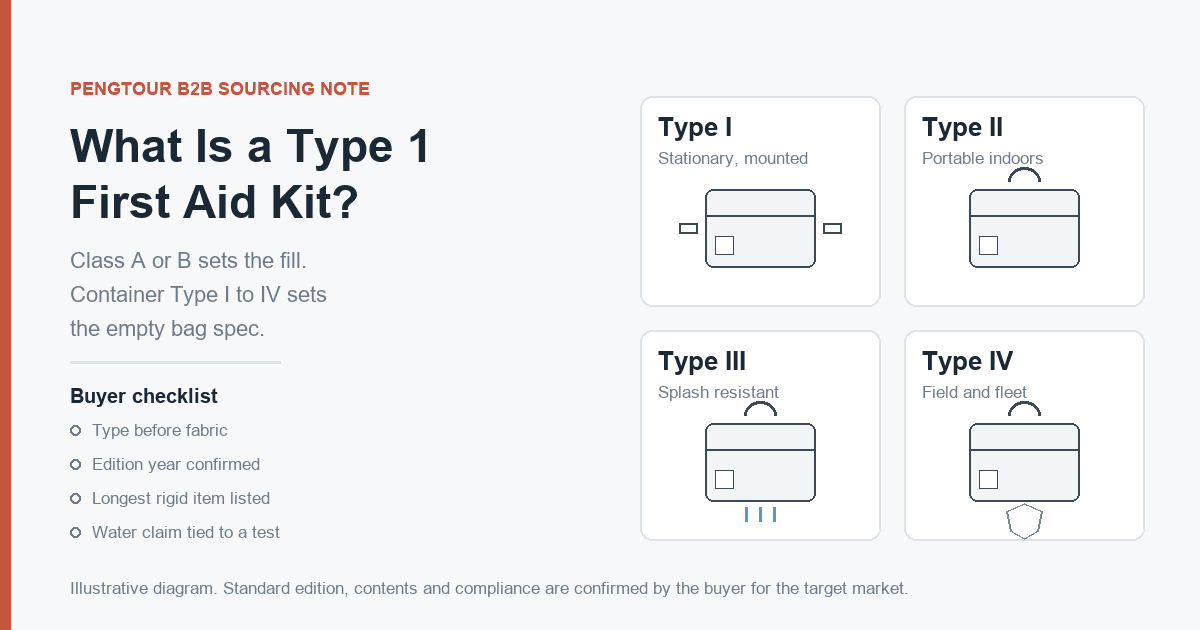
A "Type 1" label on a first aid kit is neither a size nor a product line name. In ANSI/ISEA Z308.1, the widely used North American minimum performance standard for workplace first aid kits, Type describes the container, meaning where the kit is allowed to live and how much handling, moisture, and impact it has to survive. Class describes what goes inside it.
If you source empty first aid bags, that difference is the earliest and cheapest decision you will make. The Type decides whether your bag needs hanging points, a sealed closure path, a rigid panel, or a shoulder strap long before anyone argues about fabric or color. This article translates each container type into bag requirements and RFQ fields. It is buying guidance, not first aid advice, and it never makes a compliance promise on your behalf.
Key Takeaways
- Class A or Class B describes the fill: which item categories are required and their minimum quantities. Type I to IV describes the container and the environment it is rated for. The two are independent.
- Type I is stationary, indoor, and mountable. Type II adds indoor portability. Type III adds a water resistant seal plus the ability to be mounted. Type IV targets portable use in harsh environments.
- Some Canadian provincial frameworks also number kits as Type 1, 2, and 3, but there the number is a kit level, not a container rating. Always confirm which numbering your target market uses.
- For a sewn bag, the Type sets the structural brief: hanging hardware, closure treatment, wipe-clean exterior behavior, carry method, and how much internal protection the contents need.
- Nobody is served by vague words. The person who fills and sells the finished kit confirms standards, contents, labeling, and intended use for the target market. The bag maker supplies the empty container and builds to your written specification.
What Does "Type 1" Mean in a First Aid Kit?
In the commonly reproduced summary tables of ANSI/ISEA Z308.1 (for example the tables reprinted in the U.S. Bureau of Reclamation Safety and Health Standards, 2024 edition, and in U.S. Fish and Wildlife Service policy exhibit 243 FW 1), the four container types read roughly like this:
|
Type |
Where it is used |
Portable |
Mountable |
Water resistant |
Waterproof |
|
I |
Indoor, stationary |
No |
Yes |
Not required |
Not required |
|
II |
Indoor, portable |
Yes |
No |
Not required |
Not required |
|
III |
Indoor or sheltered outdoor, portable |
Yes |
Yes |
Yes |
Not required |
|
IV |
Mobile industries and outdoor settings |
Yes |
Yes |
Not the test itself |
Yes, plus corrosion and impact requirements |
The plain language version: Type I hangs on a wall and stays there. Type II is picked up and carried within a building. Type III moves between indoor and sheltered outdoor locations and carries a seal against splashes and weather. Type IV rides in trucks, utility fleets, and construction sites, where rain, grit, and rough handling are expected. Public summaries also note that Type IV containers are held to a separate performance clause in the standard, so it is the most demanding number to claim.
Two cautions before you quote anything. First, both the 2015 and 2021 editions of the standard are still referenced in the market, and the reproduction wording differs slightly between sources. Ask which edition year your customer audits against. Second, do not assume the word "Type 1" means the same thing everywhere. Some Canadian provincial documents describe Type 1 as a personal first aid kit level, with Type 2 and Type 3 as basic and intermediate kit levels, which is a completely different axis from the container rating above.
How Do Class A and Class B Differ From Container Types?
Class A covers the most common workplace injuries. Class B covers the same categories in larger quantities for more populated, complex, or higher risk environments. Reproduced minimum fill tables typically show 16 adhesive bandages for Class A against 50 for Class B, and Class B adds items that Class A does not require, notably a padded splint and a tourniquet.
Why a bag buyer cares:
- The Class changes internal volume and the longest rigid item. A padded splint listed at roughly 4 to 4.5 in by 24 in depending on the edition sets a minimum usable length. A tourniquet listed at 1 in width is the kind of item that disappears in a deep pocket unless it gets a dedicated position.
- The Type changes the shell and the carry system, not the interior volume.
A Class B fill inside a Type I wall cabinet is a legitimate combination for a fixed production floor. The same fill inside a Type IV bag is a different bag, even if nothing about the contents changes.
What Does Each Container Type Demand From an Empty Bag?
This is where most guides stop and where your specification actually starts.
|
Type |
What the bag has to do |
Bag elements to specify |
Ask your supplier for |
|
I |
Stay put, open on the wall, be readable |
Back panel reinforced for hanging, grommets or strap loops, flat back, clear identification panel |
Mounting method, reinforcement pattern, how the bag behaves when loaded and hung |
|
II |
Be carried from room to room without spilling |
Handle placement balanced against loaded weight, closure that stays shut under movement, interior retaining notion |
Closure type, handle reinforcement, loaded carry check |
|
III |
Survive sheltered outdoor use and splashes |
Coated or laminated outer fabric, seam and closure path planned for water shedding, panel that can be wiped clean, optional hanging hardware |
Fabric specification, seam treatment, how the water resistance claim will be verified |
|
IV |
Take weather, grit, and rough handling |
Abrasion resistant shell, protected base, closure with a cover or storm flap, stronger handle and strap structure, internal retention for heavy tools |
Test method, sample quantity, pass criteria, and who pays for third-party testing |
Note what is absent from the table: promises. None of these rows says the bag is waterproof. They say what has to be specified and then verified.
Where Do Interior Dimensions Come From?
Work from the largest hard items listed for the target Class, not from a feeling about size. In practice this means:
- List the longest rigid item and give it a dedicated compartment, not a shared one.
- Give small sachets and unit boxes shallow pockets with a defined depth, because deep pockets turn into a digging exercise.
- Separate metal tools from soft supplies, since scissors and forceps press into dressings and wipes over time.
- Match mesh or transparent pockets to the actual contents, because a mesh pocket sized for a bulk pack will not hold individual sachets.
In one anonymous first aid organizer sample review at our side, small packaged items sank to the bottom of deeper pockets, scissors pressed against nearby soft supplies, and some mesh pockets did not match the intended contents. Compartment sizes were revised, the sample was loaded and reviewed again, and the buyer confirmed the revised version acceptable. That is one project observation, not a test result, and it is not a guarantee that every layout behaves the same way.
A contents-to-compartment planning pass belongs at the start of your project, and we keep that work in a separate guide: empty first aid bag organizer checklist.
Why Do Water Resistance Claims Need Their Own Evidence?
Type III mentions a water resistant seal. Type IV involves waterproof performance. Neither equals a fabric that happens to be coated, and neither equals a bag that keeps every unit dose dry after months in a service truck.
Three practical rules:
- Write the requirement as a test method plus acceptance criteria, not as an adjective. "Water resistant" alone cannot be priced or inspected.
- Treat the closure as part of the water path. The zipper line, seam treatment, and storm flap decide more than the outer fabric does, which is why we keep a dedicated note on zipper and closure selection for custom bags.
- Ask what evidence supports the claim and who holds it. Third-party testing can be arranged for a project; scope, standard, timeline, and cost are confirmed before the order is placed.
The standard's container types are also not expressed as an ingress protection rating. If your customer's procurement team wants a quantified rating, that has to be stated as its own line item with its own reference document.
What Should Be Confirmed Before First-Sample Development?
Bring this list to the first conversation with any supplier, including us:
- Target market, and the standard edition year your customer audits against.
- Class (A or B) and who is responsible for the fill.
- Type (I to IV), stated as a container expectation plus the evidence you will require.
- Mounting and hanging method, if any.
- Carry method: hand-carry, shoulder, backpack, waist, or vehicle storage.
- The longest and heaviest items, with their actual packed dimensions.
- Cleaning expectation: wipe-down frequency and the cleaning agents involved.
- Whether any symbol, cross mark, or translated wording will appear, and who authorizes it in that market. Symbols are not free to use by default; we covered this in symbols you cannot assume you may use.
- Refill and inspection behavior: can a checker see everything at a glance, or must items be unpacked?
- Packaging, labeling, barcode, and carton requirements.
Items 1, 3, and 8 are the ones that usually get skipped and later cost the most money.
What Should a First Aid Bag RFQ or Tech Pack Include?
|
Field |
Example content |
Why it changes the quote |
|
Target standard and edition |
"Buyer to confirm ANSI/ISEA Z308.1 edition for the destination market" |
Changes which evidence and which labeling we plan for |
|
Class and Type |
Class B fill target, Type IV portable use |
Sets interior volume, shell, hardware, and testing scope |
|
Dimensions and tolerances |
Length, width, height of the empty bag plus allowed tolerance |
Locks cost, cutting layout, and how the contents will actually fit |
|
Closure specification |
Zipper type, cover or flap, puller style |
Affects both price and any water shedding behavior |
|
Internal layout |
Count and depth of pockets, loops, removable sections |
Directly drives labor time, which drives unit price |
|
Materials |
Outer fabric, lining color, reinforcement points |
Availability must be checked per project |
|
Marking |
Logo method, label area, symbol authorization status |
Some symbols need buyer confirmation before artwork is made |
|
Quantity and special requirements |
Approximate order quantity, custom colors, custom packaging |
Standard projects may start from around 500 pcs; special colors, materials, structures, labeling, and packaging are evaluated separately |
Final feasibility for any of this depends on product dimensions, loading requirements, materials, hardware, accessories, and manufacturing review. Attention to detail here is what keeps a first sample from becoming a third or fourth sample.
How Pengtour Reviews an Empty First Aid Bag Project
Pengtour can evaluate, develop, and customize common sewn functional bag projects from your sample, photos, dimensions, structure notes, or tech pack. Final feasibility depends on project review and sample confirmation, and the discussion covers empty bags and empty organizer structures, not complete medical kits.
What that looks like in practice:
- Structure may include dividers, zipper compartments, mesh pockets, elastic retention loops, removable organizer sections, and label areas, subject to the stored items, dimensions, layout requirements, and applicable regulatory or testing needs.
- Materials may include Oxford, polyester, nylon, and PU-coated fabric directions, plus lining choices that make contents easier to see and the interior easier to wipe, subject to material availability and project review.
- Identification may include screen printing, rubber patch, woven label, embroidery, color coding, transparent information window, or a customer-specified label area. Symbol use, medical markings, and label wording are confirmed by you for your market.
- Review focuses on behavior, not adjectives. In the anonymous organizer revision above, the useful output was a set of measurable layout changes and a loaded re-check, not a claim.
- Typical MOQ guidance: standard projects may start from around 500 pcs, while special colors, materials, structures, accessories, labeling, and packaging are evaluated separately.
Our most directly relevant product page for this type of project is the custom first aid organizer bag, and wider medical programs are grouped under custom medical bag programs.
Have the standard edition, Class, Type, and largest packed items written down? Send those four things with your request and we can tell you quickly whether the structure is worth sampling. Request a quote.
FAQ
Does an empty first aid bag itself have to meet ANSI/ISEA Z308.1?
The requirement attaches to the kit that is placed in service, not to an empty shell sitting in a warehouse. What you can reasonably ask the bag side for is a container built to the written structure and a plan for how any Type III or Type IV claim will be tested and verified. Contents, labeling, and intended use belong to whoever fills and sells the finished kit.
Can we put a cross symbol or the words "first aid" on the bag?
Only with authorization confirmed for your destination market. Cross symbols and some medical wordings are protected or regulated depending on jurisdiction, so treat artwork approval as a compliance step rather than a design step. Our first aid pouch guide goes into this in more detail.
Can one empty bag cover both a Type III and a Type IV program?
Sometimes, and usually at a cost you should price openly. A design that is genuinely built for Type IV use tends to be heavier and more expensive than a sheltered Type III bag. If you want one platform, say which two Types it must serve and let the structural choices be driven by the harsher one.
Who verifies that the finished kit meets the standard?
Your organization or your filling partner, ideally with documented evidence. A useful habit is to ask any supplier two questions: which edition year does this claim refer to, and what document supports it. A bag maker can supply the empty container and the production records; it cannot certify a kit it did not fill.
Is a soft bag accepted where a rigid cabinet is normally used?
It depends on how your safety or compliance function reads accessibility and durability requirements, and on whether the environment matches the Type. Stationary indoor placements often stay with cabinets or mounted bags, while mobile and outdoor placements are where a soft structured bag earns its place. Put the placement scenario in writing and get it confirmed locally before ordering.