

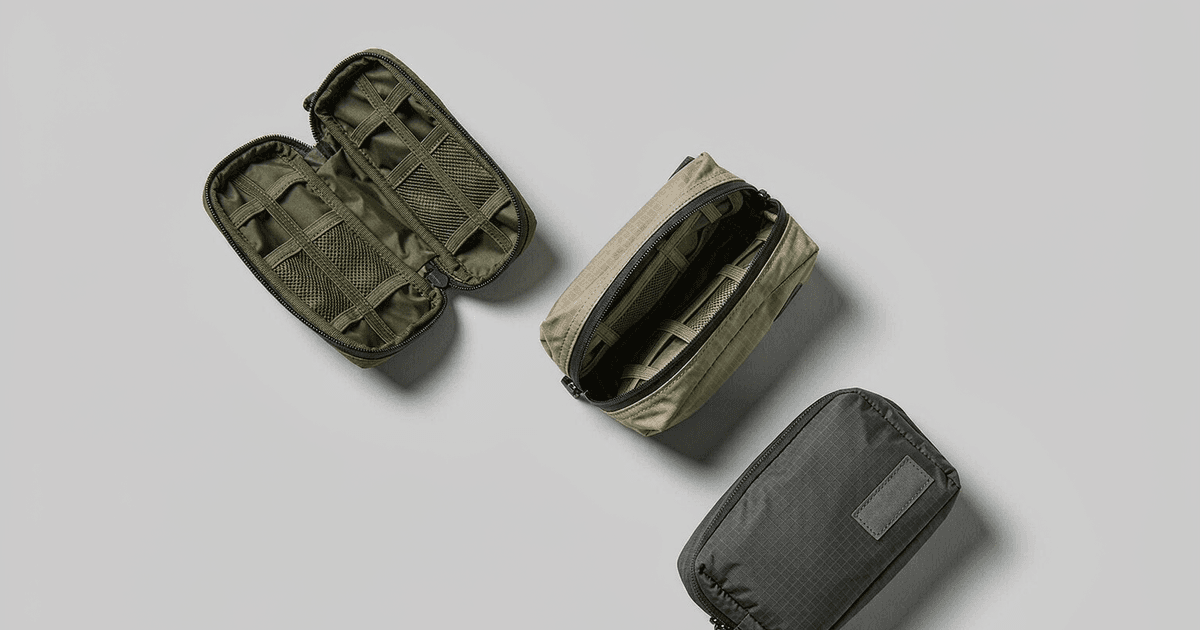
A pouch printed with a company logo and handed out at a trade show looks like a first aid kit. In most procurement systems it gets filed somewhere completely different.
One is a promotional item. It has to survive a bag, a glovebox or a desk drawer, carry a brand legibly at a small size, and land at a unit cost that still works when you are giving it away by the thousand. The other is a product whose value depends on what is inside it and on what the label is allowed to say.
Giveaway pouch projects usually go wrong when the two get treated as one thing. A marketing team asks for "a first aid bag like the ones in the pharmacy." The supplier quotes an empty pouch. Three rounds of samples pass before anyone notices the two sides were describing different products.
The useful move is to spec the pouch as the promotional item it is, and to leave the contents question on the buyer's side of the table. A specification built that way tends to survive the first sample round.
A Giveaway Pouch Is a Promotional Item, Not a First Aid Kit
The buyer of a giveaway pouch is normally not a safety officer. It is a marketing team, a distributor building a branded line, a company ordering welcome kits, or a promotional products supplier assembling a catalogue. Their success measure is different from a workplace first aid programme's success measure. They are judged on whether the item gets kept and used, not on whether it satisfies a contents standard.
That changes the brief in three ways.
Cost per unit does the real work. A pouch that costs slightly more than the budget line fails, however well it is made. This pushes the specification toward a simple structure, a single logo method, and a standard outer fabric rather than a laminated or coated one.
Size gets capped by logistics. A pouch that is compact survives the trip home in a jacket pocket or a tote. A pouch that is bulky gets left behind at the event.
Brand visibility beats internal complexity. Inside a giveaway pouch, buyers rarely need twelve dividers. They need the mark to read clearly on a panel the size of a palm, and they need the item to look substantial enough that it is not thrown away.
Once those three priorities are set, most of the technical arguments resolve themselves.
Start From the Handout Moment
The single most useful question in a pouch project is what happens in the first five minutes after someone receives it.
If it is handed out loose at a conference, the pouch needs a shape that sits flat in a tote and does not open on its own. If it goes into a company welcome kit, it has to stack and ship inside a box with other items. If it is mounted in a vehicle or on a belt, it needs a loop or clip point, and the opening direction has to work one-handed. If it is sold as part of a branded retail line rather than given away, the packaging becomes part of the product.
Each answer moves the design. A belt-mounted pouch wants a different zipper orientation from a pouch that lives in a drawer. A pouch that ships inside a retail box has a tighter height limit than one mailed on its own.
Buyers who bring this detail to the first conversation get to a working sample faster, because the factory is not guessing at the use case. Buyers who open with "a small first aid pouch" usually get a technically correct sample that fails on the second round for reasons nobody wrote down.
Size and Shape for a Pouch That Carries
Compact pouches tend to fall into a few practical families: flat rectangular sleeves, rounded rectangular pouches with a short depth, vertical pouches with a top zipper, and small clamshell shapes that open out for visibility.
Which one fits depends on how the pouch is carried and what it has to hold, and both of those are buyer-side decisions. Our role in that conversation is to point out where a shape stops being manufacturable at the price point, or where a claimed capacity will not survive real loading.
Three constraints come up repeatedly.
Depth is the first to get overestimated. A pouch that looks generous on a drawing often closes poorly once it holds anything thicker than a few centimetres, because the zipper line has to travel around a larger radius.
Opening direction decides usability. A top-opening vertical pouch is easy to hold and open with one hand. A full clamshell gives better visibility but needs two hands and a surface to lie on.
Any hanging or attachment point is a structural decision, not an accessory. A loop sewn onto a lightweight panel pulls the fabric out of shape under load, so the panel itself may need reinforcement. Our note on bag stitching reinforcement covers where those load paths usually need box-stitching or bar-tacks rather than a single seam.
Fabric and Structure Choices
For a promotional pouch, the outer fabric is usually chosen for how it prints, how it feels, and what it costs, in roughly that order.
Polyester is the common starting point. It takes printing and lamination well, it comes in a range of weights and finishes, and it suits exactly this kind of product. Oxford fabric is the other frequent choice where the pouch has to look more durable, which matters for vehicle, tool and industrial giveaway programmes. Nylon appears where weight and abrasion resistance both matter. PU-coated directions come in when the brief calls for a smoother face or a premium feel. If your programme sits between two weight bands, our breakdown of oxford fabric weights explains where the actual behavioural differences show up.
None of these should be read as stock options. Availability, weight band, finish and hand feel get confirmed project by project.
Inside, a lighter or smoother lining helps contents stay visible, which matters more in a small pouch than in a large bag because the interior is shallow and shadowed. Our guide to bag lining materials walks through how lining choice affects both appearance and what the pouch feels like when opened.
Structure options that come up for this product family include zipper compartments, mesh pockets, transparent pockets, elastic retention loops, removable pouches, identification label areas and colour-coded sections. Which of those earn their place depends on what the buyer intends to put inside, and that is a decision the buyer owns.
Branding a Small Panel
A small pouch is a harder branding surface than a tote, and the reason is arithmetic. The mark has to stay readable at a fraction of the area, so artwork with fine type, tight registration or several colours loses definition faster than most brand guides expect.
Methods that work on this scale include screen printing, rubber patches, woven labels, embroidery for simple marks, and colour blocking or colour identification to carry brand presence without relying on detail. A transparent information window or a dedicated label area can take text that would be illegible as a printed mark.
Two practical rules save a round of samples.
Simplify the artwork for the panel size before it goes to the factory, not after. A logo approved at width on a tote may need a reduced lockup for a pouch, and the brand team should make that call rather than the print supplier.
Match the method to the fabric direction. A woven label behaves differently on a coated surface than on a printed one, and embroidery needs enough panel stiffness to sit flat. The same logic runs through logo placement and application on custom bags: where a mark goes and how it is applied are both settled by the material and the panel, not by preference.
Because these pouches are handled and stored in pockets and drawers, abrasion matters as much as print quality. Picking a print method without checking how the surface behaves under friction is the most common reason a giveaway item looks tired by the second month of use.
Symbols You Cannot Assume You May Use
This is the section most promotional projects underestimate.
The red cross, red crescent and red crystal emblems are protected marks. Their use is governed by international humanitarian law and by national rules, and they are not available as generic "medical" decoration. A distributor cannot treat a red cross printed on a pouch as a design choice, and a brand cannot assume a symbol is free to use because it appears on other products.
If a pouch design includes an emblem, a warning mark, a pictogram or text that implies a medical or safety function, the buyer has to confirm the right to use it for the intended market, and the label content has to be confirmed by the buyer rather than assumed by the factory. The same applies to language requirements and to any regulatory text.
A practical alternative for promotional work is brand-owned iconography: a colour system, a company symbol, or an abstract mark that reads as "care" or "preparedness" without borrowing a protected emblem. These carry brand recall just as well and remove a category of legal risk from the project.
What an Empty Pouch Can and Cannot Claim
An empty first aid pouch is an organization and storage product. That is a real category with real value, and it is also a narrower claim than the packaging language on most promotional catalogues suggests.
What the product supports: structure, compartment layout, carrying method, material direction, branding and packing. Those are all things the project can be reviewed and sampled against.
What the product cannot support without evidence: that it is medical-grade, sterile, antibacterial, certified for medical use, approved by a regulator, compliant with all first aid standards, or able to influence the outcome of an emergency. It also cannot be presented as a complete first aid kit, because the contents, their labelling and the market rules around them belong to the buyer.
The distinction is not legal caution for its own sake. A promotional buyer who writes "medical-grade" into a catalogue entry creates a claim they have to evidence, and an empty pouch cannot evidence it. Buyers who need a pouch to sit inside a regulated programme should treat the contents and the compliance path as a separate workstream, and keep the pouch specification about the pouch. The same boundary shapes how we discuss requirements for medical and first aid bag projects.
Packing for Bulk Handout and for Retail
Packing is where promotional and retail programmes diverge most, and it is often decided last, which is the wrong order.
Bulk handout packing is usually the simplest: individual polybags, then a carton, with a carton label that tells the receiving team what is inside and how many. If the pouches are shipped to a fulfilment partner rather than an office, agree the carton configuration early, because a change later resets the counts.
Retail packing needs more: a printed box or hang-tag format, an instruction or checklist card, a barcode or SKU label, and often language variants. If the same pouch serves both channels, the packaging has to be designed as two versions from the start rather than adapted at the end.
Packaging options that come up include OPP bags, paper boxes, labels, instruction cards, checklist cards, barcode or SKU labels, and carton configurations. The material, the label language, the barcode format, the carton quantity and the outer carton dimensions all get confirmed per project, and none of them should be assumed from a previous order.
One caution for catalogue work: avoid describing packaging as eco-friendly, recyclable or plastic-free unless the specific materials used in that project support the wording. Sustainability claims attach to the actual material, not to the intention behind it.
Quantities, Sampling and One Real Layout Adjustment
Standard projects may start from around 500 pieces, while special colours, materials, structures, accessories, labelling and packaging should be evaluated separately. A single colour, single fabric, single-artwork pouch at volume is a different exercise from a programme with three variants and mixed cartons, and the quantity conversation should follow the variant count rather than lead it.
Sampling is where the real work happens. A pouch project can usually be evaluated and developed from buyer samples, photographs, dimensions, structure notes or a tech pack, though photographs and dimensions alone are not always enough for a final development decision. Complex contents or tight fit requirements may need the actual items or a fit-check sample. Our sample approval checklist for custom bags covers what to verify before signing off.
One adjustment from a first aid organizer project shows why loading matters. In the first sample review, small packaged items sank to the bottom of the deeper pockets and were hard to retrieve, scissors and similar tools pressed against the softer supplies next to them, and some of the mesh pockets did not match what the buyer intended to store in them. The compartment sizes were adjusted, the revised sample was loaded and reviewed again, and the customer confirmed it as acceptable.
Nothing in that list was a defect. The pouch was made to the drawing. It only became clear once real items went in, which is why a sample review that never gets loaded answers a much smaller question than buyers expect.
What to Prepare Before Asking for a Quote
A first quote is only as good as the brief behind it. The inputs that move a pouch project forward fastest are the use scenario and where the pouch is handed out or sold, the target market, a size or capacity direction, the categories of items expected inside, the quantity and variant count, reference photographs, the logo artwork in a usable format, and any packaging requirement.
Where a structure is still open, say so. A factory that knows the lid, opening and compartment count are undecided will propose options and price the range. A factory that assumes the structure will quote a single number that changes later, which is the more expensive path.
If you already have a specification or a tech pack from a previous programme, send it. Reusing a spec that worked is faster than rebuilding one, and reviewing an existing document is straightforward.
How Pengtour Reviews a Custom First Aid Pouch Project
Pengtour can evaluate, develop and customize common sewn functional bag projects based on a buyer's samples, photographs, dimensions, structure notes or tech pack. For first aid and medical organizer pouches, that review covers the intended contents, the layout, the opening and carrying method, the material and lining direction, the hardware, the branding route and the packing.
Possible product formats for this family include hand-carry pouches, shoulder formats, zippered organizers, foldable and modular organizers, and larger-capacity configurations, described as options subject to project review rather than as standard catalogue items. Final feasibility depends on the dimensions, the loading requirement, the materials, the hardware and the outcome of an engineering review.
Two boundaries are worth stating plainly. Pengtour does not define first aid contents or the compliance position for a target market; those are buyer-confirmed. And an empty pouch is not a substitute for medical-device packaging or for a certified kit.
If your programme needs a pouch that fits a specified set of items, send the items list, the rough layout, the size direction, the target market and the artwork. The project can be reviewed around the actual contents instead of a generic category name. You can see the wider sewn bag range under custom functional bags, or look at how custom soft bag development runs from first requirement to approved sample, and send the details for a quote when the brief is ready.
FAQ
Can a giveaway pouch carry our logo and brand colours?
Yes, within the limits of the panel. On a compact pouch the practical methods are screen printing, rubber patches, woven labels, simple embroidery, and colour blocking or colour identification. The constraint is area rather than method, so artwork with fine type or several colours usually needs a simplified lockup for the pouch size. Confirm the lockup before sampling rather than after.
What is a compact first aid pouch usually filled with?
That decision sits with the buyer, and it depends on the programme. Common directions include bandages and dressings, individually packed wipes, small tools such as scissors or tweezers, gloves, cold packs, instruction cards and checklists. Items that are regulated, sterile or market-specific are buyer-defined for the target market. Pengtour builds the empty pouch and the internal layout, not the contents.
Can we order a small run for a single event?
Standard projects may start from around 500 pieces, and special colours, materials, structures, accessories, labelling and packaging are evaluated separately. A single-event order is usually simpler to approve when it uses one fabric, one colour and one artwork, because each variant carries its own setup. Tell the supplier the event date and the variant count together, and the quantity question can be answered against something real.
Does the pouch have to show a first aid symbol?
No, and it should not carry one unless the right to use it has been confirmed for the intended market. The red cross, red crescent and red crystal emblems are protected marks rather than generic decoration. Most promotional programmes work better with brand-owned iconography such as a colour system or a company symbol, which carries recall without the authorization question.
Can the same pouch be packed for retail shelves as well as bulk handout?
It can, but the packing has to be designed as two versions from the start. Bulk handout packing is normally an individual polybag plus a carton with a carton label. Retail packing adds a printed box or hang-tag format, an instruction or checklist card and a barcode or SKU label, and often language variants. Deciding this after the pouch is approved resets the packaging timeline.
Key Takeaways
- A giveaway pouch is a promotional item. Its success measures are unit cost, survivability and brand visibility, not contents compliance.
- Start the specification from the handout moment. How and where the pouch is given out decides the shape, the opening direction and the attachment points.
- Fabric determines the branding method set, and on a small panel the real constraint is artwork area rather than print technology.
- Protected medical emblems require confirmed authorization. Brand-owned iconography avoids the problem entirely.
- An empty pouch can be specified, sampled and approved. It cannot be described as medical-grade, sterile, certified or as a complete first aid kit.
- Load the sample with real items before approval. Layout problems rarely appear on a drawing and always appear in the hand.