

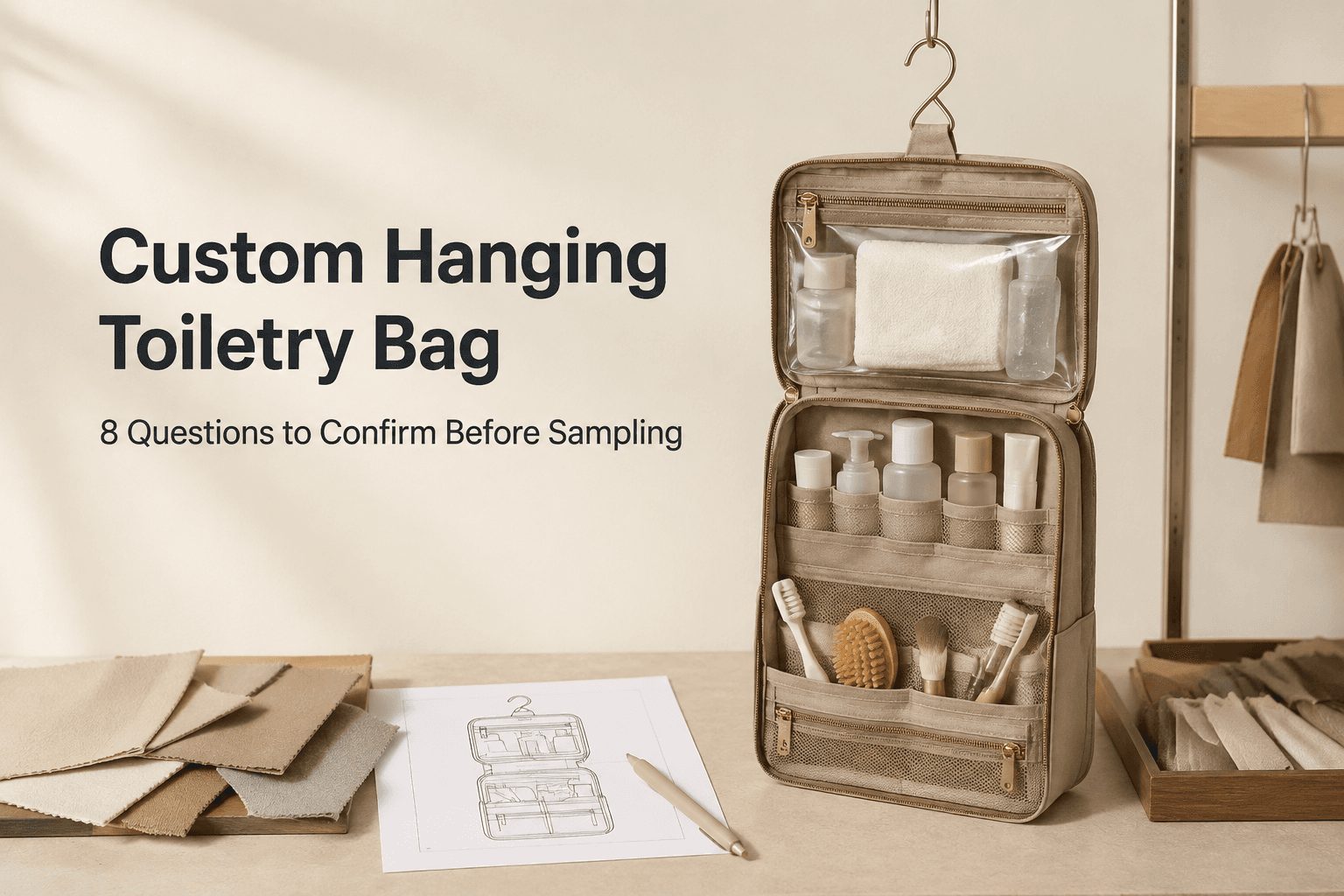
Author: Leo, Export Manager, Dongguan Pengtu Luggage Co., Ltd. Last reviewed date: August 26, 2025
Briefly: Before approving the first sample, please use this custom hanging toiletry bag sample list. Confirm the product list, PVC or PU material specifications, hook load-bearing capacity, folding durability, wet and dry separation, logo and color requirements, hardware accessories, and packaging. Test the actual product in the sample.
A hanging toiletry bag looks simple: a hook, a few pockets, and a foldable body. The real trouble often only becomes apparent after the first toiletries are packed in.
The hooks may feel loose. The bag may tilt forward. The PVC material at the folds may turn white. The zipper may be difficult to zip up. An empty bag cannot reveal all these problems, because balance, pocket fit, zipper smoothness, and fold thickness all depend on the actual items inside.
First, determine the structure; color and appearance can be considered later.
If you are developing a custom hanging toiletry bag , please complete the following eight checks with the manufacturer before sampling. Clear requirements specifications can reduce unnecessary modifications and provide a more accurate basis for factory quotations.
Overview of the eight inspection items
| Check | Content to be confirmed by the buyer |
|---|---|
| Expected content | Product dimensions, weight, location, and access order |
| Polyvinyl chloride or polyurethane | Material grade, thickness, surface treatment, stiffness and testing requirements |
| hook | Load weight, accessories, suspension time, and failure criteria |
| Foldable | Cyclic conditions, test loads, folding whitening, and sealing performance |
| Dry and wet parts | What exactly does "wet" mean? What water-related claim should be filed? |
| Logos and colors | Artwork, Pantone color chart reference, manufacturing process, adhesion test and tolerances |
| Element | Zippers, webbing, seams, reinforcement materials and metal fittings |
| Package | Folding size, individual packaging, labeling, cartons and Amazon Logistics requirements |
1. What documents does the factory need before taking samples?
Start with the product list, not the fabric.
The factory needs to know exactly what will be in the bags. How tall is the shampoo bottle? What is the diameter of the skincare product jar? Where will the toothbrush and razor be placed? How long will the makeup brushes be? Will the towels get wet? Are there any bottles that are prone to leaking?
Each component affects the construction:
- The height of the bottle determines the depth of the pocket.
- The diameter of the bottle affects the tightness of the elastic band loops.
- The load will affect the position of the hook and the method of reinforcement.
- The length of the brush helps determine the width of the bristles.
- Bottles that are prone to leakage will affect the separation of dry and wet products.
- The placement of a product can affect its hanging balance and folded thickness.
In our experience, many sample modifications are not due to incorrect external dimensions, but because buyers only provide the external dimensions without specifying the internal requirements.
Factories can produce bags according to the length, width, and height required by customers, but they cannot design a practical internal structure without knowing the actual contents.
If a complete technical information package is not yet ready, please send product photos, dimensions, weight, and an annotated sketch. Even simply indicating the placement of each bottle is more helpful than a general text description. Buyers still comparing different styles can also refer to Pengtour's cosmetic bag type guide .
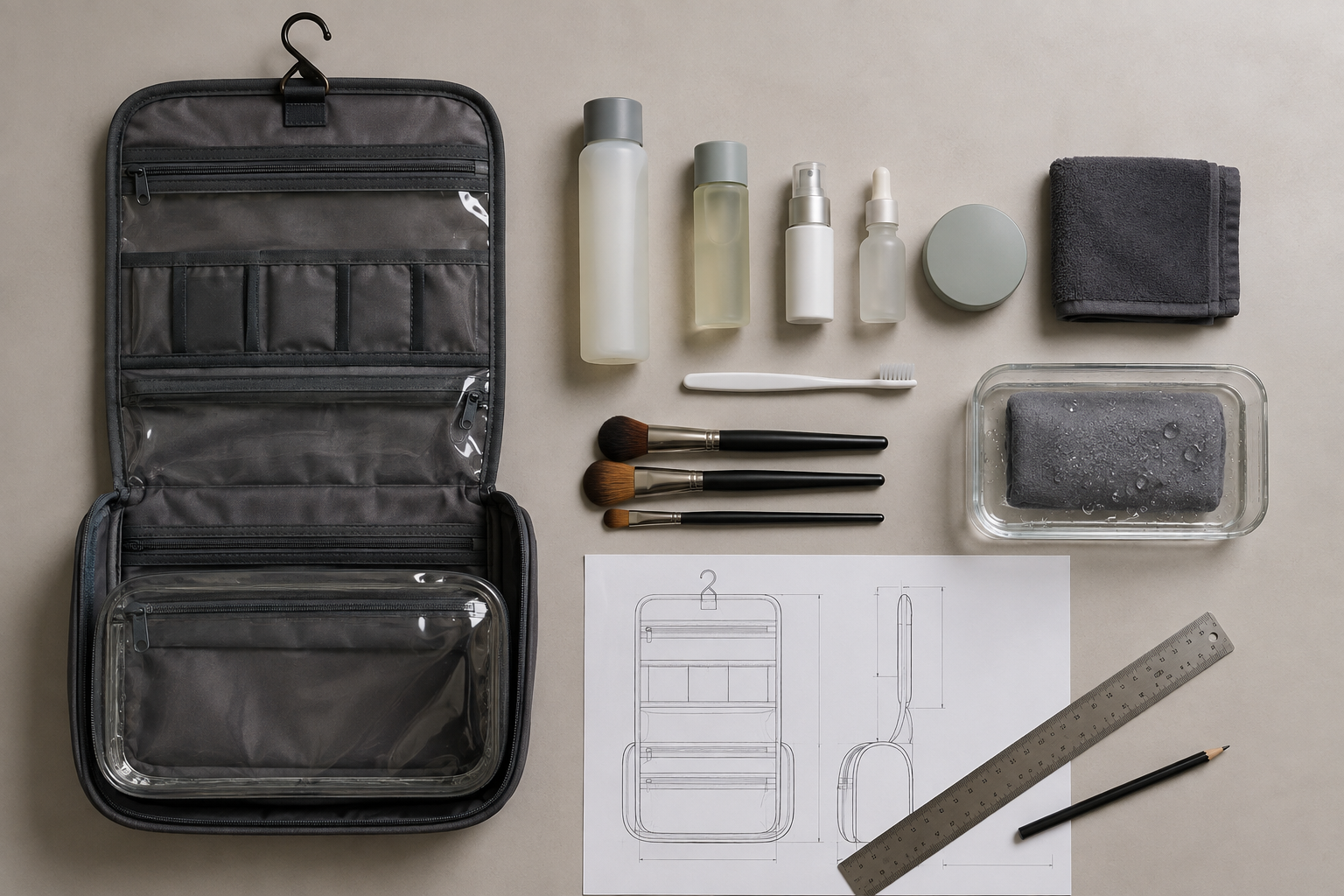
2. What should the thickness of a PVC pipe be?
No single PVC thickness is suitable for all bags. It depends on the bag's size, load-bearing capacity, folding frequency, manufacturing process, and target cost.
For common transparent toiletry bag projects, 0.3–0.6 mm is a reasonable starting thickness range and can be used as a reference for discussion. This range is derived from factory experience and is not an industry standard.
Thin PVC sheets may wrinkle, collapse, or stretch and deform under heavy bottles. Thicker sheets will feel stiffer after folding, and after repeated folding, the creases may show more noticeable whitening.
Before confirming the thickness, please check the following:
- Bag dimensions after unfolding and folding
- Total load
- Expected opening and closing frequency
- High-frequency welded or stitched structures
- Transparency and stiffness requirements
- Expected storage and usage temperature
- Pressure inside retail packaging bags
If you require the use of brand-new PVC material, please specify the material grade and specific requirements for brand-new material in writing. Verbal promises cannot guarantee consistency between different batches of products.
During sampling and bulk inspection, odor, surface oil stains or migration, transparency, color, and batch consistency should be checked. If chemical restrictions exist, the testing scope should be determined based on the target market and the buyer's restricted substance list.
REACH, RoHS, and California Proposition 65 are not universal "export certifications" for every toiletry bag:
- The REACH regulation may impose obligations on plastics, textiles and other articles placed on the EU market.
- RoHS primarily applies to electrical and electronic equipment.
- California Proposition 65 focuses on the listed chemicals and the extent to which consumers are exposed to them.
Inform the factory where the products will be sold and whether they are subject to the customer's specific restricted substances list or testing procedures.
If polyurethane is used for edging, handles, decorative panels, or signage patches, specify the backing fabric, thickness, surface treatment, scratch resistance requirements, and colorfastness requirements. Washable polyurethane and waterborne polyurethane are not the same thing; their properties cannot be determined by the name alone.
3. How should the hook load test be set up?
Test loads should be based on the actual packaging weight. Suspending an empty sample offers little help in understanding its load-bearing capacity.
When the backpack is opened, the hooks, connecting webbing, stitching, and the backpack body work together to support the weight. Confirmation:
- hook surface material
- Hook size and opening direction
- Attachment location
- Is webbing reinforcement needed?
- Do we need to reinforce the sutures or use other reinforcement methods?
- Corrosion resistance expected
If the packaged bag weighs 2 kg, use 2 kg as the baseline test load. Any additional safety margins should be agreed upon based on the actual use of the bag.
The test specification should also include the following:
- Test load
- Suspension time
- Static or dynamic loads
- Permissible hook-shaped deformation
- Acceptable movement at the connection point
- Standards for suture failure
- Acceptable bag tilt angle
"Alloy" or "stainless steel" refers only to the material category and does not indicate its corrosion resistance. Bags intended for use in damp bathrooms, coastal travel, or long-term applications may require separate corrosion resistance testing.
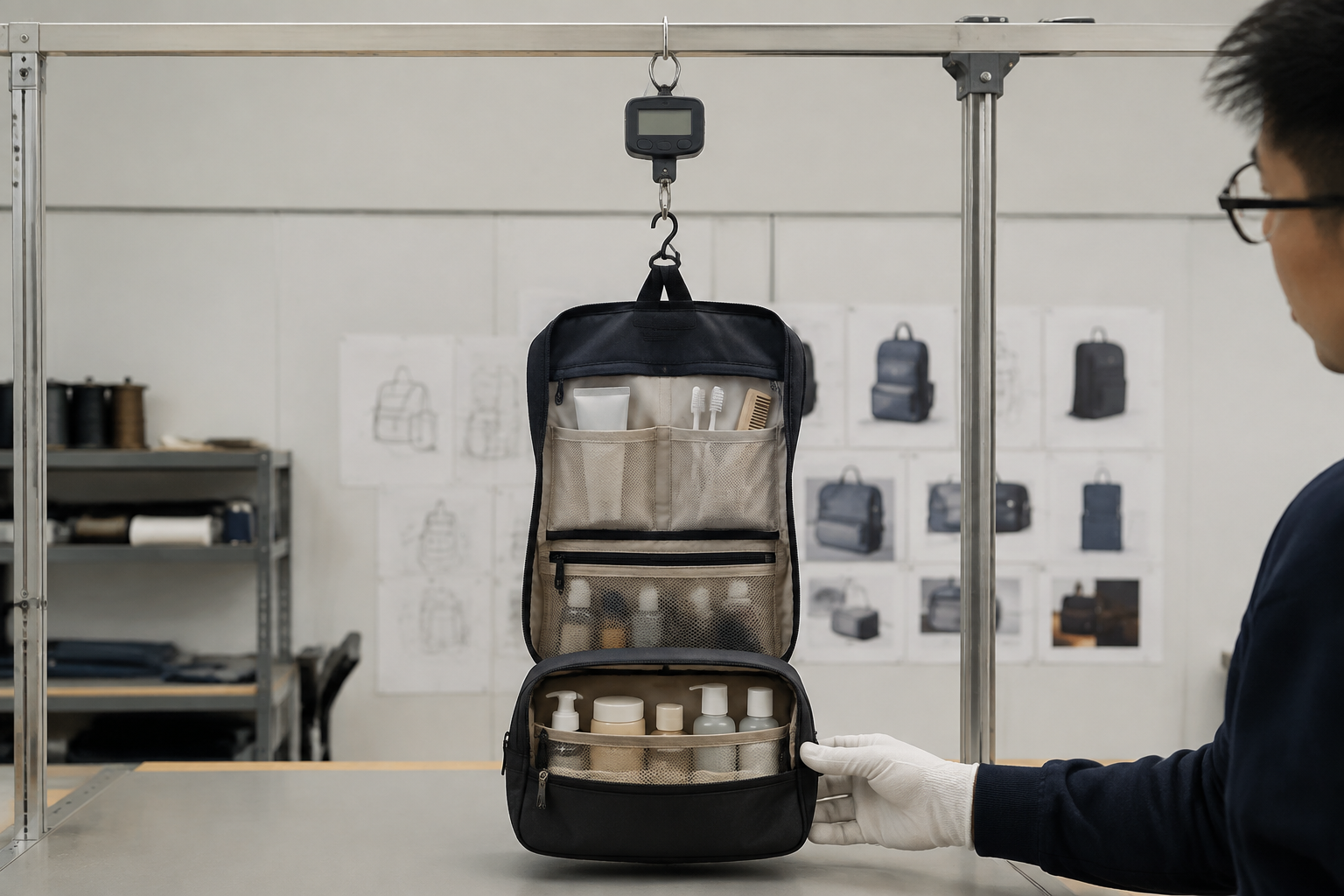
4. Why does PVC turn white at the folds?
In our sample testing work, PVC creases are one of the first areas we inspect. Depending on the formulation, thickness, crease radius, temperature, and usage conditions, repeated bending can lead to noticeable whitening, hardening, or cracking.
The project can specify a start and end point for the test—for example, 500 loops—and then perform the checks:
- The folds are white
- Surface cracks
- Combination and separation
- loose stitches
- Zipper performance
- snap or hook-and-loop closure
- Can the bags filled with goods still be closed normally?
Five hundred cycles of testing is an example of validation conditions for a specific project and is not a universal standard. For example, everyday travel bags may require more cycles of testing, while promotional items or infrequently used items may require different testing conditions.
The test should also reflect actual load conditions. The stress generated by folding an empty bag is different from that generated by folding a bag full of bottles, jars, and accessories.
5. How to define wet and dry areas?
Before choosing a partition structure, first clarify the meaning of "wet".
This could refer to a damp toothbrush, a used towel, a wet bottle, or a container that may leak. The level of isolation required varies depending on the situation.
PVC bags can separate wet and dry items and provide an easy-to-wipe surface. However, finished bags still include zippers, openings, binding, stitching, and joints between materials.
PVC bags do not automatically make the entire bag waterproof or leak-proof.
If you intend to use terms like "waterproof" or "leak-proof" on your packaging or product page, please agree on the testing methods, liquid volume, testing duration, and acceptance criteria beforehand.
If the test results do not support these claims, more accurate wording should include:
- Independent wet item compartment
- Easy-to-wipe PVC bags
- Waterproof part
- Removable transparent bag
Mesh pockets also need to be tested in practice. Check the mesh opening size, elastic recovery rate, binding strength, and pocket opening size.
During sample review, the target bottle is repeatedly inserted and removed. This will reveal whether the elastic band is loose, the mesh is deformed, or whether small objects are leaking from the opening or side.
6. How to check the adhesion and color difference of the label?
Private label specifications should clearly define the labeling process, graphic design, color references, and testing methods. "Clear printing" and "good adhesion" are not quantifiable acceptance criteria.
Choose between screen printing and heat transfer printing based on the material surface, pattern size, number of colors, and intended use. It's not as simple as using screen printing for small patterns and heat transfer for large patterns.
The results of screen printing depend on the ink system, surface treatment, and curing conditions. Heat transfer also requires experimentation, as excessively high temperatures can cause PVC to warp, whiten, or leave indentations.
Before sampling, please provide:
- Original logo design
- Pantone Color Chart
- Sign size and position
- Preferred printing method
- Material background color and texture
- Permissible color difference
- Adhesion test procedure
- Appearance requirements after wear or aging
Tape tensile testing can be used as a project-level adhesion test, but the specification should clearly state the tape type, contact time, applied pressure, peel angle, and pass/fail criteria. Simply stating "tested with 3M tape" will not yield repeatable results.
For color evaluation, textile composition can be evaluated according to ISO 105-J03:2009 . Opaque polyurethane, plastic, or coated surfaces can be evaluated according to ASTM D2244-25 . CIELAB color coordinates can be calculated according to ISO/CIE 11664-4:2019 .
For projects with high color requirements, a tolerance of ΔE ≤ 1.5 can be agreed upon, but this is not a universal ISO limit for all packaging bag materials.
The specification should also define:
- Color difference formula
- Instruments and settings
- Measurement location and number of readings
- Light source and observation conditions
- Approved reference samples
- Procedures for handling discrepancies between visual and instrumental examination results
Texture, transparency, and gloss all affect the results. Textured polyurethane, transparent PVC, metal fittings, and smooth surfaces should also be visually compared with approved samples under agreed-upon lighting conditions.
For transparent PVC, the measurement method, backing, geometry and other test conditions should be agreed upon with the laboratory before setting numerical tolerances.
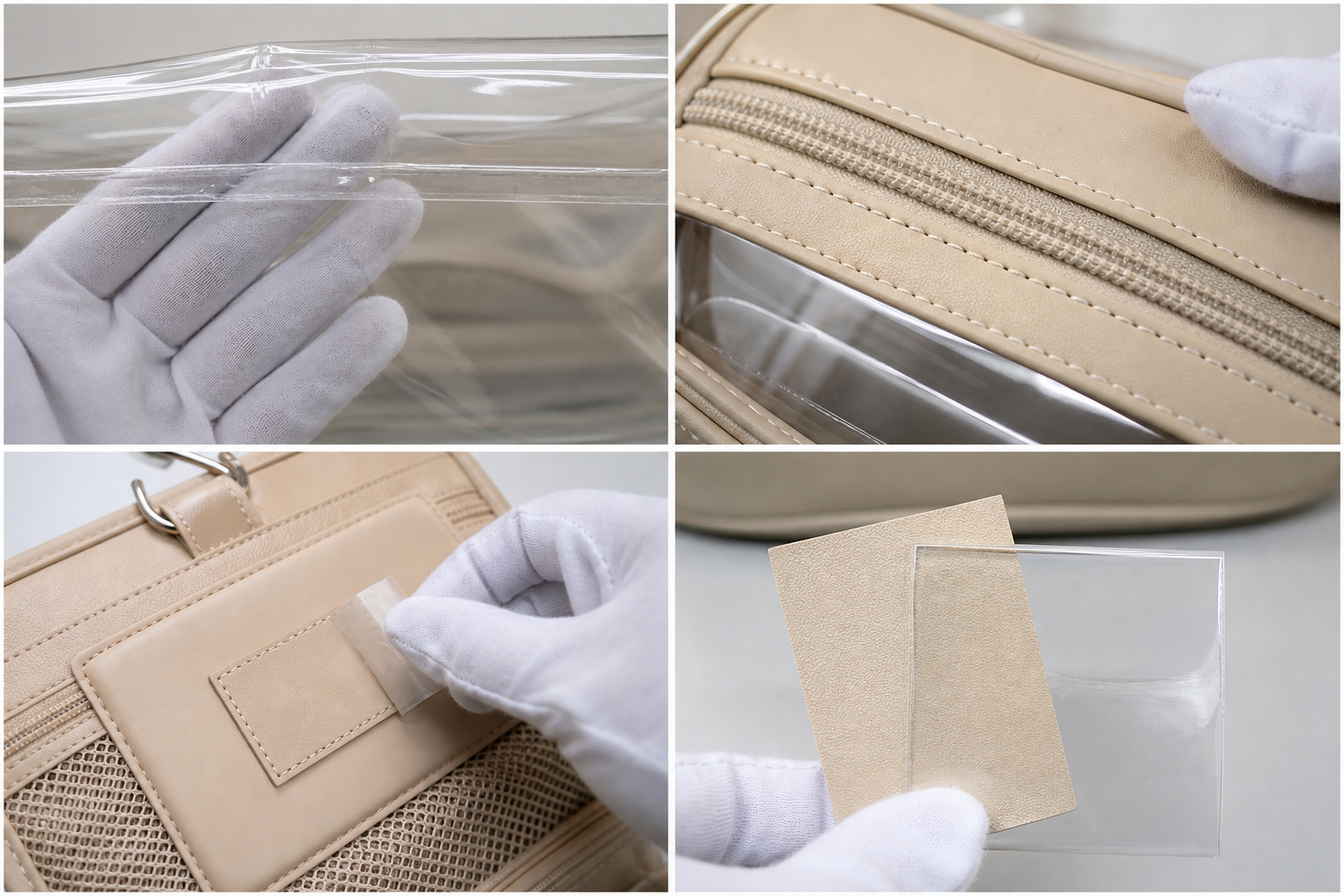
7. What aspects of seams, zippers, webbing, and hardware should the buyer confirm?
The connection process should be compatible with the materials and the required waterproof rating. Zippers, webbing, and hardware also require clearly defined materials and acceptance criteria.
For compatible thermoplastic materials, high-frequency welding can create weld joints without leaving sewing needle holes in the welded area. This is ideal for transparent PVC pockets and easily wipeable areas.
Even so, it's impossible to make the entire bag completely waterproof. Water can still seep in through zippers, openings, edges, or seams.
Depending on the bag's construction, load-bearing areas (such as hook connections, handles, and webbing) may require additional stitching, reinforced stitching, or other reinforcement methods. For more details, please refer to Pengtour's custom bag stitching reinforcement guide .
For zippers, buyers can specify YKK, SBS, other brands, or approved equivalent brands. The factory can also recommend suitable brands based on target cost and intended use. In any case, please be sure to confirm:
- Brand and Model
- Nylon coils, molded resin or metal teeth
- Puller materials and surface treatment
- Zipper color
- Backpack performance when fully loaded
- Smoothness of edges and corners
Coatings or waterproof zippers can improve splash resistance, but they don't make the entire bag completely waterproof. Pengtour's guide to choosing zippers for custom feature bags explains how to evaluate zippers in conjunction with the bag's overall structure.
For webbing and straps, check their width, thickness, color, stitching location, and colorfastness. For metal hooks, zipper pulls, snaps, and rivets, check the following:
- Sharp edges or burrs
- Electroplating consistency
- Oxidation
- Loose assembly
- Contact may scratch PVC or PU surfaces.
When assessing corrosion resistance, color fastness, and durability, the agreed test conditions and approved samples should be followed, rather than relying solely on the component name.
8. Which packages should be identified during the sampling process?
The thickness of the folded packaging affects the number of individual packages, cartons, and shipping costs. If buyers wait until production is complete before making packaging changes, some changes may be difficult to implement or costly.
An empty hanging bag looks very thin. But once you add PVC pockets, mesh, binding, padding, hooks and other accessories, the folded size changes significantly.
Please confirm the following during the sampling process:
- OPP or PE plastic bags, bubble wrap, or other individual packaging
- Paper or inserts are needed to maintain the shape.
- Hang tags, barcode labels, and instruction cards
- Quantity per box
- Carton dimensions and gross weight
- Three- or five-layer corrugated cardboard boxes
- Shipping marks, warehouse labels and barcode content
Five-layer cartons may be more suitable for projects requiring higher transport protection, but not all orders need to use five-layer cartons. The choice of carton structure should be based on product weight, shipping method, stacking conditions, and buyer's warehouse requirements.
For Amazon FBA, please provide the latest stock availability, barcodes, and inbound requirements for your target market. Requirements vary by market and product type, so factories should not rely on specifications from old orders. Buyers can check the latest packaging and shipping requirements in Amazon Seller Central; logging into Seller Central may be required.
Retail projects may also specify requirements for display hooks, shelf packaging, barcode placement, and external dimensions. Please verify these requirements during the sampling stage, rather than adding them after mass production.
What should be checked after these eight items are completed?
For more complex hanging toiletry bags, two rounds of sample testing can be considered. If the first round of samples meets the acceptance requirements, then a second round of testing is unnecessary.
The first sample typically checks the following:
- aspect
- put up
- Material
- Product compatibility
- Load suspension performance
- Basic appearance
The second sample can be used to verify changes to requirements for hooks, pockets, folding methods, logos, colors, or packaging.
Batch acceptance should not rely solely on statements such as "defect rate less than 3%". The buyer and factory should agree on the following:
- Sampling plan
- Definitions of serious defects, major defects and minor defects
- Acceptance limits for various defects
- Number of functional tests
- Color and appearance standards
- When the results exceed the agreed limits, the measures that need to be taken
Percentages are merely results. The definition of defects, sample size, and testing methods are the key factors that make acceptance requirements truly effective.
What information should buyers provide to OEM toiletry bag manufacturers?
To help the factory evaluate construction plans, materials, quotations, and sample directions, please prepare:
- A product list that specifies the size and weight of each beverage or accessory.
- Reference samples, drawings, technology packages, or marked sketches
- Preferences for PVC, PU, mesh fabrics and linings
- Hook load and testing requirements
- A clear definition of wet/dry separation
- Logo design sketches and Pantone color references
- Destination Markets and Compliance Requirements
- Individual packaging and carton requirements
- Expected order quantity
- Sampling and batch production planning
- Batch inspection and acceptance standards
The more detailed the design outline, the easier it is to identify structural problems before making a prototype. Clearly identifying the problems at the beginning is far easier than reopening the design drawings, changing materials, and remaking the prototype later.
If you are developing custom hanging toiletry bags, transparent PVC travel organizers, or your own brand of toiletry bags, please check out Pengtour's custom toiletry bag options and cosmetic bag structure guide .
When you are ready to request a quote, please send Pengtour a product list, dimensions, load weight, preferred materials, logo design, expected quantity, and target market. This information will provide our team with a practical basis for reviewing the structure and sample requirements.
Request a quote for a custom toiletry bag from Pengtour
About the Author
Leo is the export manager of Dongguan Pengtu Luggage Co., Ltd. He is responsible for providing support to overseas buyers in the processes of product requirement review, sample making, and quoting for customized luggage.