

Most buyers will decide on the material within the first five minutes. “We want PU.” “We need transparent PVC.” This decision usually goes on for a while—sometimes even all the way to the production stage, even if the final packaging structure requires other materials.
At Pengtour, we use PU, PVC, Oxford cloth, polyester, nylon, and other custom-made soft-pack materials. During sample production, we've found that the material itself is rarely the sole cause of sample errors. More often, problems lie in various aspects such as the bag's structure, lining, zipper placement, logo design, packaging, and target market. The outer material is merely a variable, not the key factor determining the success or failure of the entire project.
The following sections describe what we explain to buyers before cutting the samples.
PU vs. PVC: Core Material Comparison Table
The performance data in the table below reflects common patterns in the development of custom cosmetic bags. The final result still depends on material grade, thickness, backing, construction, stitching, zippers, and any project-specific testing requirements.
| aspect | PVC | PU |
|---|---|---|
| visibility | It can be made into transparent or semi-transparent materials—suitable for transparent toiletry bags and visible storage designs. | Typically opaque. More suitable for surface displays and branded cosmetic bags. |
| feel | It feels more like plastic. The texture varies depending on the thickness and surface finish. | Softer, more like leather. The specific effect depends on the PU surface material chosen. |
| Water contact | PVC sheets may be waterproof, but the quality of the finished bag still depends on the seams, zippers, edging, and openings. | In general, it can be cleaned by wiping with a damp cloth, but soaking or repeated contact with water should be evaluated according to the material grade and structure. |
| Logo options | High-frequency embossing, screen printing, or patch branding—depending on thickness and surface treatment. | Embossing, gravure printing, screen printing, hot stamping, metal plates, rubber patches, woven labels—all depend on the surface texture. |
| Commonly used | Transparent toiletry bags, travel organizers, visible storage bags, promotional packaging. | Beauty gift sets, skincare sets, branded cosmetic bags, and high-end retail packaging. |
| Compliance review | Some PVC or vinyl materials may require phthalate content testing, labeling, or customer testing reviews to target specific markets. | Environmental or ecological claims require substantive documentation and target market validation. |
| Cost direction | For simple transparent structures, it is generally cost-effective—depending on the thickness, structure, and order quantity. | They are typically more expensive than basic PVC or polyester materials—depending on the grade and structure of the material. |
Quick Shopping Guide
PU material– this packaging bag is part of the brand's products. Examples include beauty gift sets, skincare sets, makeup tool bags, and mid-to-high-end retail packaging. Buyers care a lot about the feel of picking up and opening the packaging bag.
PVC material– transparent design is key. Transparent toiletry bags, travel organizers, hotel toiletry bags, and e-commerce gift sets allow users to find the items they need without opening the packaging.
Oxford cloth/polyester/nylon– lighter, more color options, more cost-effective, and durable. No need for a leather exterior or a transparent panel.
Choosing the right fabric is the first step. The construction, lining, zippers, and logo design must all match the selected fabric. This is the next step.
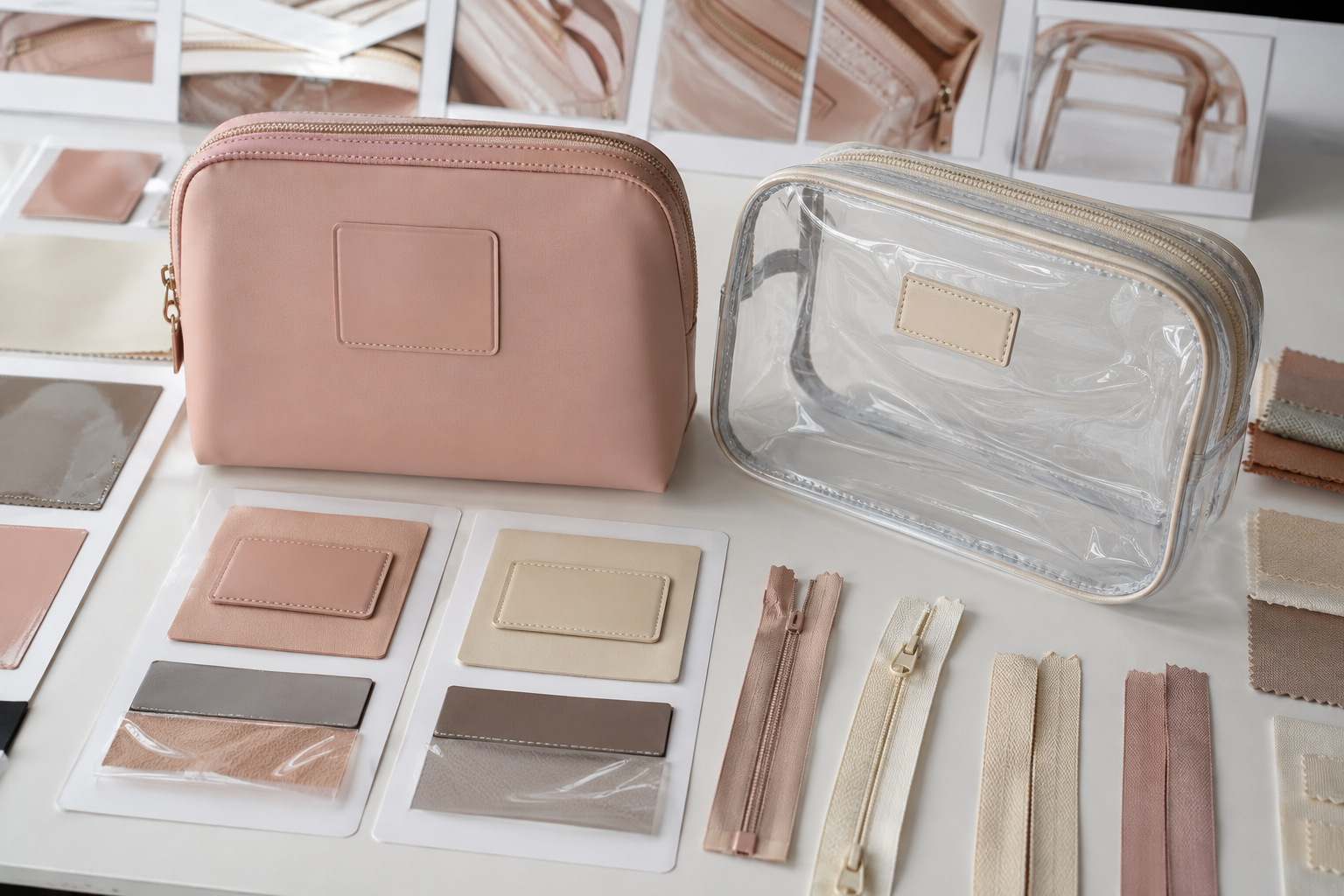
Why material selection is not just about appearance.
Buyers often make their decisions by touching color swatches. This is a good starting point, but not enough for custom projects.
Flat samples cannot show how rounded corners, folded edges, seams, or zipper pulls change under stress. Based on our factory's experience, some materials may look clean when laid flat, but once made into bags with a certain depth, they will wrinkle, turn white, or become uneven.
The material also determines the range of logo production methods. PU material: embossing, screen printing, hot stamping, metal labels, rubber patches. PVC material: high-frequency embossing, screen printing, partial brand logo patches. Fabric material: embroidery, woven labels, rubber patches, heat transfer printing.
Surface texture is crucial. A rough texture will result in uneven screen printing. An overly soft surface will not be able to maintain sharp embossed edges. Therefore, the material and structure must be determined before proofing, not afterward.
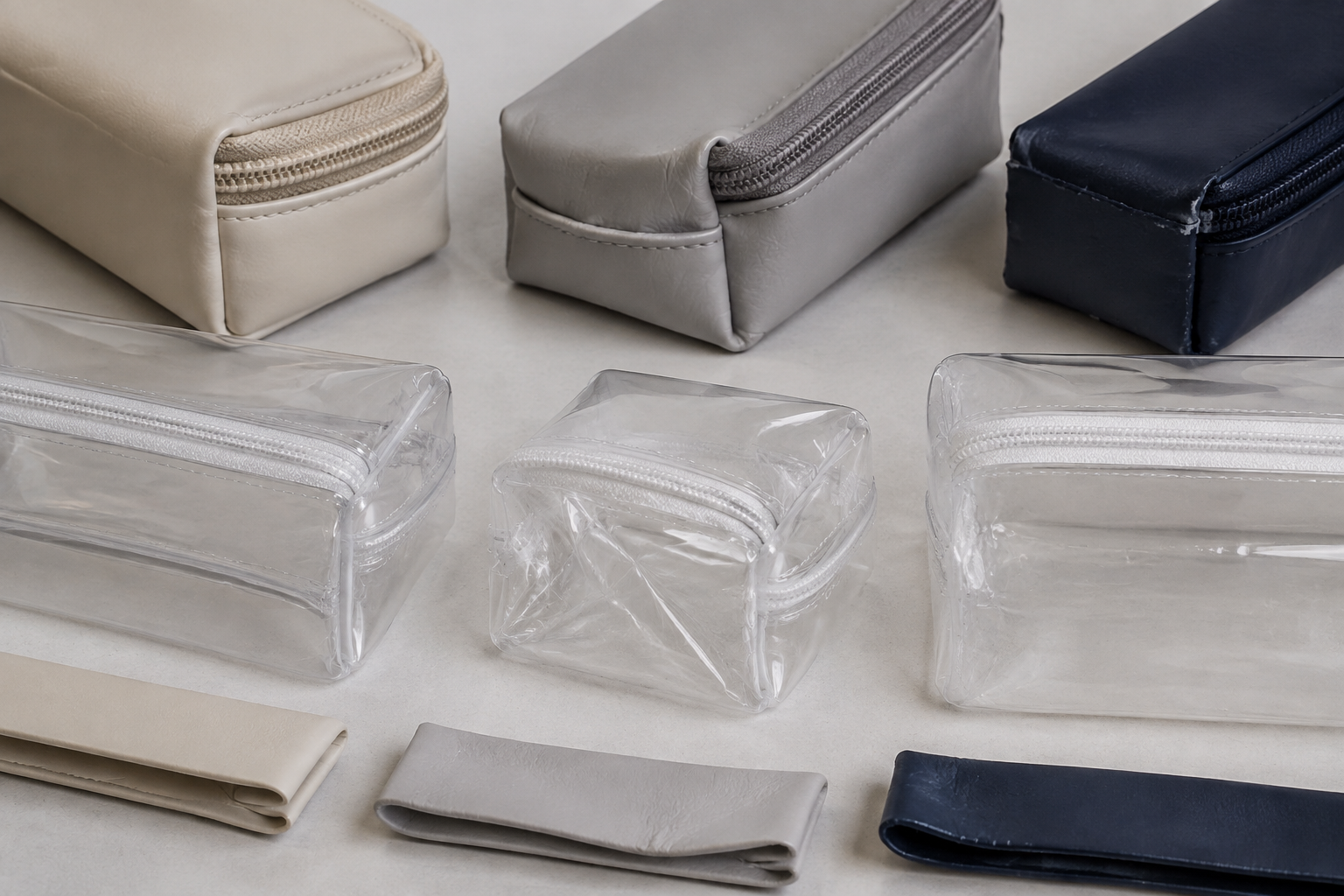
When to choose a PU cosmetic bag
For beauty gift sets, skincare sets, cosmetic tool bags, and mid-to-high-end retail packaging, PU material is generally worth considering. These buyers are very particular about the feel of the bag when picked up, opened, and used again six months later.
PU material supports a variety of surface treatments: glossy, matte, textured, pebble-like, and soft-touch. The same rubber patch or metal label will present drastically different effects on glossy PU and soft-touch PU. The surface treatment and label design should be determined simultaneously.
Key structural points to review before sampling:
- Folding edge treatment- sharp corners are prone to creases
- Bag depth– a deep cavity will cause greater lateral stress on the PU side panels when fully loaded.
- Corner radius– a smaller radius increases the surface tension at the bend.
- Sewing methods- Some seams require lining reinforcement.
- The location of the marker—its distance from the folded edge, the curvature of the zipper, and the corner areas—will affect the final product's appearance.
Do not approve empty PU samples. Fill with the actual product, seal, and check that the surface is smooth. An empty PU bag and a full PU bag are not the same thing.
When to choose a toiletry bag made of PVC material
Users need to be able to see what's inside the bag without opening it. This is where transparent PVC comes in. Toiletries bottles, brushes, skincare products, small tools, travel accessories, hotel toiletries bags, e-commerce parcels—transparent material can perfectly meet these needs.
Buyers often notice that while PVC sheets are waterproof, finished bags are not necessarily waterproof.
Finished bags consist of stitching, zippers, binding tape, openings, seams, and hardware. All of these factors affect their waterproof performance. If you have specific requirements for waterproofing or leak-proofing, please write them down before sampling—including testing methods and acceptance criteria. Making requests after sampling almost always means starting from scratch.
Is the destination the EU or the US? PVC or vinyl-related materials may require compliance checks as early as possible: phthalate restrictions, warning label requirements, customer test reports, and retailer-specific material rules. These matters must be addressed before material confirmation, not after the goods have been shipped.
For a clear structure of travel and toiletries, Pengtour's custom amenity kitpage provides a reference for available structures and customization options.
When is Oxford cloth, polyester, or nylon fabric more suitable?
Not every cosmetic bag needs a leather exterior or a transparent panel.
Lighter, more color options, better cost control, and suitable for everyday use—Oxford cloth, polyester, and nylon. Travel cosmetic bags, toiletry bags, hanging storage bags, multi-compartment storage bags, and promotional sets. These materials are ideal for the above-mentioned items and pair perfectly with zippers, bindings, linings, woven labels, and rubber patches.
A simple statement like "We want a fabric cosmetic bag" is far from sufficient. Fabric weight, surface texture, coating, color, logo production method, intended use—factories need these details before they can begin prototyping to avoid repeated revisions. Vague descriptions lead to expensive sampling costs.
In addition to PU and PVC materials, Pengtour's custom upholstery manufacturingpage also introduces other customization options.
Linings can also affect the product experience.
Every time a bag is opened, the lining is the first thing the user sees and touches. Most buyers consider it a secondary factor. But this is not the case for cosmetic bags.
- Light-colored eyelinerlooks clean and bright, but it makes foundation marks and loose powder stains more visible.
- Dark lining– can cover stains, but small accessories can easily get stuck at the bottom.
If this bag is intended to hold foundation, skincare products, makeup brushes, eyeshadow palettes, or anything else prone to leakage—please inform the factory before sampling. "Easy to clean" also needs to be clearly defined: wipe-clean, spot-clean, hand-wash, basic stain resistance. Each definition corresponds to different lining materials and structures. Without this information, the factory will be left to guess.
For buyers who value cleanliness as a selling point, Pengtour's articles on how to clean a makeup bagcan serve as an internal reference.
Logo design techniques should be verified against materials.
Finalize the logo design before prototyping; don't wait until after prototyping to make a decision. Don't arbitrarily change materials for the logo design—changing them after prototyping usually means remaking the sample.
| Material | Compatible marking technology | Key considerations |
|---|---|---|
| PU | Embossing, gravure printing, screen printing, hot stamping, metal labels, rubber patches, woven labels | Surface texture and softness affect print clarity and embossing effect. |
| PVC | High-frequency embossing, screen printing, and spot repair | It depends on transparency, thickness, flexibility, and surface finish. |
| Oxford cloth/polyester/nylon | Screen printing, embroidery, woven labels, rubber patches, heat transfer printing | Fabric texture, coating, and base color all affect the final logo output. |
Position is also important. If the logo is too close to the zipper curve, crease, or corner, it will be distorted. Before cutting, please be sure to send the design draft, dimensions, color, preferred position, and reference images. The factory can identify problems during the cutting stage, not after cutting.
Compliance and market statements should be reviewed as early as possible.
The choice of materials is not only reflected in the appearance; it also affects the wording of compliance documents, packaging copy, and product listings.
PVC or vinyl products sold in the EU or the US may be subject to phthalate restrictions, warning label requirements, customer testing reports, and retailer-specific regulations. This does not mean that PVC cosmetic bags cannot be sold in these markets, but rather that all relevant requirements must be clearly defined before production begins.
"Environmentally friendly," "non-toxic," "recyclable," and "sustainable"—these terms have legal force. The U.S. Federal Trade Commission's (FTC) Green Guide explicitly warns against using broad environmental claims that are not verified and certified. If these terms are to be used on packaging or product pages, corresponding supporting documentation must first be provided.
For B2B procurement, these discussions should take place in the first week, not after production is completed.
What evaluations did Pengtour make before swatching the colors?
The first question most people ask when consulting about soft-pack products is: What's inside?
Cosmetic bottles, brushes, skincare products, tools, cards, inserts, instructions, and accessories—the contents determine the packaging structure. Based on this, the following factors are considered: opening method, lining material, zipper direction, zipper type, handles, hooks, D-rings, logo design, and packaging format.
We wouldn't say that PU is necessarily better than PVC. Such an answer isn't practical for specific projects. What we can do is analyze the product, budget, application scenario, brand positioning, and target market, and then propose a truly suitable solution.
Most of the sample modifications we see are not caused by material errors, but rather because the materials, structure, markings, and intended use are determined separately by different people at different stages. If these four aspects were aligned from the outset, the sample production process would be shortened.
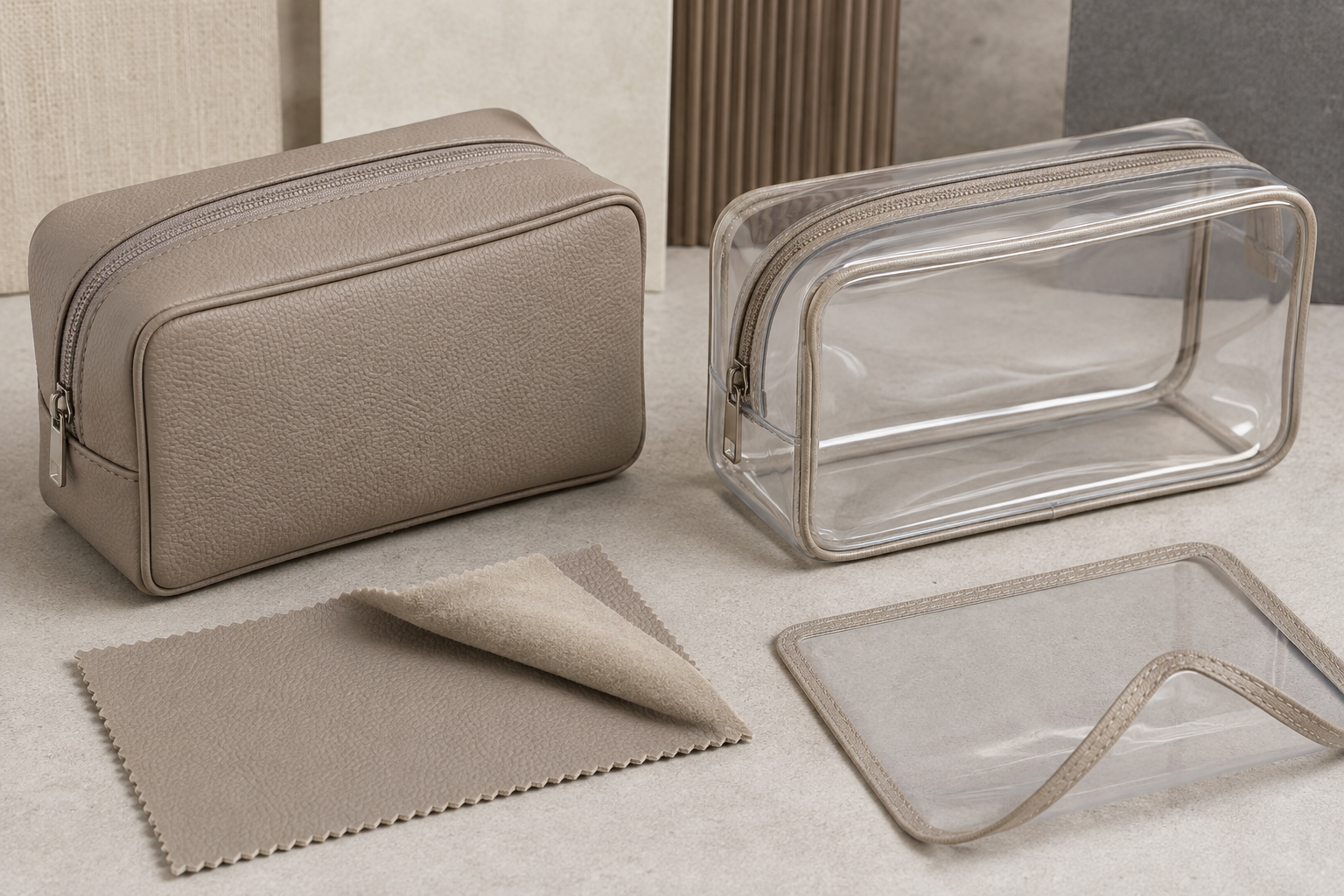
What should buyers prepare before requesting a quote or samples?
The more complete the presentation, the fewer revisions are needed for the sample.
- Product images, dimensions, weight, and accessories list
- Intended uses: everyday carry, travel storage, gift sets, promotional items
- Target market – the United States, Europe, or other regions
- Reference samples or design drawings
- Material selection (if already determined): PU, PVC, Oxford cloth, polyester, nylon, or others
- Logo file, location, color, preferred technology
- Packaging specifications
- Quantity – Initial order quantity and expected reorder quantity
- Testing or labeling requirements (if any)
Summary
PU, PVC, Oxford cloth, polyester, nylon—these materials are all suitable for cosmetic bags and toiletry bags. The best choice depends on the specific project.
- PU:Appearance, feel, and brand presentation effect
- PVC material:Users need to be able to see through the bag.
- Oxford cloth/polyester/nylon:lightweight, brightly colored, cost-effective, suitable for everyday use.
Don't start with the materials. Begin with the product, structure, branding, cleaning requirements, packaging, and target market. Materials come from there, not the other way around.
Contact Pengtour
Are you designing a PU cosmetic bag, PVC toiletry bag, transparent travel organizer, or other custom soft bag? Please provide product details, material specifications, logo file, quantity, and target market. Pengtour will review the materials and structure to ensure suitability before prototyping, based on the actual needs of the project.
Browse custom toiletry bags| View custom soft-pack options| Get a quote| Contact Pengtour
External References: US Federal Trade Commission Green Guidelines| EU REACH Regulation Phthalate Restrictions| California Proposition 65 Phthalate