

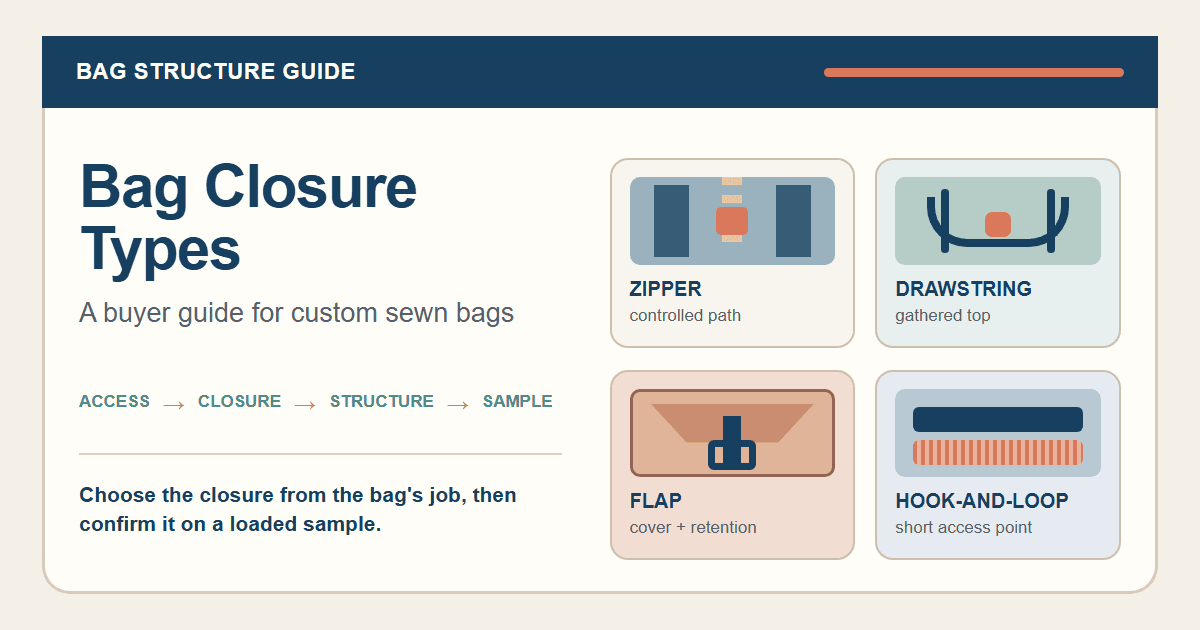
No bag closure is best for every project. A suitable choice depends on the contents, the way users reach them, the amount of opening control required, the surrounding bag structure and what the finished sample must demonstrate.
A zipper can control a long opening around a travel organizer. A drawstring can gather a soft top quickly. A flap can cover the opening and work with a buckle or another retention point. Hook-and-loop can suit a short tab or flap where alignment and opening action are acceptable. An open top may fit a tote concept that values immediate access, but it provides less control over loose contents unless another retention feature is added.
For a custom project, the useful question is not "Which closure sounds strongest?" It is "Which closure supports this access task, in this opening, with these contents?" The answer then needs to be written into the RFQ and checked on an assembled, loaded sample.
Start With the Opening Task
The closure should follow the user's action. Start by describing how the bag will be loaded, opened and carried.
Record these points before comparing closure families:
- The contents, including dimensions, quantity and approximate weight
- How often the main opening will be used
- Whether the user normally operates it with one hand or two
- The opening direction and the required access width
- Whether contents must stay in position when the bag is tilted or carried
- Whether the bag opens flat, partially, from the top or through a flap
- Pockets, dividers or lining parts near the opening
- The expected appearance and branding direction
- Any project-specific testing or acceptance requirement
A cosmetic pouch holding a few small items does not create the same opening task as a hanging toiletry organizer with loaded pockets. A travel organizer that opens flat also places different demands on the closure path than a soft drawstring pouch.
The contents can expose problems that are invisible in an empty bag. A bottle may press against the zipper path. A filled pocket may prevent a flap from lying flat. A drawstring channel may reduce the usable mouth more than expected. Define the normal loading condition before the sample is developed.
Main Bag Closure Types for Custom Projects
The routes below are starting points. They are not fixed rankings for cost, durability or retention. Material grade, opening geometry, attachment method, surrounding layers and project requirements can change the result.
Zipper Closures
A zipper can run across a top opening, around a curved panel, along several sides or around a clamshell structure. It may suit projects that need controlled opening length and repeatable access to an enclosed compartment.
The buyer still needs to define the opening task. A short straight zipper behaves differently from a long curved path. A double-pull opening changes where the user starts and stops. A loaded compartment can place pressure on the chain, slider, zipper ends and nearby seams.
At this stage, decide whether a zipper is the right closure family. Detailed questions about coil direction, zipper construction, slider quantity, puller and opening path belong in the next specification step. Buyers who have chosen this route can specify the zipper after choosing the closure route.
A waterproof-style zipper does not make the complete bag waterproof. Water-related performance depends on the outer material, seams, stitching, opening design, assembly and test conditions.
Drawstring Closures
A drawstring gathers a flexible opening by pulling a cord or tape through a channel. This route may suit a soft pouch, lightweight bag or secondary compartment where quick top access and a gathered appearance fit the product brief.
The gathered mouth changes the usable opening. Buyers should check the channel construction, cord route, cord ends, operating force and the amount of opening left after loading. The sample should also show whether the contents interfere with gathering and whether the closed shape matches the intended presentation.
A drawstring does not create a universal seal. Gaps, fabric folds and the way the channel closes depend on the construction and loading condition.
Flaps With Buckles or Other Retention Points
A flap covers part or all of an opening. It may work with a buckle, snap or another project-specific retention point. This route can separate the covering function from the fastening function: the flap shapes the opening, while the attachment holds it in the intended position.
The buyer should define flap length, overlap, stiffness, edge finish and the position of the retention point. A buckle also needs a compatible webbing or tab structure. If the flap carries branding, its closed position and loaded shape should be checked together.
The closure component cannot be reviewed alone. Buckles, tabs, webbing and local attachment areas need compatible dimensions and sewing space. The related hardware decisions can be checked in the guide to review closure hardware and attachment interfaces.
Hook-and-Loop Closures
Hook-and-loop may be considered for a flap, pocket, divider or short access point. The contact area, orientation and surrounding fabric need to support the intended opening action.
During sampling, check whether the two sides meet in the loaded condition, whether nearby lining or contents interfere, and whether the opening force suits the use scenario. Placement matters. A wide contact area that misses its matching surface after the bag is filled will not perform as intended.
The RFQ should identify where the hook and loop are placed, the required contact area, color direction and any operating or testing requirement. Do not treat the material name as proof of a fixed cycle life or holding result.
Open-Top Bags and Secondary Closures
Some tote and carry-bag concepts use an open top because fast access and a simple silhouette are central to the design. The buyer should decide whether that opening provides enough content retention for the actual use.
If more control is needed, a secondary feature may be evaluated. The exact option depends on the bag format and manufacturing feasibility. It should be shown on the drawing and reviewed on the sample rather than added as a vague note such as "with closure."
Open-top construction is still a deliberate closure decision. It affects opening width, edge finish, lining, handle position, loaded shape and the user's access sequence.
Compare Closure Routes by Buyer Task
Use the table as a question set, not as a performance ranking.
|
Buyer task |
Closure direction to evaluate |
What the sample should answer |
|
Control a long or shaped opening |
Zipper |
Does the path open smoothly with the intended contents loaded? |
|
Gather a soft top quickly |
Drawstring |
Is the usable mouth wide enough, and does the gathered shape fit the brief? |
|
Cover the opening with a visible panel |
Flap with a retention point |
Does the flap overlap, close and sit correctly when the bag is filled? |
|
Close a short tab, pocket or divider |
Hook-and-loop |
Do the contact surfaces meet and operate as intended after loading? |
|
Keep access immediate |
Open top or a limited secondary closure |
Is the level of content retention acceptable for the real use scenario? |
|
Combine access with internal organization |
Main closure plus pockets or dividers |
Do internal parts stay clear of the closure path and opening action? |
A project may use more than one route. A zippered main compartment can contain an internal hook-and-loop divider. A flap bag can have zippered pockets. Each closure still needs a defined job. Combining components without assigning their tasks can add bulk and sample revisions without solving the access problem.
A Closure Is a System, Not a Loose Component
The closure works through the surrounding construction. Five interfaces deserve attention.
Opening Geometry
The opening length, curve, corner shape and panel depth affect how the closure is installed and operated. A closure that works on a flat sample strip may behave differently around a boxed corner or a full bag opening.
Outer Fabric and Lining
The outer material, lining and any support layer meet at the opening. Their thickness, flexibility and folded edges can affect the finished path. The RFQ should identify the material direction on both sides of the closure, not just the visible component.
Tabs, Webbing and Attachment Areas
Buckles, snaps, pullers and other parts may depend on sewn tabs or webbing. Those attachment areas need enough space, suitable material layers and a reinforcement direction based on the expected loading. Buyers can review stitching and reinforcement around closure points when defining zipper ends, hardware tabs, pocket openings and webbing connections.
Internal Contents and Organization
Pockets, dividers, elastic sections and the products themselves can enter the closure path. Check the bag in its normal orientation. A closure that operates well while empty may bind, twist or miss its contact area after the contents are added.
Manufacturing and Approval References
The approved sample, drawing, material confirmation, hardware reference and written specification should describe the same closure. Photos can support the record, but they do not replace dimensions, placement and project-specific acceptance requirements.
When a Zipper Has Already Been Chosen
Once the buyer has selected a zipper closure, the next decisions become more specific. The project may need to confirm the zipper route, chain direction, slider quantity, puller, start and end positions, surrounding panels and operation under normal loading.
Keep these decisions separate from the broad closure comparison. This prevents a general article about bag closure types from turning into a second zipper specification guide. It also gives the supplier a clearer sequence: choose the closure family first, then define the exact zipper and its interfaces.
Turn the Closure Choice Into an RFQ
A useful RFQ connects the closure to the whole bag. Include the following fields:
- Bag category and intended use
- Contents list, dimensions, quantity and approximate weight
- Bag dimensions and normal carrying orientation
- Closure family and the task it needs to perform
- Opening drawing with length, direction, overlap or gathering area
- Outer fabric, lining and support layers around the opening
- Zipper, cord, buckle, hook-and-loop or other component references where available
- Tabs, webbing, seam and reinforcement locations
- Color, finish and branding requirements
- Pocket or divider parts close to the opening
- Expected opening action and normal loading condition
- Reference sample, photos, tech pack or structure drawing
- Testing method, sample quantity and acceptance rule when formal performance is required
- Packaging and labeling requirements that affect the closed bag
An early feasibility review may start with fewer details. Final sampling needs enough information to prevent the supplier from guessing the opening structure or the job of each component.
Avoid loose instructions such as "strong zipper," "secure buckle" or "waterproof closure." These phrases do not define a measurable result. State the use condition and, if a formal result is required, identify the test object, method, loading condition, cycle or force requirement, sample quantity and acceptance rule.
Review the Closure on a Loaded Sample
Review the empty bag first, then repeat the review with the actual products or realistic substitutes inside.
Empty-Bag Review
Check the opening dimensions, panel shape, zipper or cord path, flap alignment, tab position, hardware orientation, lining, binding, seams and visible workmanship. Compare them with the drawing and confirmed specification.
This stage can find missing parts, uneven placement and obvious interference. It cannot show how the closure behaves when the bag takes its intended shape under loading.
Loaded-Bag Review
Load the sample in the planned orientation. Open and close it as a user normally would. Observe whether:
- The intended access width remains available
- Products press against the zipper, flap or drawstring path
- Pockets or dividers interfere with the opening
- The flap reaches its retention point without forcing the bag shape
- Hook-and-loop surfaces still meet
- Buckles and tabs sit in the expected direction
- Zipper ends, corners and nearby seams show visible distortion
- The closed bag keeps the intended appearance and packing fit
For a wider approval sequence, buyers can review the closure on a loaded bag sample.
Normal opening, closing, lifting and carrying are practical sample checks. They do not prove zipper cycle life, formal load capacity, abrasion resistance, waterproof performance or long-term durability. Those conclusions require an agreed test method and a recorded result.
How Pengtour Reviews Closure Requirements
For selected custom sewn functional bags, Pengtour can review the closure together with the opening, surrounding material layers, pockets, dividers, webbing, hardware and normal loading condition. Possible project directions may include single- or double-zip openings, selected flap or roll-top structures, buckles, zipper pullers and other components that fit the design review.
The exact option depends on the bag category, contents, materials, construction, quantity and project requirements. Not every closure or hardware combination is suitable for every bag.
During sample development, the review may cover opening size and angle, zipper path and smoothness, flap or tab alignment, hardware position, stitching, seams and the bag's behavior with realistic contents. The approved physical sample and final specification materials can then be used together as production references, subject to the confirmed project controls.
To discuss a project, send the closure and bag requirements for review. Include the contents, bag size, opening sketch, material direction, closure reference, target quantity and any testing or acceptance requirement.
FAQ About Bag Closure Types
Does every custom bag need a zipper closure?
No. A zipper may suit a controlled long opening, but a drawstring, flap, hook-and-loop section or open top may fit another access task better. The choice depends on the contents, opening shape, retention need, surrounding construction and sample result.
Can one closure make the whole bag waterproof?
No closure name proves that the complete bag is waterproof. Water-related performance depends on the closure, outer materials, seams, stitching, opening design, assembly and test conditions. A formal claim needs project-specific testing and records.
Can a bag use more than one closure type?
Yes. The main compartment, external pocket, internal divider and removable section may have different closure tasks. Define each task separately and check that the components do not interfere when the bag is loaded.
Do normal opening and closing checks prove durability?
No. They can reveal visible interference, misalignment, jamming or loosening during sample review. They are not a cycle-life, pull, fatigue or long-term durability test. Formal requirements need a defined method, condition, sample quantity and acceptance rule.
Key Takeaways
- Choose the closure from the contents and access task, not from a generic ranking.
- Define the opening geometry before selecting component details.
- Review outer fabric, lining, tabs, webbing, seams and internal parts as one closure system.
- Use the RFQ to assign a clear job to every closure.
- Check the empty bag and the realistically loaded sample.
- Keep ordinary sample observations separate from formal performance testing.
- Use the approved sample and written specifications together as project references.