

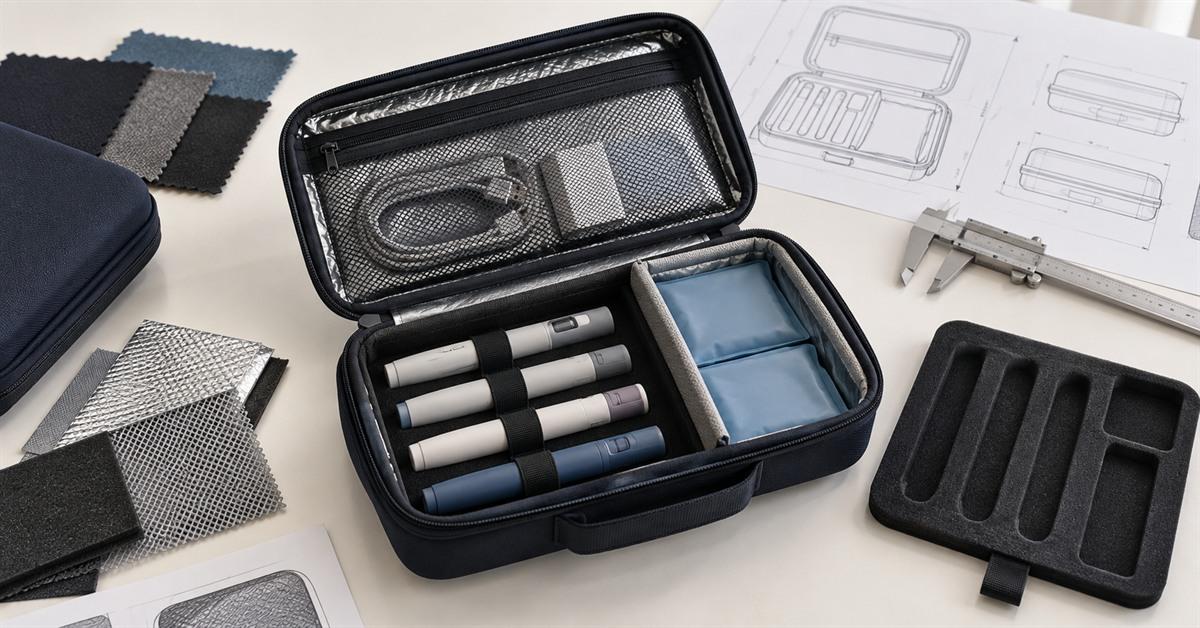
In short: Before drawing up the instructions, we need to see the complete kit—not just four pens. A top view should clearly show the blood glucose meter, test strip bottle, needle, wipes, and two packs of gel. Next to it should be three numbers: the expected maximum ambient temperature, the carrying time, and the 30°C upper limit. The dimensions of the casing alone don't provide much information.
"Four pens, eight hours, EVA casing" sounds like a concise description, but the layout still needs improvement. Which pens? What else needs to be brought along? Where will the pen case be kept during those eight hours?
These answers will change the dimensions of the lining, gel pouches, and finished product packaging. They will also determine how samples are tested. We will review these decisions in the following order.
Is this travel insulin cooler box suitable for opened insulin pens or unopened medications?
Please prioritize the usage phase. This project involves opened and currently used insulin pens. The product is a passive EVA pen case that does not require power or refrigeration. Inside the case, two pre-packaged softgels are placed in separate pockets under an aluminum foil-lined tray. The four insulin pens will not share this compartment.
If the medication is unopened, we will begin with a separate briefing. The medication name, dosage form, and market are primary considerations, as the label determines storage conditions.
Eli Lilly's current prescribing information for lispro insulin in the US illustrates the importance of this stage. Purchasing personnel using this label will write one of two drastically different statements in their briefings: "Unopened, 36–46°F (2–8°C)" or "In use, below 86°F (30°C), for up to 28 days." I would not copy any of these statements onto other medications before reading their labels.
Brief example: "Four [pen-style] test pens. Test in a test chamber at 35–40°C for six hours. Only when the air readings on the left, middle, and right sides are all below 30°C is the test considered合格 (qualified/acceptable)."
Now we have the load and the test target.
What's inside a custom insulin cooling bag?
Please send a top-down view of the entire gear set. Ensure all items are in the frame, including the two ice packs. Please label the main dimensions next to each item.
Please provide the model number, total length, and thickest point for each pen. Please provide a side view photo of the pen clip and an end view photo of the pen cap and dosage button. The pen barrel can be inserted, but no part of the pen cap should touch the cap.
If the pencil case needs to hold several different sizes of fountain pens , please send the two largest sizes. We do not use average sizes: small pens may wobble inside, while large pens may be difficult to remove.
Tell us which item should be placed out first. If it's a test strip bottle, don't bury it under the four pens. The box can be closed neatly, but the layout can be terrible.
Under what outdoor temperature can you work for eight hours?
Another number needs to be added next to "eight hours". Where does this eight-hour period refer to – an air-conditioned office, or a workplace with a temperature of 38 degrees Celsius? Please provide the highest ambient temperature that is closest to the actual situation.
Consider the expected market and daily usage scenarios. Is this product primarily intended for use in an office bag, or will it be left outdoors on hot workdays? Please include this information in the sample application.
Our standalone insulin cooling bag test covered a recorded setup: four simulated insulin pens, two 75g gel packs, and three pressure probes connected to a separate factory data logger. This test serves as an example of a testing method. The results are not applicable to larger containers, different loads, or different coolant configurations.
Why do we need gel packs?
We designed the gel pouches along with the case and pen holder. These gel pouches are not optional accessories added after the phone case is finished.
The set contains two 75g soft packs, each frozen at -18°C for 4 hours. They are placed flat in two pockets under a foil-lined tray. Because the pockets are the same size as the finished package, the packaging will not slip next to the pen.
If you are purchasing coolant from elsewhere, please send us the packaged finished product. The catalog lists the length and width, but not the filler thickness, sealing edge, or curvature. These three details affect the tray height and zipper closure.
The U.S. Food and Drug Administration (FDA) guidelines for insulin storage state that frozen insulin should not be used. Therefore, I record the lowest temperature and the duration (in hours) below 30°C.
Is it a fitted EVA liner or an adjustable partition?
Fixed cutting grooves are suitable for pens of stable length. The shortest and longest pens are placed alternately in the same groove. If a short pen rolls or a long pen doesn't leave a gap between fingers, the groove is not yet suitable for cutting.
Changing tables need movable partitions. They are really convenient and also give the baby more room to move around in.
After putting everything in, zip the box up, turn it around on the workbench, and then turn it upside down. This is more illustrative than shaking an empty box. Reopen the box; a pen slipped out of its place, and we had to go back to the shelf. I also tried to find the first thing I needed without emptying the box.
How should an insulin pen insulated box be checked at three temperature points?
I marked three factory test points on the diagram: the left side, between the four pens, and the right side. The probe lines came from a separate factory data logger used to read the air pressure around the load. After placing the probes, I closed the case and didn't zip it up until the test was finished.
The effective time is determined by which probe reaches 30°C first. We will not average the readings of a hotter probe with the readings of two colder probes just to gain an extra hour on paper.
The settings photo will be saved in the temperature log. After moving the blood glucose meter to the center position, the photo and probe markings will also need to be changed accordingly. At this point, the modified blood glucose meter will run independently instead of using the previous curve.
What must the first sample prove?
Before conducting the test, we loaded the first sample and checked its structure. Four pens were placed into their respective slots, followed by the detector, test strip vial, needle, and swab. We used the two gel packs specified in the briefing instead of borrowing off-the-shelf ones from other projects. The placement and surface treatment of the markings can wait until the sample cassette is properly closed and carried.
I zipped up the zipper, without closing the lid, and checked the two corners. Then I reached for the test strip bottle. If the pen had to be taken out first, it meant the pockets were in the wrong order.
Next comes a simple carrying check: hold the pen barrel and walk it around the workbench, then turn the pen upside down. The diagram next to the pen case clearly shows any pen movement. I hold the pen barrel and pull each pen out; if the pen cap or dosage button is a slot type, more finger space is needed because the slot design requires more room. The highest pen also needs its cap checked, as the pen clip may rub even when the barrel is closed.
Finally, I lifted the foil-lined tray to examine the two 75-gram packs of tobacco. If the edge of one pack slipped out of the tray bag, it would push the tray towards the pen. We need to adjust the position of the tray bag or the height of the tray before starting to brew.
As per the project agreement, the lead cores in the test chamber were placed at -18°C for four hours. All lead cores were then reinstalled in the same position. The technicians placed the lead cores on the workbench and, referring to the setup photograph, placed the left lead core, the middle lead core between the two pens, and the right lead core in sequence. Finally, they zipped up the lead core box.
The log sheet will indicate the chamber conditions, minimum reading, and the first probe to reach 30°C. If we change the housing, liner, sample, or gel pack, a new log sheet needs to be opened and the test repeated. This prevents subsequent samples from matching the wrong curve.
What should be included in a design briefing for an insulin refrigerator?
CAD can be used later. In the initial layout phase, a well-annotated photograph or hand-drawn sketch can usually answer more pressing questions: Which components must be appropriate, and which components will the user use first? Add the following notes next to them:
- The contents include: the model, size, quantity, and photos of the pen or bottle, as well as all accompanying accessories.
- Scope of use: Opened or unopened medicines, applicable product labels, environmental range, upper temperature limit and storage time.
- Cooling device: Provide a sample of the finished gel pack if possible, or its size, filling weight, quantity and preparation conditions.
- Business briefing: insert preferences, external size restrictions, approval records, logo design, colors, packaging, and expected order quantity.
The factory can use this as a basis for layout design. A beautiful drawing without load or testing conditions is of little use.
How can buyers negotiate OEM insulin cooler bag samples with Pengtour?
For customized OEM insulin warming packs, please send Pengtu your pen kit, accessory list, ambient temperature range, target time, and ice pack details. Before providing a quote, we can review the EVA shell, internal structure, and sample testing plan. The customization process illustrates the development path; when requesting OEM samples , please attach a photo of the marked kit and a brief description.