

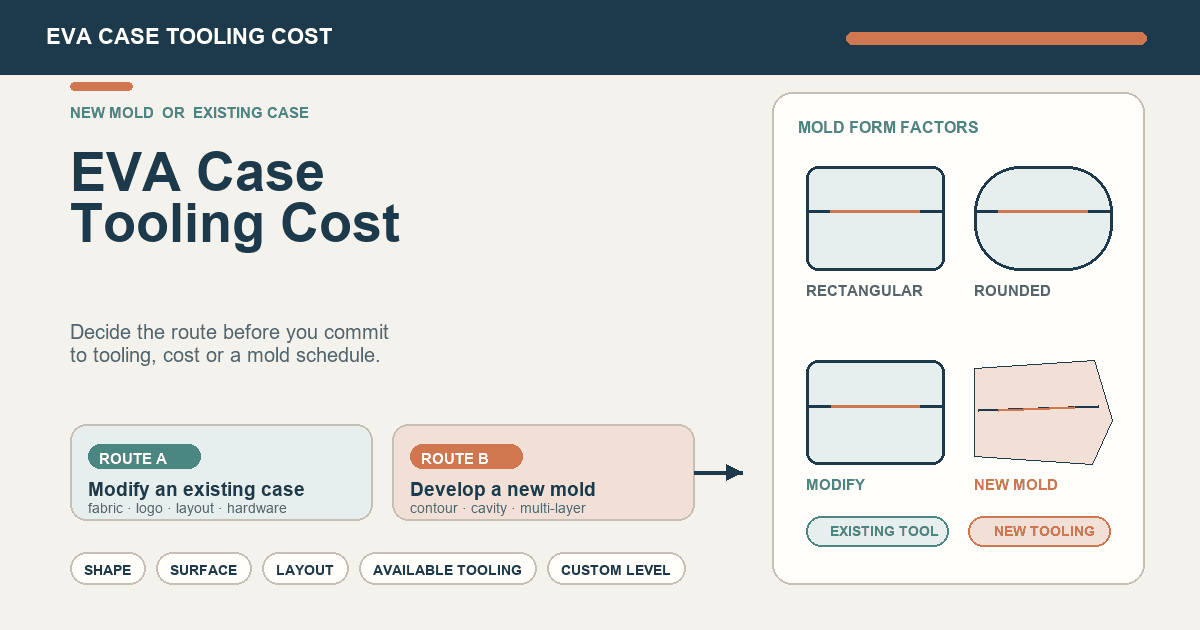
Tooling cost is usually the first number a buyer asks about on a custom EVA case project. It is also the wrong first question, because the amount depends entirely on a decision that has not been made yet: whether your case needs a new mold at all.
A custom EVA case does not automatically require new tooling. Whether a mold is needed depends on the case shape, the surface structure, the product size, the internal layout, the tooling that already exists, and the level of customization you require. Projects that start by asking "how much is the mold" often pay for tooling they did not need, or commit to a route before they know whether an existing case could have been adapted.
This guide walks through the tooling route decision first, then the cost conversation. It covers custom EVA protective cases for cameras, audio equipment, medical and first aid devices, tools, drones, instruments and consumer products. Exact tooling scope, cost and timing depend on the confirmed project requirements.
The Real Question Comes Before the Price
Buyers often arrive with a single question: how much does the mold cost. That number cannot be answered responsibly before four things are clear.
What shape does the case need to take. A rectangular clamshell, a square case and a contoured case that follows a product silhouette are different tooling problems.
What structure the surface needs. A plain shell, a fabric-wrapped shell, a textured surface and a multi-layer construction all change what has to be built.
How the product sits inside. A general cavity and a dedicated cutout for one specific product are different internal layouts.
How much is already available. This is the variable most projects overlook. Existing tooling and existing case samples can change the answer entirely, and a buyer who never asks will not find out.
The practical takeaway is simple. The tooling conversation should start with the case structure, not the budget. Once the structure is fixed, the tooling question answers itself: new mold, modification of an existing case, or a combination where only part of the tooling is new.
Buyers can record these structure inputs in a custom bag design brief so the case, the layout and the tooling decision develop from the same confirmed set of requirements.
Route One: Modify an Existing Case or Use Existing Tooling
Not every custom case needs a new mold. If a supplier already produces a case with a similar form factor, adapting that case can be a practical route. This is the route many first-time buyers should evaluate before assuming a new mold is the starting point.
An adaptation route typically changes some of the following:
- Outer fabric, colour and surface finish
- Branding method and logo position
- Internal layout, dividers and pocket arrangement for your accessories
- Zipper, pull, handle or hardware selection
- Labelling, care instructions and packaging configuration
- Sizing, where the existing form factor allows a workable adjustment
What usually does not change is the outer shell geometry, because that is what the tooling defines. If your product needs a shape the existing case cannot hold, adaptation is not available regardless of how the fabric or interior is configured.
This route matters commercially because it can change both cost and timing. A project that adapts an existing case generally avoids a full mold development cycle and may avoid a separate tooling charge, depending on what actually changes. That is a project-by-project outcome, not a fixed rule, and it should be confirmed in writing rather than assumed.
Buyers with a real sample in hand get a much clearer answer. If you can supply an existing case sample alongside your product, the factory can compare the two structures directly instead of inferring from photographs. Dimensions, drawings and 3D files all help, but a physical sample removes the most common source of tooling disputes.
Route Two: Develop a New Mold
A new mold becomes necessary when the case has to hold a shape or a fit that existing tooling cannot deliver. Typical reasons include:
- A contoured or product-shaped exterior that follows the item silhouette
- A dedicated cavity matched to one specific product and accessory set
- A multi-layer or multi-part construction
- Structural features such as draft angles, undercuts or stepped profiles that the existing tool cannot form
- A size or proportion that falls outside the existing case range
- A fit requirement tight enough that a general cavity would not protect the product
Once you are on this route, the tooling is no longer a single line item. A molded EVA case may involve shell tooling, a cutting die for fabric and foam, a logo plate or print tooling, and insert tooling for the internal foam. Depending on the construction, additional cutting or forming steps can appear as well.
Buyers who already know they need a new mold can move to the execution side and read how tooling development is actually planned in custom EVA tooling development and design.
How to Tell Which Route Fits Your Project
Use these questions before asking for a tooling figure. The answers usually make the route obvious.
1. Is the outer shape regular or contoured? A regular geometric shell opens the adaptation route. A shape that follows your product's contour usually points to new tooling.
2. Does the case need to fit one specific product, or a category? A category-level fit can often work with a general cavity and adjustable interior. A single-product fit usually needs dedicated tooling.
3. How many accessories go inside, and do they need dedicated positions? Adding dividers and adjustable pockets to an existing interior is often possible. Cutting a new cavity pattern for a fixed accessory set is tooling work.
4. How much of the case is a branding and material change? Fabric, colour, print and logo changes are the cheapest part of a project. They should not be the reason to open a mold.
5. What volume do you expect in the first run and the reorder? Volume affects how tooling is amortized and whether a more expensive tool is justified, but it does not by itself decide the route.
6. How much schedule flexibility do you have? A new mold adds development time before sampling. If your launch date cannot move, this is a real constraint on the route decision.
If answers 1 through 3 point toward a general form and a category fit, ask for an adaptation assessment. If they point to a product-specific fit or a contoured shape, start planning for new tooling instead.
What to Ask Before You Commit
Once the route is clear, put the following in writing before any tooling charge is agreed. These questions are the difference between a predictable project and an expensive surprise.
Can this project be developed from an existing case or existing tooling? Ask this first, even if you expect a new mold. The answer may reshape the whole plan.
If an existing case is adapted, which parts change? A clear list of modified components tells you where cost and risk actually sit.
Is the tooling charge refundable, deductible against the bulk order, or one-time? Tooling ownership and charging terms are frequently left vague and become a dispute after volume is committed. Get the terms written into the quotation or the contract.
Does the sampling charge count toward the first production order? Some projects treat it as recoverable, others do not. This changes the effective cost of the first run.
What design changes would be needed to avoid a new mold? A supplier who reviews your structure can often propose a construction change that keeps the project on a cheaper route. Ask for that recommendation explicitly.
What would make the existing case route impossible? Knowing the limit condition tells you whether you are choosing the adaptation route or accepting it under pressure.
What changes later would trigger re-tooling or a new cutting die? Material and layout changes during the project can affect tooling. Knowing this in advance prevents disputes about who absorbs the cost.
Once these answers are documented, the tooling figure becomes comparable across suppliers. Comparing custom EVA case quotations covers how to normalize one-time and recurring costs once both quotes are structured the same way.
How Pengtour Reviews a Tooling Request
At Pengtour, a tooling request is reviewed as a structure question before it is treated as a cost question. Whether a mold is required depends on the case shape, the surface structure, the product size, the internal layout, the tooling already available, and the customization level you need.
We do not assume that every custom EVA case requires new tooling. Where an existing case or existing tooling can reasonably cover the requirement, that option is worth evaluating with you. Where the product needs a dedicated contour or a product-specific cavity, we will say so rather than fit the project into a shape that does not protect it.
Reference material helps the review. Product dimensions, photographs, 2D drawings, 3D files, physical product samples, existing case samples and packaging samples can all be used as input. Some complex products need more than that, such as a physical product, a detailed drawing, a 3D file, accessory dimensions, or a fit-check sample. A case cannot always be developed accurately from photographs alone, so if your project depends on shape accuracy, supplying the physical reference early is the fastest route to a reliable answer.
Development work may involve pattern development, thermoforming or compression mold development, foam insert drawing, internal layout drawing, logo position confirmation and packaging layout confirmation. Which of these apply depends on the confirmed scope. Tooling cost, timing and ownership terms are confirmed per project rather than published as fixed figures.
Once the route and the structure are agreed, the sampling stage defines the standard for mass production. Reviewing a custom EVA case sample before production covers what to check and how to record the approved sample.
FAQ About EVA Case Tooling Cost
Does every custom EVA case need a new mold?
No. Whether a mold is required depends on the case shape, the surface structure, the product size, the internal layout, the tooling already available and the customization level. Projects that only change fabric, colour, branding or internal layout may be developed from an existing case or existing tooling. A new mold is generally needed when the case requires a contoured exterior, a product-specific cavity or a construction the available tooling cannot form.
Is modifying an existing case cheaper than developing a new mold?
It usually reduces tooling cost and development time, but it is not a fixed rule and depends on what changes. If the outer shell geometry can stay the same and only fabric, branding, hardware or the internal layout changes, an adaptation route avoids much of the mold work. If the exterior shape or the product fit must change, a new mold may still be required. Ask the supplier to confirm the route in writing before committing to a tooling charge.
Can I pay the tooling charge upfront or have it deducted from the bulk order?
Terms vary between projects, so confirm them before committing. Tooling charges may be one-time, refundable under conditions, or deductible against the bulk order. Some suppliers also amortize small tooling into the first production run. Put the agreed terms in the quotation or the contract rather than relying on a verbal statement.
What information do you need to tell me if I want to compare adapting a case against a new mold?
Send the product dimensions and shape, photographs, 2D drawings or 3D files, the accessory list and quantities, any existing case you already own or want to reference, and the branding and packaging requirements. If a physical product or an existing case sample is available, include it. That is enough for an initial route assessment, and it is the fastest way to get a reliable answer instead of a generic tooling range.
Key Takeaways
- The tooling question comes after the structure question. Shape, surface, internal layout, available tooling and customization level decide whether a new mold is needed at all.
- A custom EVA case does not automatically require new tooling. Fabric, colour, branding, hardware and internal layout changes can often be developed from an existing case.
- A new mold becomes necessary for contoured exteriors, product-specific cavities, multi-layer constructions and shapes outside the available tooling range.
- Compare routes before asking for a price, and ask for an adaptation assessment even if you expect new tooling.
- Confirm tooling ownership, refundability, deduction terms, sampling charges and re-tooling triggers in writing before committing.
- Supplying 2D drawings, 3D files or a physical sample shortens the review; complex products may need a fit-check sample to confirm structure accurately.
Ready to check whether your project can start from an existing case? Send your product dimensions, accessory list and any reference case to request a quote, or review the custom EVA case range to see what existing form factors are available.