

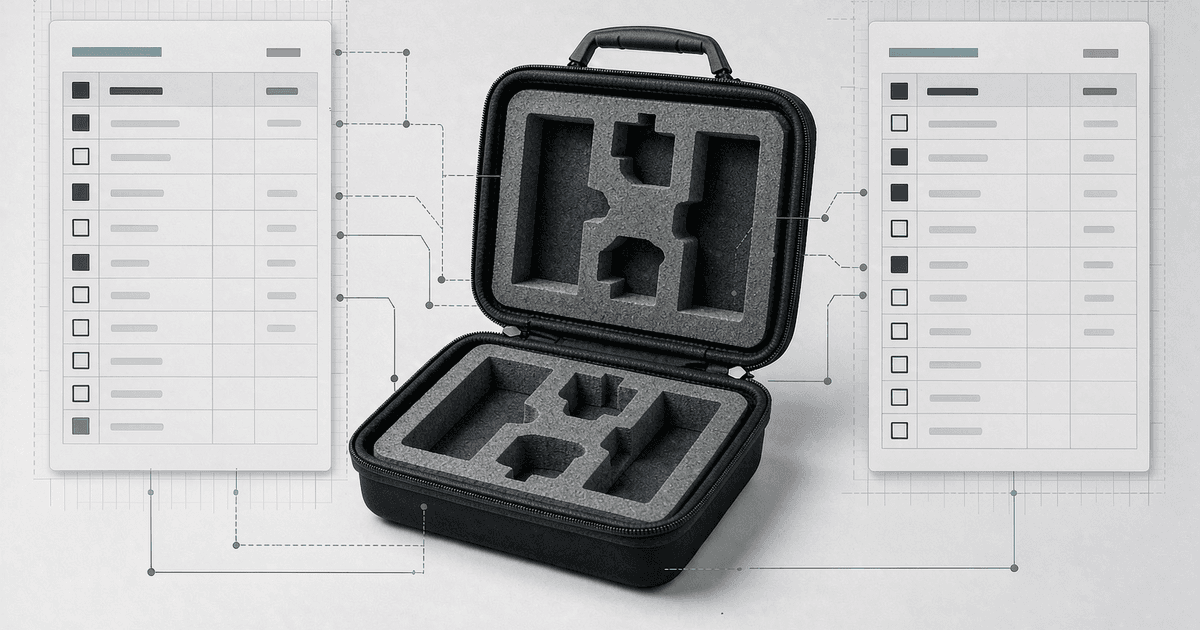
A low unit price can describe a cheaper case. It can also describe a shorter quotation.
One supplier may include the finished case, foam insert, logo, individual packing and ordinary inspection in the unit price. Another may quote only the shell and add the insert, packaging, tooling and inspection later. The two figures look comparable, but they do not cover the same product.
The reliable way to compare custom EVA case cost is to put every quotation on the same specification revision, quantity, currency, delivery basis and approval scope. Then separate recurring unit cost from one-time development cost and separately quoted services.
This guide gives sourcing teams a practical method for doing that without relying on unsupported market price ranges.
Quick Answer: How Should You Compare Custom EVA Case Quotes?
Compare quotations in this order:
- Confirm that every supplier received the same controlled brief and revision.
- Lock the case scope: shell, outer material, lining, insert, zipper, handle, logo and packaging.
- Separate recurring unit price from one-time development, tooling and setup charges.
- List samples, revision rounds, testing, inspection, labels and other services as included, excluded or pending.
- Put currency, quantity, quotation validity and delivery terms on the same basis.
- Calculate total project cost for the quantity being purchased, without counting the same fee twice.
- Compare the remaining differences in specification, approval risk and repeat-order control.
Do not start by asking which unit price is lowest. Start by asking what each price actually buys.
Use One Controlled Brief Before You Compare Prices
A fair comparison begins before the quotations arrive. If suppliers receive different product information, they are pricing different projects.
Use one revision-controlled brief for all candidates. It should state:
- Product and accessory dimensions
- Intended use and handling conditions
- Target outside size or allowed envelope
- Required usable internal space
- Case opening and zipper direction
- Outer material or appearance direction
- EVA shell construction direction
- Lining and internal organization
- Foam insert, molded support, pockets, straps or dividers
- Handle and carrying requirements
- Logo artwork, position, size and preferred method
- Individual packaging, labels and carton requirements
- Order quantity and variant split
- Sample, inspection and testing requirements
- Delivery destination and requested trade basis
- Drawing, Tech Pack or brief revision number
If these inputs are still incomplete, use the custom EVA case quote brief first. The goal is not to make every supplier use the same construction. It is to make their assumptions visible so the alternatives can be judged against the same buyer task.
Mark each requirement as confirmed, target, optional or pending. A pending point can change the quotation later, so it should not disappear inside a single total.
Lock the Product Scope Line by Line
A custom EVA case may include an outer material, EVA structural core, lining, zipper, handle, pocket, elastic strap, foam insert, molded support, logo and packaging. Not every project uses every component.
That is why a quotation described only as "custom EVA case, one unit" is too broad for comparison. Build a scope table instead.
|
Scope item |
What to confirm |
Why quotes may differ |
|
Overall case |
Outside size, usable inside size, shape and opening |
Similar outside dimensions can hide different internal space or forming work |
|
EVA shell |
Construction direction, formed shape and approved reference |
Thickness alone does not define the complete structure |
|
Outer surface |
Material type, grade, backing, texture, finish and color |
A shared material name may still cover different specifications |
|
Lining |
Material, covered areas and attachment method |
Full lining and partial lining are different scopes |
|
Internal support |
Foam insert, molded support, straps, pockets or dividers |
Not every case requires a custom foam insert |
|
Zipper and hardware |
Zipper type, pullers, handle, webbing and fittings |
Small components can change both material and assembly work |
|
Branding |
Method, size, position, colors and setup |
Unit application and one-time setup may be quoted differently |
|
Packaging |
Polybag, box, labels, inserts and carton requirements |
Retail-ready packing and basic bulk packing are not equivalent |
|
Quality scope |
Sample reference, inspection items and agreed criteria |
"QC included" means little unless the scope is stated |
Use the same table when reviewing the custom EVA case range. Ask each supplier to confirm its proposed construction beside the requirement rather than replying with a general "included."
A supplier may propose a different material or internal structure for a valid reason. Keep that alternative visible. Do not let it replace the requested baseline without being labeled as an alternative.
Separate Recurring Cost From One-Time Cost
The next step is to sort every charge by how it behaves across the project.
|
Cost group |
Typical items to place here |
Comparison question |
|
Finished-case unit price |
Approved case construction, materials, components, assembly, logo application and agreed packing |
Does this unit price cover the same approved scope? |
|
Development and sample cost |
Design work, prototype, sample labor, sample shipment and agreed revision work |
How many samples or revisions are included, and what triggers a new charge? |
|
Tooling and setup |
Forming mold, cutting tools, logo setup or other project-specific tooling where required |
Is the charge separate, included or spread across the unit price? |
|
Additional services |
Buyer-requested testing, third-party inspection, special documentation, labeling or sorting |
Is the service included, optional or still pending? |
|
Delivery-related cost |
Freight, insurance, destination handling and other charges under the agreed trade basis |
Are all suppliers quoting from the same delivery point? |
Not every custom EVA case requires new tooling. The requirement depends on the case shape, surface structure, size, internal layout, existing tooling and customization level. The quotation should state what tooling is needed for the proposed design instead of treating a mold fee as automatic.
The same rule applies to foam inserts. Some cases use a custom-cut insert; others use molded support, straps, pockets, dividers, flat lining or a combination. Compare the proposed internal solution, not the word "insert" by itself.
Watch for double counting. If a supplier has already spread a setup charge across the unit price, do not add the same charge again when calculating the project total. Ask for written clarification when the treatment is unclear.
Normalize the Commercial Basis
Two identical case specifications can still produce different totals because the commercial basis is different.
Put these fields at the top of the comparison sheet:
|
Commercial field |
What must match or be made visible |
|
Quantity |
Same order quantity and the same split by color, size, logo and packaging |
|
Currency |
Same currency or a recorded conversion basis and date |
|
Price validity |
The period during which the supplier will honor the offer |
|
Delivery basis |
Same named trade basis, location and included logistics scope |
|
Payment schedule |
Deposit, balance point and any condition linked to inspection or shipment |
|
Sample status |
Concept quote, sample-stage quote or post-approval production quote |
|
Lead-time basis |
Start condition and dependencies, not only a number of days |
|
MOQ basis |
Material, structure and variant assumptions behind the minimum |
MOQ and lead time are project-specific. Material purchasing, product structure, quantity, tooling, approval status and order requirements can change them. Treat a general website promise as background information, not as the controlling term for the current order.
A production quotation should state when its schedule starts. Sample approval, material confirmation, deposit receipt, artwork approval or another agreed condition may affect that date. If suppliers use different start points, their lead-time figures are not yet comparable.
Mark Every Item as Included, Excluded or Pending
A simple status system exposes most hidden gaps:
Includedmeans the quotation names the item and places its cost in a stated line.
Excludedmeans the buyer or another provider will handle it.
Pendingmeans the requirement or price cannot be confirmed until a decision, file, sample or test scope is available.
Alternativemeans the supplier priced a different construction or service from the baseline.
Do this for materials, inserts, logo setup, sample shipment, revision work, testing, inspection, labels, retail packaging and freight.
"Pending" is not automatically a problem. Early-stage projects often contain open items. The risk comes from treating a pending item as if it were included in a final total.
If a quotation contains vague phrases such as "standard material," "normal packing" or "usual QC," ask the supplier to define the applicable specification or reference. A shared label without a shared definition cannot support a fair comparison.
Calculate the Total for the Actual Purchase Scenario
Once the scope is aligned, calculate the total for the quantity you expect to buy.
Use this structure:
Project total = quantity × confirmed unit price + one-time development/tooling + separately quoted services + delivery-related cost
This is a budgeting framework, not a universal price formula. A quotation may group charges differently. Count each item once and keep the supplier's written treatment visible.
Here is a simplified example without market price assumptions:
|
Item |
Supplier A |
Supplier B |
What the buyer should do |
|
Unit price |
Includes logo and individual packing |
Excludes logo setup and uses bulk packing |
Add missing scope or request a matched alternative |
|
Tooling |
Separate one-time line |
Included in unit price |
Confirm whether B's repeat-order price changes |
|
Sample revisions |
One stated revision method |
Not stated |
Ask B to define revision scope and approval method |
|
Inspection |
Ordinary factory checks against approved requirements |
"QC included" |
Ask B to name the reference and inspection scope |
|
Delivery |
Quoted to named handover point |
Factory pickup |
Put both offers on the same delivery basis |
The lower unit price may still become the better offer after normalization. The point is to reach that conclusion from comparable information rather than from an incomplete first number.
Compare Approval Risk, Not Just Quotation Scope
The quotation is only one project version. A sample may reveal that the shell depth, product fit, zipper path, insert, lining, logo or packaging needs revision.
The buyer-approved physical sample and final confirmed specification package can together serve as production and inspection references. If they conflict, clarify the applicable version before production preparation. The custom EVA case sample approval checklist shows how to record the sample, drawings, dimensions, materials, artwork, packaging and revision comments.
A revised physical sample may be required when a change affects the molded shell, fit, cavity, opening, zipper path, internal support, material construction, tooling or packaging size. Lower-risk local changes may use an agreed written, photo, video or document confirmation method if the buyer accepts it.
After a material change, structural change or major sample revision, ask each shortlisted supplier to update:
- The affected drawing or specification revision
- The unit-price scope
- Any tooling or setup requirement
- Sample and revision charges
- MOQ and material assumptions
- Production schedule and start condition
- Packaging and delivery scope
Do not compare one supplier's first concept quote with another supplier's post-sample production quote. Label the quotation stage and revision on every comparison sheet.
Use a Seven-Step Quote Comparison Workflow
Step 1: Freeze the comparison revision
Name the brief, drawing and specification revision used for the comparison. Remove obsolete versions from the active package.
Step 2: Build the baseline scope
List the required shell, outer material, lining, internal structure, zipper, handle, logo, packaging and quality references.
Step 3: Map each quotation to the baseline
Mark every line included, excluded, pending or alternative. Ask questions where a general term hides a specification.
Step 4: Separate cost groups
Move recurring unit cost, sample cost, tooling/setup, additional services and delivery into separate sections.
Step 5: Normalize commercial terms
Align quantity, variant split, currency, validity and delivery basis. Record differences that cannot be normalized.
Step 6: Review samples and assumptions
Check whether the supplier's proposed case actually meets the intended fit, opening, organization, appearance and packaging task. Ordinary sample review does not prove drop, waterproof, load or certification performance unless a separate test method and result are available.
Step 7: Issue a comparison decision
Record why the selected quotation is preferred. The reason may be lower normalized total cost, a more suitable construction, clearer approval control, lower unresolved scope or a better fit with the launch schedule. Keep the rejected alternatives and open risks visible for the project record.
How Pengtour Supports Comparable EVA Case Quotations
Pengtour quotes custom projects from confirmed requirements. For eligible EVA case projects, our team can review product dimensions, shape, opening, internal layout, foam inserts, materials, color, logo, zippers, handles, pockets, hardware, packaging and sample requirements.
The quotation scope may separate the finished case, project-specific development or tooling where required, sample work, optional testing or inspection and delivery-related items. Exact price, MOQ, sample schedule and production lead time depend on the confirmed project.
During development, Pengtour can record buyer comments, identify affected components and confirm which sample or document revisions are needed. Quality review may compare materials, dimensions, appearance, stitching, zipper operation, internal structure, logo, fit and packaging against the approved project references. The exact inspection and acceptance scope remains project-specific.
Review the available EVA case customization options before fixing the baseline. When the product information, target quantity and packaging direction are ready, send one controlled EVA case brief for quotation. Using the same revision for every candidate makes the returned proposals easier to compare.
FAQ
Do all custom EVA cases require a new mold?
No. Whether new tooling is required depends on the case shape, surface structure, product size, internal layout, existing tooling and customization level. Ask the supplier to state what tooling the proposed construction needs and whether that cost is separate, included or spread across the unit price.
When should a quotation be updated after a sample revision?
Request an updated quotation when a revision affects the shell, fit, cavity, opening, zipper path, internal support, material construction, tooling, packaging size or another priced requirement. The updated quote should identify the new sample and document revision so the team does not compare it with an obsolete scope.
Should inspection, testing and delivery be inside the unit price?
There is no universal grouping rule. A supplier may include ordinary factory inspection in the unit price and list buyer-requested testing, third-party inspection or freight separately. What matters is that the scope, responsibility and cost treatment are written clearly and compared on the same basis.
Can two quotes use the same outside dimensions and still describe different cases?
Yes. The usable internal space, shell construction, lining, insert, opening, pockets, hardware and packaging can differ even when the stated outside length, width and height match. Compare the complete approved structure and internal task, not the outside dimensions alone.
Key Takeaways
- A low unit price may be a low-scope quote rather than a lower-cost version of the same case.
- Use one controlled brief and revision for every supplier.
- Lock the product scope before comparing cost.
- Separate recurring unit price from development, tooling, services and delivery.
- Mark every unclear item included, excluded, pending or alternative.
- Normalize quantity, currency, validity and delivery basis.
- Update the comparison after material, structure or major sample revisions.
- Choose from comparable proposals, then record why the selected scope is preferred.