

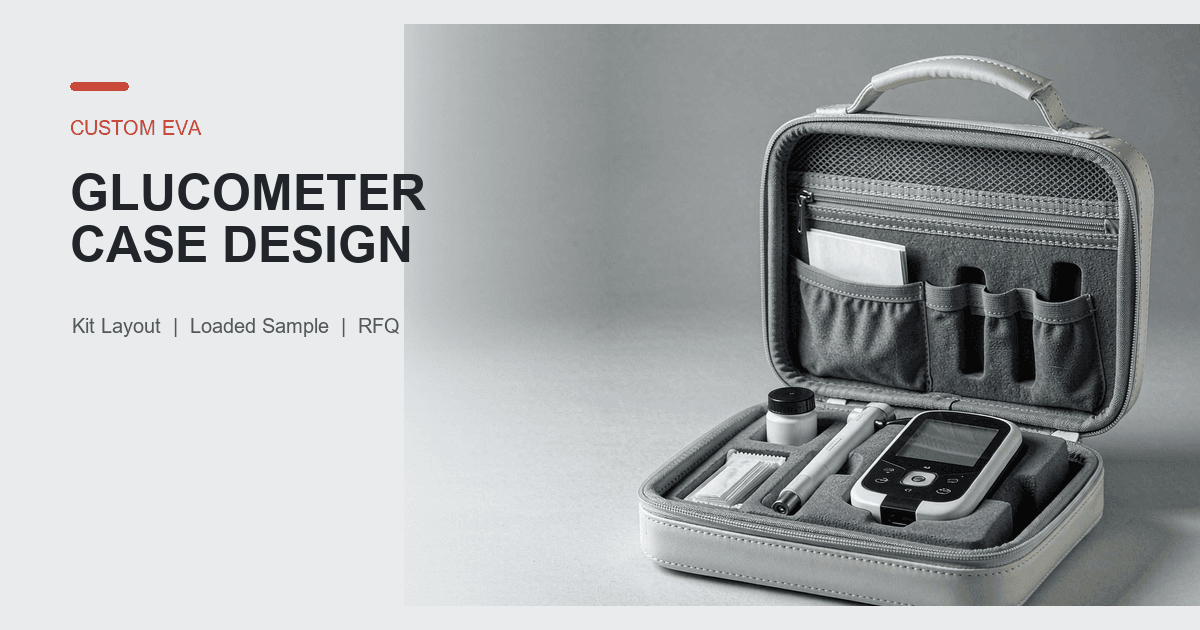
A custom EVA glucometer case should be developed around one approved device kit, not around the word "glucometer." The meter body is only one part of the load. The buyer also needs to define the test-strip container, lancing device, unused lancets, wipes, spare batteries, instructions and any replenishment stock that will ship or travel with the product.
For a device brand or sourcing team, the practical sequence is:
- Freeze the exact meter model, market SKU and clean kit contents.
- Separate the core device from clean consumables and excluded used items.
- Map the meter screen, buttons, strip port, battery door and grip areas.
- Arrange the kit around the intended test and replenishment sequence.
- Give every pocket, elastic loop, divider or shaped support a defined job.
- Check access, visibility, opening and zipper travel with the kit loaded.
- Confirm that lid contents do not press into the meter or consumables.
- Approve the physical sample against the exact kit and document revision.
- Keep ordinary sample observations separate from formal performance or regulatory evidence.
This process gives both sides a comparable RFQ. It also helps a supplier evaluate custom molded EVA cases without assuming that one generic organizer can support every glucose-meter platform or sales kit.
Freeze the Exact Device and Clean Kit
Start with the product configuration that will actually be sold, distributed or issued. A request such as "EVA case for a glucose meter" leaves the supplier guessing about the device version, consumables, quantities and intended use.
Create a controlled kit list with at least these fields:
- Meter brand reference, model and product revision
- Finished meter length, width, depth and weight
- Screen, button, strip-port, battery-door and connector locations
- Test-strip vial or packet dimensions and planned quantity
- Lancing-device dimensions and storage orientation
- Quantity and packaging of unused lancets
- Wipes or other clean preparation items, if included
- Spare batteries, cable, manual, quick-start card or logbook
- Outer retail packaging, labels and insert cards
- Items that are not included in the case
The final production device is normally the strongest fit reference. A size-accurate model can support early development. Controlled drawings or 3D data may also help establish geometry, but the buyer should identify the file revision and any dimensions that still require physical confirmation. The broader process for custom EVA case design from 3D models can support this input stage.
Do not combine different market kits under one approval record without checking the differences. One SKU may ship with a test-strip vial and lancing device. Another may add wipes, batteries, a cable or a larger instruction pack. Those changes can affect pocket depth, loaded closing pressure and the outside size.
Separate Clean Supplies From Excluded Used Items
A glucometer case is an organizer for the approved clean kit. It should not automatically be treated as a disposal container for used lancets, used test strips or other contaminated items.
The RFQ should state which clean items the case must organize and how the end-use workflow handles used items. If the project requires an additional disposal component, the buyer must define that component, its applicable requirements and how it interacts with the case. Do not ask an ordinary mesh pocket or fabric compartment to perform a job it was not designed or validated to do.
A useful kit map separates four groups:
Core Device
The meter should have a repeatable location and removal direction. Its display, buttons, strip port and other exposed features should not receive uncontrolled pressure from a pocket, elastic strap or accessory.
Clean Consumables
Unused lancets, test strips, wipes and other clean items need defined quantities and packaging. Their storage method should support visibility and replenishment without allowing small parts to migrate around the meter.
Replenishment Stock
The buyer should decide whether the case carries only the next-use set or additional stock. A deeper pocket may increase capacity, but it can also project farther into the base when the lid closes.
Excluded or Separately Managed Items
Used lancets, used strips, liquids, temperature-controlled medication and any item with a separate handling requirement should be identified as outside the ordinary case scope unless the project includes a specific, validated solution.
This boundary is important for B2B comparison. Two quotations are not equivalent if one supplier is pricing a clean device kit while another is expected to add an unconfirmed disposal or temperature-control function.
Map the Meter Before Drawing the Insert
The meter should not be reduced to a maximum-length rectangle. Map the finished device and identify where ordinary support may be evaluated and where the case should avoid concentrated contact.
Mark these features on the drawing or sample record:
- Display face and bezel
- Power, memory and navigation buttons
- Test-strip insertion port
- Data or charging port, if present
- Battery door
- Raised feet, clips or housing features
- Label, serial-number or barcode area that may need to remain visible
- User grip and finger-removal areas
- Surfaces that may accept normal support contact
- Areas that require project-specific clearance
The cavity, lining and retention method should follow the real geometry. The general method for EVA case dimensions and clearance can help organize the measurements, but the loaded physical sample should confirm fit, removal and closing behavior.
A finger recess may improve removal. Its position should follow the intended grip rather than an empty area in the drawing. If the recess exposes the screen edge, a button or the strip port, the user may apply pressure to the wrong feature when removing the meter.
Build the Layout Around the Use Sequence
The internal layout should reflect the order in which clean items are found and removed. For a compact kit, the buyer may want the meter, strip container and lancing device visible at the same time. For another program, the priority may be inventory control, compact retail packing or quick replenishment.
Review the sequence step by step:
- Open the case in the intended direction.
- Identify the meter without removing other items.
- Reach the test-strip container and lancing device.
- Remove a clean lancet or wipe without spilling the remaining stock.
- Return the device and supplies to repeatable locations.
- Confirm missing items through a visual check, if that is part of the project.
- Close the case without forcing the lid or zipper.
This is where a generic product photo is not enough. A mesh pocket can hold small parts, but it may hide inventory or sag toward the meter. An elastic loop can retain a tool, but the loop pressure and removal direction must suit the actual item. A divider can separate groups, but it can also consume usable width.
For the broader medical-product context, custom EVA medical case planning explains the category. This article keeps the task narrower: one glucose-meter kit, one intended sequence and one approved layout.
Assign One Job to Each Internal Structure
A glucometer case may use a shaped cavity, foam insert, molded support, elastic loop, mesh pocket, zippered pocket or divider. The correct combination depends on the kit, access task, case depth and sample result.
Use each component deliberately:
- A shaped cavity or molded support can locate the meter body.
- A foam insert can create controlled locations for the meter and rigid accessories.
- An elastic loop can retain a lancing device or vial when removal remains practical.
- A mesh pocket can organize flat or light clean supplies when loaded projection is controlled.
- A zippered pocket can reduce migration of small unused items.
- A divider can separate replenishment stock from the main device area.
- A printed or molded position marker can support kit identification when agreed by the buyer.
The EVA case foam insert guide covers the general insert decision. In this project, the buyer should ask which structure locates the meter, which one controls the test-strip container and which one prevents small consumables from crossing sections.
Avoid adding a feature only because it appears in a competitor listing. A thick lid pad, deep pocket or strong elastic strap can change closing pressure. The loaded sample should show that every component performs its intended organization task without creating an obvious conflict.
Control the Lid Load and Closing Path
Many compact kits place consumables in the lid. The layout can look clear while open and still create pressure when closed.
Test the planned quantity, not an empty pocket. Load the actual strip container, lancing device, unused lancets, wipes, batteries and printed materials in their assigned positions. Then close the lid slowly and review:
- Whether the lid contents project toward the meter
- Whether hard accessories align with the display or buttons
- Whether small packets gather in one corner
- Whether the zipper closes without unusual force
- Whether the lining or pocket edge catches on an item
- Whether the loaded lid changes the meter's position
- Whether an item crosses into another section when the case is held upright
- Whether the case reopens without a component falling out
If the buyer expects several replenishment quantities, define the maximum approved load. The sample should not be approved with two wipes and later packed with a much deeper stack unless the loaded interaction is reviewed again.
Closing resistance is an ordinary sample observation. It is not a compression test, zipper-life test or proof of protection. Formal evidence needs a separately agreed method, sample condition and acceptance criteria.
Review Opening, Access and Carrying Direction
The case should support the intended use without forcing the user to balance loose clean items or place the meter on an unsuitable surface during access.
Check these points on the sample:
- Required opening angle
- Whether the lid stays clear of the base contents during normal access
- Meter grip and removal direction
- Visibility of the strip container and lancing device
- Access to clean consumables without unloading the complete case
- Zipper-puller location when the case is open
- Handle position and loaded balance
- Behavior when the case is carried upright or laid flat
- Interaction between external labels and the carrying direction
A compact handle may be sufficient for one program. Another may use a wrist strap or no external carry hardware because the case sits inside a larger medical or travel bag. The RFQ should state the actual task rather than asking for every option.
Ordinary loaded carrying checks do not establish a certified handle load, drop result or transport performance. If the project requires formal evidence, the buyer must define the load, duration, method, sample condition and reporting requirement separately.
Approve the Fully Loaded Sample
An empty shell does not prove that the kit works. Approve the sample with the exact device and approved quantities of clean consumables whenever possible.
Use this review sequence:
- Confirm the case sample version, meter revision and kit-list revision.
- Load the meter, strip container, lancing device, unused lancets, wipes, batteries and documents.
- Check the meter's support, screen/button/port clearance and removal path.
- Remove and replace the meter through the intended hand movement.
- Access each clean supply in the planned sequence.
- Confirm that small items stay in their assigned sections during ordinary handling.
- Close the lid slowly and review projection, resistance and zipper travel.
- Carry and reopen the case in each intended orientation.
- Check logo, color, labels, instructions, unit packaging and packing orientation.
- Record pass, conditional approval or revision needed for each line item.
The general EVA case sample approval checklist can hold the wider record. Attach a glucose-meter kit sheet that identifies the exact device, clean consumables, quantities, layout and sample version used for approval.
If a change affects the meter housing, strip container, lancing device, consumable quantity, cavity, pocket depth, zipper path, material construction or packaging fit, evaluate whether a revised physical sample is required. An updated drawing may not reveal loaded contact or closing pressure.
This review confirms only the items observed under the agreed ordinary sample scope. It does not prove drop, shock, compression, water, chemical-cleaning, biological, temperature-control, sterilization, diagnostic or regulatory performance.
Build a Comparable B2B RFQ
A useful RFQ separates confirmed product inputs from open design choices.
Device and Clean Kit
- Meter model, revision and market SKU
- Physical sample availability or controlled drawing/3D revision
- Finished dimensions, weight and contact map
- Strip-container type, size and quantity
- Lancing-device size and orientation
- Unused lancet and wipe packaging and quantity
- Battery, cable, manual and additional clean items
- Explicit excluded items and separate handling requirements
Layout and Access
- Meter orientation and removal direction
- Screen, button, port and battery-door keep-clear areas
- Test sequence and replenishment sequence
- Pocket, elastic, divider, shaped support or insert preferences
- Maximum approved lid load
- Required opening and carrying orientation
- Visual inventory or labeling requirement
Materials, Branding and Packaging
- Outer material and color direction
- Lining and contact-surface direction
- Zipper, handle and hardware requirements
- Logo artwork, method, size and placement
- Labels, model/SKU identification and instructions
- Unit packaging, retail box and carton requirements
- Cleaning or material evidence requested by the buyer, if applicable
Approval and Evidence
- Loaded sample contents and quantity
- Measurement method and project-specific acceptance criteria
- Approved reference sample and document package
- Formal test requirements, if any
- Revision and re-approval rule
- Target order quantity and destination for quotation planning
Avoid an RFQ that says only "hard EVA glucometer case with mesh pocket." It does not define the device revision, clean kit, consumable quantity, contact map, access sequence, lid load or approval method.
How Pengtour Can Support a Glucometer Case Project
Pengtour can evaluate selected EVA medical-case projects using the actual product size, shape, opening, internal layout, insert or molded support, outer material, lining, zipper, handle, pocket, elastic strap, logo, packaging and sample requirements.
For a glucometer case project, the review can focus on:
- The confirmed meter and market-kit revision
- Meter contact, grip and keep-clear areas
- Test-strip container and lancing-device positions
- Clean consumable quantities and migration control
- Lid-pocket depth and loaded closing behavior
- Opening, access and carrying direction
- Logo, labels, instructions and retail packaging
- Loaded sample observations and revision records
The final structure, materials, acceptance criteria, evidence scope, MOQ, sampling schedule and production schedule depend on the confirmed project. The buyer-approved physical sample and final specification package can be used together as production and inspection references, subject to agreed tolerances and acceptance criteria.
To start a project review, request a custom case quote with the device model, clean kit list, consumable quantities, drawings or sample availability, layout task, artwork, packaging and required evidence.
Frequently Asked Questions
Can One EVA Case Fit Several Glucose Meter Models?
A shared outer shell may be evaluated, but each meter needs a compatibility record. Screen location, buttons, strip port, battery door, body profile and grip can differ even when maximum dimensions look similar. A shared platform may require separate inserts, labels or approved packing lists.
Can a Supplier Develop the Case From Drawings or 3D Data?
Controlled drawings or 3D data can support early structure development. The buyer should identify the file revision, finished dimensions and unresolved features. A physical device or size-accurate model is useful for confirming actual fit, removal, contact and loaded closure before approval.
Should Used Lancets or Test Strips Be Stored in the EVA Case?
An ordinary EVA organizer should not be assumed to be a sharps-disposal or contaminated-waste container. Define the case for the approved clean kit. If the workflow requires a separate disposal component, the buyer must specify and validate that component and its applicable handling requirements.
Does an EVA Glucometer Case Provide Medical, Sterile or Temperature-Control Performance?
Not by default. Material choice and ordinary sample fit do not prove medical-grade, sterile, antibacterial, temperature-control, waterproof or regulatory performance. Any such requirement needs a defined finished-product specification, test method, acceptance criteria and applicable evidence.