

1. What Information Is Required to Develop a Custom EVA Case?
When initializing a B2B hard shell case manufacturing project, submitting a comprehensive specification sheet for EVA cases prevents engineering bottlenecks. The foundational data needed falls into three major categories: physical product dynamics, environmental performance metrics, and aesthetic branding criteria.
-
Physical Dynamics: Engineers require the absolute dimensions and weight distribution of the device or equipment being housed. A common mistake is providing only the maximum length, width, and height, which ignores asymmetrical projections like dials, lenses, or handles. The total mass dictates the load-bearing requirements of the outer shell and the shock-absorption thresholds of the custom EVA foam inserts.
-
Environmental Metrics: The operational environment must be clearly defined. Will the case be used outdoors by field technicians, requiring an IP67-rated waterproof zipper and UV-resistant PU outer fabric? Or is it an internal medical device kit that requires an easily sanitizable, anti-microbial lining?
-
Aesthetic Branding: Branding elements must be specified early. Buyers should decide whether they require silk-screen printing, debossing, or a molded rubber logo badge, as certain options alter the exterior thermoforming mold design.
2. Designing an EVA Case Directly from a 3D Model
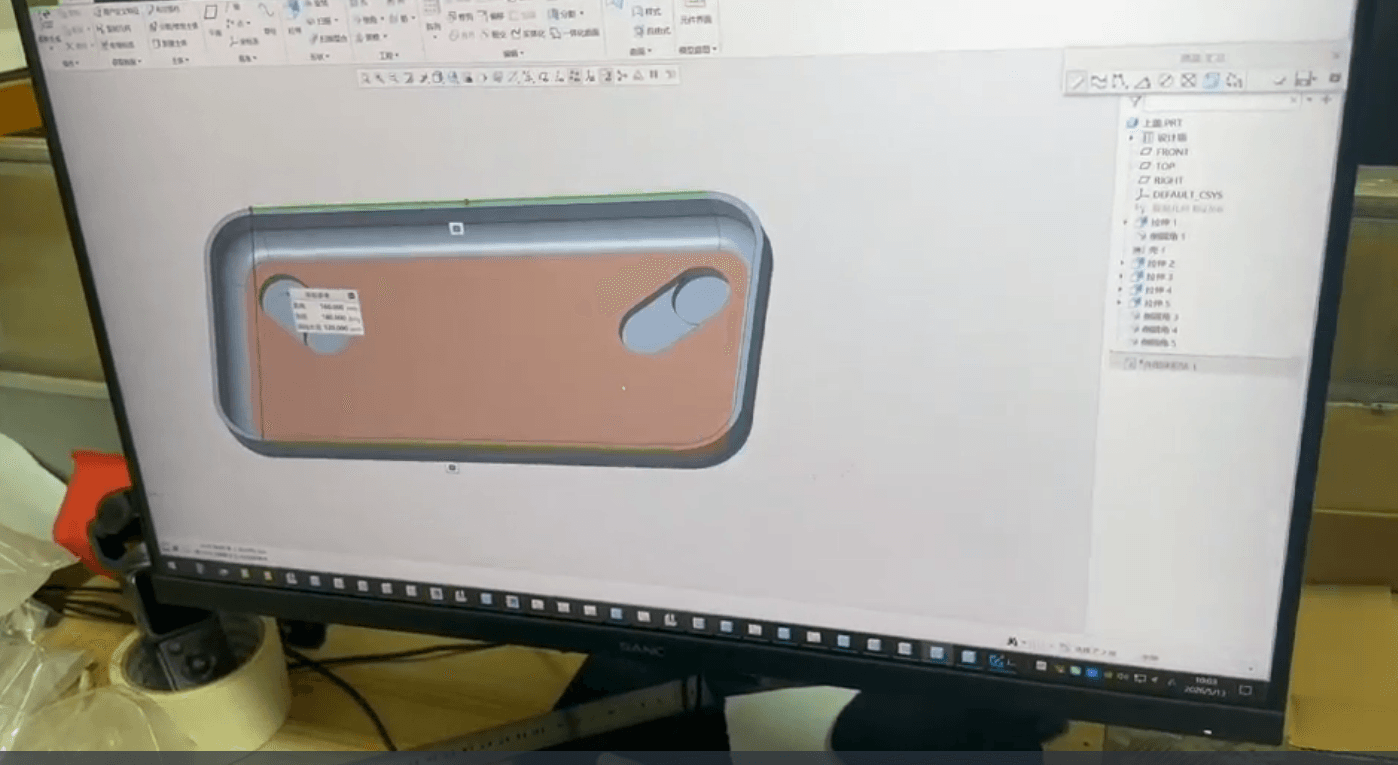
Industrial case manufacturers routinely execute custom EVA case design protocols using client-supplied digital assets. This process leverages reverse-engineering software to build a digitized enclosure around your virtual product.
Before moving from a digital model to sampling, buyers can review the custom EVA case design requirements that should be confirmed for structure, materials, branding, and packaging.
The design department utilizes native engineering files to construct the precision-molded interior. The most reliable file extensions for this workflow are STEP (.stp) and IGES (.igs), alongside native SolidWorks (.sldprt) files.
Once imported into CAD software, engineers isolate the product's outer boundaries and apply a calculated offset clearance—typically between 1.0mm to 2.0mm. This intentional gap accounts for the natural manufacturing tolerances of thermoformed polymers and the specific compression ratios of the foam, ensuring the item can be smoothly extracted from its seat without sacrificing friction-fit security.
For a broader fit-planning reference, review how custom EVA case dimensions, product geometry, and clearance should be confirmed before sample approval.
Furthermore, digital cross-sectioning allows designers to run virtual stress-distribution simulations. This digital engineering verification ensures that fragile nodes on your hardware, such as optical lenses or toggle switches, do not bear the brunt of an impact during a drop event.
3. Selecting Materials for Your Specification Sheet
Choosing the correct material matrix is essential to meeting your custom EVA case requirements. The table below outlines the industrial-grade laminates and interior foam linings used in professional protective packaging design.
| Layer Type | Material Option | Primary Technical Benefit | Common B2B Application |
| Exterior Fabric | Ballistic Nylon (1680D) | Extreme abrasion resistance, high tensile strength | Industrial tools, military gear |
| Exterior Fabric | Matte PU Leather | Water-shedding surface, sleek corporate aesthetic | Medical devices, high-end electronics |
| Core Structure | High-Density EVA (75C) | Rigid structural integrity, crush-proof barriers | Heavy calibration instruments |
| Interior Lining | Velvet / Multispandex | Scratch-free contact, soft tactile feedback | Optical lenses, handheld displays |
| Foam Insert | Cross-linked PE Foam | Rigid positioning, zero chemical off-gassing | Laser levelers, drone chassis |
4. Engineering Interior Foam Inserts for Multi-Component Kits
For equipment setups containing multiple components—such as a main unit, spare batteries, charging docks, and data cables—the interior layout requires strategic zoning. Custom EVA foam inserts must balance space optimization with structural wall thickness.
For projects organizing card decks, miniatures, and other small parts, see Pengtour's board game organizer guide for custom game card and toy EVA cases.
For broader insert-selection guidance, review the EVA foam insert guide for product inputs, accessory layout, access, loaded closure, and physical sample checks.
Engineering Case Study: When developing a custom case for a European handheld surveying instrument brand, the kit required housing a main device, tripod adapters, and three lithium-ion battery packs. By positioning the highly vibration-sensitive main unit at the geometric center within the CAD model and maintaining isolation walls of no less than 15mm around the perimeter, the final package successfully passed a rigorous 1.5-meter multi-angle drop test.
Our past engineering deployments confirm that maintaining a minimum wall thickness between adjacent cavity pockets is vital. For standard polyurethane (PU) or ethylene-vinyl acetate (EVA) foam blends, this partition wall should never drop below 12mm to 15mm. If the foam walls are too thin, structural failure occurs during repeated extraction cycles, leading to torn dividers and internal component collisions. For fragile diagnostic instruments, we recommend using closed-cell Polyethylene (PE) foam, which offers superior structural memory and chemical resistance against migrating industrial oils and solvents.
5. B2B Sourcing and Technical Specifications Checklist
To ensure your RFQ (Request for Quote) receives an immediate, accurate assessment from our engineering team, compile your data according to global manufacturing standards (such as ISO 9001 quality frameworks).
Ensure your technical brief addresses these core mechanical parameters:
-
Shell Hardness Rating: Typically requested between 65C to 80C Shore hardness depending on the rigidity required.
-
Fabric Denier: For nylon choices, specify 600D, 840D, or 1680D to dictate wear resistance.
-
Compliance Mandates: Highlight if your industry requires RoHS, REACH, or biocompatible Oeko-Tex certified interior linings.
According to the International Safe Transit Association (ISTA 2A) standards, the peak internal acceleration (G-value) for electronic protective packaging during a drop test should not exceed 80% of the device's own bearing limit. A high-density EVA composite structure combined with custom lining effectively absorbs up to 90% of impact kinetic energy.
With over 13 years of experience in custom EVA protective case manufacturing, our engineering team operates under a fully certified ISO 9001:2015 quality management system. We guarantee strict Non-Disclosure Agreements (NDAs) for all shared STEP/IGES 3D models. Submit your initial product dimensions and weight parameters today, and our design center will provide a preliminary layout feasibility report within 48 hours.
Custom EVA Case Requirements FAQs
What is the minimum data required to get an initial cost estimate?
We can provide a preliminary cost estimate using the basic external dimensions (Length x Width x Height) of your product, its approximate total weight, and the estimated annual procurement volume. However, formal production quotes require final 3D CAD files or physical samples.
Can you work with a 3D model if it contains internal component data?
To protect your proprietary technology, you do not need to share the internal schematics of your device. We only require the outer shell geometry (the external surface skin) of your product to design the custom EVA foam inserts.
What is the standard tolerance for thermoformed EVA cases?
Due to the thermal expansion and contraction of materials during compression molding, the standard industry tolerance for the external dimensions of an EVA case is ±2.0mm to ±3.0mm, while the interior custom foam cavities maintain a tighter tolerance of ±0.5mm to ±1.0mm.
Do you provide material certificates for international customs compliance?
Yes. All raw materials, including the EVA foam cores, surface fabrics, and adhesives, undergo rigorous laboratory screening. We provide full compliance documentation for REACH, RoHS, and halogen-free standards upon request.
For projects based on CAD models or reference samples, review our custom EVA case development options before finalizing the structure, materials, and sample requirements.