

Most buyers treat a quoted lead time as a single number. That number is never one thing. A custom EVA case project is a chain of separate segments, and each segment has its own starting point, its own owner, and its own failure modes. Two factories can both quote honestly and still give you numbers that differ by months, because they are counting different segments and counting them from different moments.
This becomes obvious once you look at what suppliers actually publish. One factory lists sample development at seven to ten days and bulk production at twenty-five to thirty-five days. Another lists prototyping at three to five days and mass production at fifteen to thirty days. A third gives a stage table running from eighteen to thirty-four weeks for the same scope of work. These are not all wrong. They are counting different things, and they are not telling you which parts you own.
The useful question is not "how long is the lead time." It is "what is this number counting, when does it start, and which segments sit on my side of the line." This guide covers that for custom EVA protective cases for electronics, audio equipment, medical and first aid devices, tools, cameras, drones and consumer products. Exact schedules depend on the confirmed structure, materials, tooling, quantity and approval status of each project.
A Lead Time Is Five Segments, Not One Number
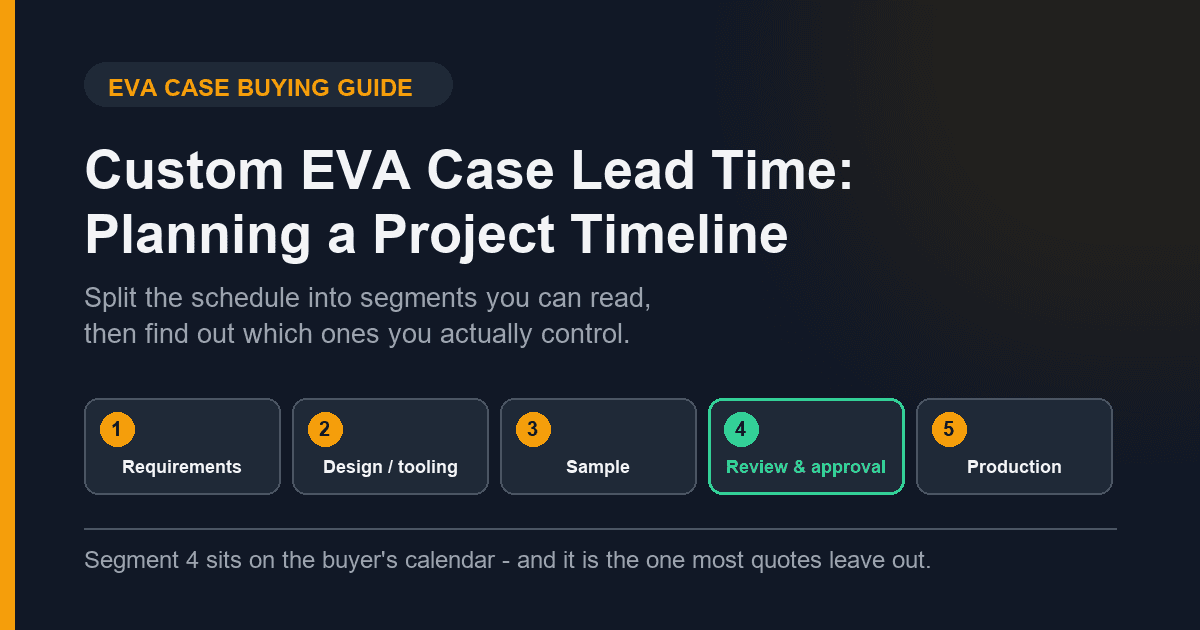
Once you split any custom case project into segments, the schedule stops being mysterious. Five segments cover nearly every project, from a first sample to a container leaving the factory.
Segment 1: requirement review and structural confirmation. Both sides establish what the case has to hold, how it opens, what goes inside, what materials apply and what the branding should be. Nothing has been cut yet. The duration of this segment depends mostly on how complete your input is and how fast decisions come back.
Segment 2: design, pattern or mold development. The case structure is developed so the product actually fits. Depending on the route chosen, this covers pattern work, model making or mold tooling. Tooling route decisions affect this segment more than any other factor, which is why it is worth resolving the tooling question before you commit budget.
Segment 3: sample development. The physical sample is produced using the confirmed structure. This segment expands once you account for material preparation, cutting, forming, stitching, logo application, insert fitting and checking.
Segment 4: sample review, revision and approval. The sample is tested with the real product, changes are requested, and a final version is approved. This is the segment buyers most often forget, because it is the one where the calendar is genuinely yours.
Segment 5: production preparation, manufacturing, inspection and packing. Production files are locked, materials are staged, manufacturing runs, pieces are checked and packed for shipment.
Nothing here is a promise about duration. It is the structure that any confirmed schedule must map onto, so you can tell which part of a quoted number actually applies to your project.
The Segment That Is Usually Missing: Long-Lead Materials
Most published timelines describe factory work. They rarely describe the part of the schedule that happens before factory work can start, and that part is often long.
Certain materials have to be sourced or produced to your specification, and they do not sit on the factory shelf:
- EVA foam in a specific colour or density
- Branded or custom zippers, pulls and hardware
- Specific exterior fabrics, coatings or laminations
- Custom lining, webbing or padding
- Specialized packaging, inserts or printed materials
When any of these are project-specific, they become procurement items with their own lead times, and they can start before tooling is even finished. A factory that quotes you a production schedule without asking whether your materials are custom may be assuming standard stock you do not have.
The practical move is to list your material requirements in the first RFQ rather than after the sample is approved. Material questions answered early let sourcing and design progress in parallel. Material questions answered late force them into sequence, and sequence is where schedules quietly expand.
Buyers who want a complete input list before contacting suppliers can work through a custom bag design brief so structure, materials and scheduling requirements start from one confirmed set of information.
The Segments You Control
Here is the part most timelines leave out. A meaningful share of a project schedule sits with the buyer, not the factory, and none of it shows up in a production lead time quote.
Reviewing the sample. A sample arrives and then sits. It may need to travel, be tested with the real product, be shown to a second stakeholder, compared against a competitor sample, or reviewed by legal if the case carries regulated claims. Each of those is calendar time you own. The sample approval checklist exists because most of this segment is wasted when nobody agrees on what "approved" means.
Running internal approval. Procurement, legal, brand and finance reviews add up. In larger organizations a change that needs three signatures can take longer than the factory takes to rebuild a foam insert.
Changing your mind. A revision requested after approval restarts work. The factory absorbs part of it; your launch date absorbs all of it. Some changes are cheap to make early and expensive to make late, which is the entire argument for deciding carefully during the first review rather than the third.
Confirming logistics. Booking freight, preparing documentation and arranging receiving are on your side of the line, and they happen whether or not the cases are finished.
Buyers who want a written record rather than a verbal "looks fine" can use our golden sample reference approach to shorten this segment.
How to Write Lead Time Into Your RFQ
A useful RFQ does not ask "what is your lead time." It asks questions whose answers you can check. These are the ones that reveal real schedules.
Ask what event starts each segment. If a factory cannot say whether sampling begins at requirement confirmation or after a deposit and design sign-off, the number is not usable for planning.
Ask which materials are standard stock and which are made or sourced to your specification. The answer tells you whether procurement sits inside or outside the quoted schedule.
Ask what the sample revision policy looks like in practice, including how many rounds are typically included before charges or timing change.
Ask what must be true on your side for the schedule to hold: an approved drawing, a confirmed logo file, a written approval of the physical sample, a confirmed quantity, a confirmed packaging requirement.
Ask whether the quoted schedule is measured from order confirmation, from sample approval or from deposit. These produce very different calendar dates from the same project.
Buyers who want a fuller RFQ structure can compare approaches in the custom headphone case pricing and RFQ checklist, which applies to case projects generally.
Why Two Quotes Can Differ by Months
Two suppliers quoting the same project can be both accurate and months apart. The usual reasons are structural, not deceptive.
Different counting start points. One quote counts from deposit, the other from approved sample. Add a sampling segment to the second and the gap appears for no reason other than arithmetic.
Different scope in the number. One quote covers development through production. The other covers production only, with development quoted separately or assumed already complete.
Different material status. One factory holds your specification in stock. The other has to source or produce it, and that sits ahead of manufacturing.
Different tooling route. Modifying an existing case and building new tooling are not the same schedule, and treating them as one number is the most common source of a bad comparison.
Different approval assumptions. One supplier assumes one review round with a decision. The other prices for a customer who takes three.
The fix is not finding a supplier who promises less time. It is normalising every quote onto the same segments before comparing them. Choosing between suppliers is a wider task than comparing schedules, and our custom bag manufacturing guide covers the other signals worth weighing alongside timing.
How We Quote Schedules at Pengtour
Our production team brings 13 years of hands-on experience in EVA case and sewn bag manufacturing. We quote schedules as segments with stated starting conditions rather than as a single headline number, because a single number hides exactly the information you need to plan.
Regular custom sampling typically takes approximately 7 to 15 days after requirements are sufficiently confirmed. Modeling, tooling, materials and complexity may affect the schedule. Mass-production lead time is confirmed for each project based on the product, materials, specifications, quantity, tooling, approval status and order requirements, and it does not begin counting before the applicable commercial and approval conditions are met.
In practice this means the quotation states which segments are covered, what each one starts from, and which parts of the schedule depend on inputs we need from you. If your project needs third-party inspection or testing before shipment, scope, standard, schedule, responsibility and cost are confirmed in advance rather than assumed.
Buyers who want the general picture of how a case moves through the factory can read our EVA case manufacturing process overview, which covers the production stages in sequence.
What to Ask Before You Commit to a Launch Date
Before you commit to a launch date, get these four things in writing.
The segment breakdown, with a start condition for each segment rather than one total.
The material status, separating standard stock from anything made or sourced to your specification.
The review expectations, including who signs off on your side and how long your own process typically takes.
The change terms, covering what happens to timing and cost if the structure changes after approval.
A supplier who answers all four clearly is giving you a schedule you can plan against, even when the absolute numbers are longer than a competitor's headline figure. If you want to see current capabilities and discuss a specific project, request a quotation with your dimensions, quantity, insert requirements and target timing, and we will map the schedule segment by segment.
FAQ
When does the lead time clock actually start?
It starts from different points for different segments, which is why one total number is rarely useful. Sampling generally starts once requirements are sufficiently confirmed. Production scheduling normally depends on approval status and order conditions, not on the date of first contact. Ask any supplier which event starts each segment, because two honest quotes can differ by weeks purely from where counting begins.
How do I find out what is driving the schedule in my project?
Ask three things in writing: which materials are custom rather than stock, whether tooling is new or adapted from existing tooling, and how many sample revision rounds are assumed. Those three answers explain most schedule variance between projects that look similar on paper.
What can I do on my side to shorten the overall timeline?
Most of it comes from the review segment rather than the factory segments. Provide complete dimensions, an accessory list, artwork and drawings in the first RFQ. Decide who signs off internally before the sample arrives. Test the sample against the real product the day it lands rather than a week later. Confirm packaging requirements early, because they touch materials. Each of these compresses the segments you control.
How should lead time be written into an RFQ?
Ask for a segment breakdown with a stated start condition for each segment, rather than a single total. Also state your own required inputs and target date so the supplier can tell you whether the schedule is feasible against your window. MOQ is a separate question: our custom bag MOQ guide covers how minimum quantities are confirmed per project, since quantity decisions affect both pricing and scheduling.