

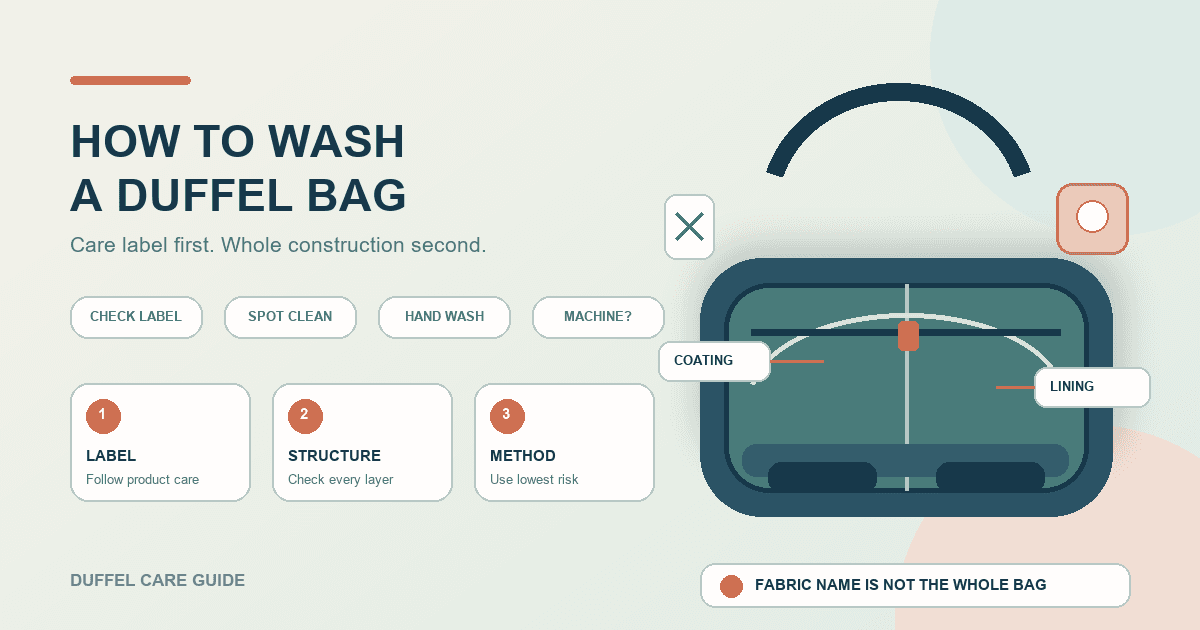
The safest way to wash a duffel bag is to start with its care label, then inspect the whole bag before choosing a method. The shell fabric matters, but it is only one part of the decision. A coating, lining, foam layer, printed logo, rigid base, wheel frame, leather trim, or bonded panel may rule out a wash method that the face fabric could otherwise tolerate.
If the label is missing or unclear, begin with the least invasive option: remove dry dirt, test a hidden area, and spot clean. Move to hand washing only when the full construction can tolerate water. Use a washing machine only when the product instructions explicitly allow it.
Key Takeaways
- Read the care label before using water, detergent, or a machine.
- Check the complete construction instead of relying on a nylon, polyester, or canvas shell label.
- Remove loose dirt and detachable parts before wet cleaning.
- Spot cleaning is the safer starting point when instructions are incomplete.
- Hand washing is not automatically safe for coated, padded, structured, printed, or wheeled bags.
- Machine wash only when the care label permits it and no component creates a conflict.
- Rinse away cleaning residue and let every compartment dry completely before storage.
- Brands should define the intended care method while selecting materials and approving samples.
Check the Care Label Before You Wash the Bag
The care label is the first source for the specific product. It may limit water temperature, detergent type, immersion, machine cycles, drying methods, or professional cleaning. Those instructions take priority over a general online guide because the manufacturer knows the materials and construction used in that model.
Do not infer machine washability from a material name alone. Two polyester duffels can use different coatings, backings, linings, padding, reinforcement, printing, adhesives, or base panels. One label may allow a gentle machine cycle, while another may call for surface cleaning only.
If the label allows machine washing, keep following the stated cycle and drying directions. If it prohibits immersion, do not substitute hand washing for machine washing and assume that the result will be safe. Both methods can saturate layers that were not designed to be soaked.
When the label is missing, faded, or ambiguous, contact the brand if possible. Otherwise, stay with dry debris removal and a small spot-cleaning test rather than escalating to a full wash.
Inspect the Whole Duffel, Not Just the Outer Fabric
A duffel is an assembled product. Before cleaning it, check what is attached to or hidden behind the shell.
Look for:
- a coated or laminated outer surface;
- a separate lining;
- foam or padding between layers;
- a rigid or semi-rigid base panel;
- cardboard or other moisture-sensitive inserts;
- screen printing, heat transfer, embroidery, patches, or bonded decoration;
- leather, suede, or contrasting trim;
- metal fittings that may react to prolonged moisture;
- wheels, telescoping handles, or a fixed chassis;
- removable shoulder straps, base boards, inserts, or organizers.
These parts can respond differently to water, agitation, detergent, and heat. A wheeled or structured travel bag, for example, may need surface cleaning even when a similar unstructured shell could be washed more thoroughly.
The same distinction matters in product design. A duffel's structure and usable space depend on the lining, padding, dividers, pockets, opening, and support components. Those features also affect how water enters, where residue can remain, and how long the bag takes to dry.
Prepare the Duffel for Cleaning
Preparation prevents small objects, trapped dirt, and detachable hardware from causing avoidable problems.
- Empty the main compartment and every pocket.
- Check corners, shoe sections, document sleeves, and hidden zip pockets.
- Shake out loose dirt outdoors or remove it with a low-suction vacuum and a suitable attachment.
- Brush away dried soil before adding water.
- Remove detachable straps, base boards, inserts, tags, or organizers when the product instructions permit removal.
- Note which parts need to be cleaned and dried separately.
- Close or position zippers according to the care instructions. Do not force a damaged zipper through a wash.
- Test the proposed cleaner on a hidden area and wait for the area to dry before continuing.
A spot test can reveal color transfer, finish changes, or adhesive problems on that small area. It does not prove that full immersion or machine agitation is safe for the entire bag.
Start With Spot Cleaning
Spot cleaning limits water and mechanical action to the area that needs attention. It is usually the lowest-risk wet method when the care instructions are incomplete.
Use a clean, soft cloth or a soft brush suitable for the surface. Apply a small amount of the cleaner permitted by the care label. Work gently from the edge of the mark toward the center so the dirty area does not spread. Avoid flooding seams, printed artwork, bonded patches, foam-filled panels, or hardware unless the product instructions allow it.
After lifting the soil, use a separate damp cloth to remove cleaner residue if the label permits. Repeatedly adding detergent without removing it can leave a visible or stiffened area.
Clean the lining separately when it can be pulled outward without stressing the seams. If it cannot, use as little moisture as the task allows and keep pockets open during drying.
When Hand Washing May Be Appropriate
Hand washing gives you more control than a machine, but it still exposes the bag to water. Use it only when the care label allows washing or the brand confirms that the full construction can be immersed or thoroughly wetted.
A cautious hand-wash process is:
- Use the water temperature and cleaner stated on the label.
- Wet the bag only as much as the approved method requires.
- Clean with light pressure rather than twisting, wringing, or aggressive scrubbing.
- Work through the lining and pockets without pulling them out of shape.
- Rinse until permitted cleaning residue is removed.
- Press out excess water with clean towels instead of wringing the bag.
- Open compartments and support the bag in its natural shape while it dries.
Do not assume that canvas always tolerates soaking or that nylon and polyester always tolerate hand washing. The coating, color treatment, backing, decoration, padding, and structure can change the answer.
Can You Put a Duffel Bag in the Washing Machine?
Only when the care label explicitly permits machine washing and the complete bag has no conflicting component.
Before using a machine, confirm:
- the allowed cycle and water temperature;
- whether straps and inserts must be removed;
- whether zippers should be open or closed;
- whether the bag needs a protective laundry bag;
- which detergent type is permitted;
- whether bleach or fabric softener is prohibited;
- whether the base, frame, wheels, decoration, coating, or trim can tolerate agitation;
- how the product must be dried afterward.
A fabric category is not permission. The phrase "polyester duffel" does not tell you whether the bag has a PU backing, foam laminate, cardboard base, heat-transfer graphic, or fixed wheel chassis. The label and construction must agree.
If one component conflicts with machine washing, choose the safer method for the complete product. A detachable part can be cleaned separately only if the instructions support that separation.
Rinse and Dry Every Compartment Completely
Cleaning is not finished when the visible stain disappears. Residual cleaner and trapped moisture can remain in folded seams, pocket corners, foam layers, zipper tapes, and the base.
Follow the label for rinsing. Do not keep saturating a surface that is meant to be wiped clean. For a washable bag, remove the cleaner without twisting the body or pulling the lining out of shape.
Airflow matters. Open the main compartment and pockets, position the bag so air can reach the lining, and dry detachable parts separately. Keep the bag away from unapproved high heat. Direct heat from a dryer, radiator, heater, or hair dryer can affect coatings, adhesives, foam, printing, and shape unless the product instructions specifically permit it.
Do not store the bag until the seams, lining, pockets, straps, and padded areas are dry. A surface can feel dry while a folded or padded section still holds moisture.
What About Odors?
An odor is a symptom, not a material specification. First remove the source: dirty clothing, spilled liquid, food residue, damp towels, or soil in a shoe compartment. Then clean the affected area by the approved method and dry the bag completely.
Avoid adding a strong fragrance to cover a smell before the source has been removed. Also avoid treating vinegar, baking soda, disinfectant, essential oil, or an odor spray as universally safe. These products can interact with dyes, coatings, adhesives, leather, metals, or printed surfaces. Use them only when the bag maker or the relevant cleaner instructions support that use, and test a hidden area first.
Daily packing habits reduce the cleaning burden. The guide to sorting wet and dirty gym items shows how to separate items before they soil the main compartment. Separation helps with organization and cleanup, but it does not make a pocket leakproof or odor-proof.
For Brands: Define Care Before Selecting the Final Construction
A brand that expects regular cleaning should write that expectation into the product brief before materials and details are approved. "Easy to clean" is too vague to guide a supplier or produce a useful care label.
Record the intended method instead:
- surface wipe only;
- spot clean with a specified type of cleaner;
- hand wash under defined conditions;
- machine wash only if the final construction is developed and verified for it;
- removable liner or insert cleaned separately;
- no immersion because of a frame, padding, bonded part, or decoration;
- air-dry position and parts that must remain open.
Then review each layer against that expectation:
|
Project Element |
Care Question to Resolve |
|
Outer fabric |
What exact fabric, denier, finish, backing, or coating is proposed? |
|
Lining |
Can it be reached, wiped, pulled outward, removed, or replaced? |
|
Foam and support |
Will padding or a base insert retain water or change shape? |
|
Decoration |
How will printing, embroidery, patches, or bonded logos respond to the intended method? |
|
Hardware |
Are zippers, buckles, hooks, rivets, wheels, or handles compatible with water and agitation? |
|
Construction |
Are there folds, enclosed seams, pockets, or layered panels that are difficult to rinse and dry? |
|
Care label |
Does the final instruction match the approved sample and material records? |
Cleaning expectations are one input to material selection, alongside appearance, abrasion needs, product weight, branding, target market, cost, and manufacturing feasibility. The guide to bag lining material choices explains why a lining request should remain a project question until the use, construction, and care method are defined.
Do not add a machine-washable claim because the face fabric appears suitable. That statement must match the finished bag, including the least tolerant component, and needs project-specific verification.
How Pengtour Supports a Project-Specific Care Requirement
Pengtour can evaluate selected custom sports and gym bag and travel-bag projects from buyer samples, drawings, dimensions, structure notes, material requirements, or a tech pack. The review can treat the intended care method as a project input rather than assuming one method for every duffel.
Depending on the design, the material record may need to identify the outer fabric, coating, lining, padding, base support, decoration, hardware, and removable parts. During ordinary sample review, the team can compare material and structural details with the approved specification and check visible construction, pockets, zippers, handles, layout, and closure under the agreed sample conditions.
This normal review does not prove machine-wash durability, colorfastness, coating retention, adhesive performance, corrosion resistance, odor control, or a fixed product life. If a project requires a cleaning-performance claim or a formal wash test, the method, sample construction, conditions, acceptance criteria, and responsible testing party should be agreed separately.
During custom soft bag development, keep the intended care method in the brief as materials and components change. A revised coating, lining, logo method, base insert, or hardware set may require the instruction to be reviewed again.
To discuss a project, request a project-specific quote with the bag's intended use, contents, target dimensions, materials, expected care method, reference sample or drawings, logo file, quantity, and packaging requirements.
FAQ
Can You Dry a Duffel Bag in a Dryer?
Only if the care label specifically permits it. Without that instruction, ventilation and air drying are the safer choice because heat and tumbling can affect coatings, foam, adhesives, printing, trim, and shape. Open all compartments and wait until padded and folded areas are dry before storage.
How Do You Remove Smell From a Duffle Bag?
Remove the source, clean the affected area by the method allowed on the label, and dry the bag completely. Do not assume baking soda, vinegar, disinfectant, fragrance, or an odor spray is safe for every finish. Test any permitted product on a hidden area first. Cleaning does not guarantee antibacterial, mold-resistant, or permanent odor-control performance.
Does Nylon or Polyester Mean a Duffel Is Machine Washable?
No. The fiber name describes only part of the product. A nylon or polyester duffel may also contain a coating, lining, foam, rigid base, adhesive, printed artwork, leather trim, metal hardware, or a wheel frame. Machine wash only when the instructions for the finished bag allow it.
What Should a Brand Specify for a Frequently Cleaned Duffel?
State the intended care method, expected soil or spill exposure, outer fabric and coating, lining access, removable parts, decoration, hardware, drying method, and any test or acceptance requirement. Review the final care instruction against the approved sample instead of copying a generic label from another bag.