

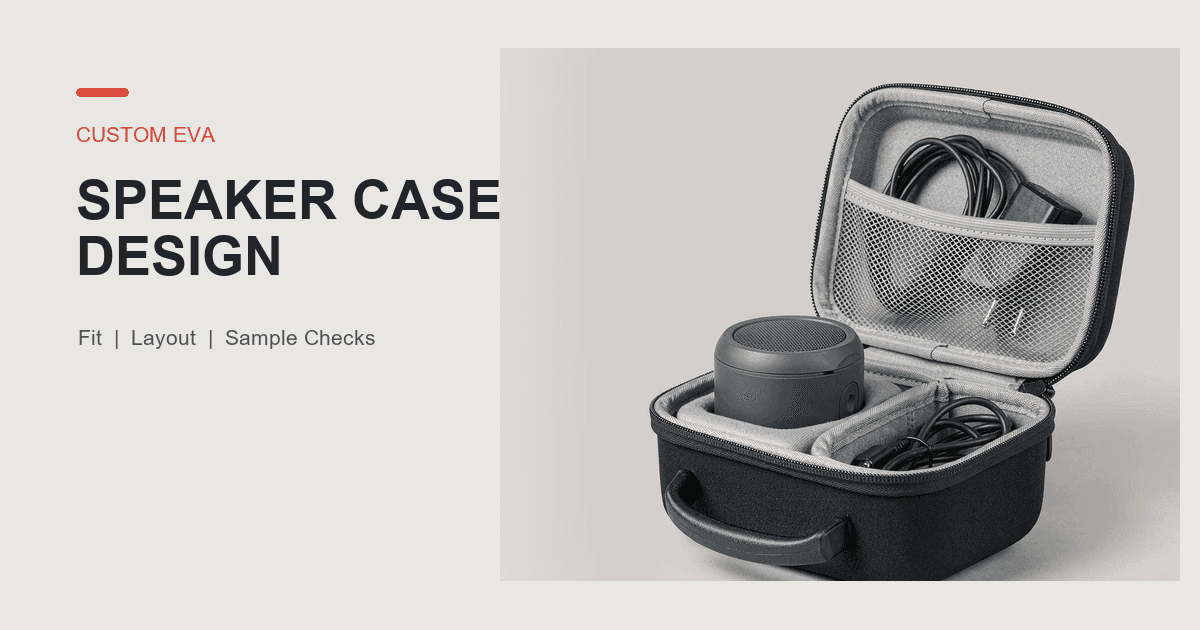
A custom EVA speaker case should be designed around one confirmed speaker model and its real accessory set. The shell outline alone is not enough. Buyers also need to define how the speaker sits, where the hand releases it, what touches the grille or controls, where the charger goes and how the case opens when fully loaded.
A practical sequence is:
- Freeze the exact speaker model, revision and accessory list.
- Choose the speaker orientation and removal path.
- Define contact surfaces, fit and project-specific clearance.
- Keep chargers, plugs and cables from pressing against the speaker.
- Select the internal support method for the actual shape.
- Review opening, zipper travel and carrying direction.
- Approve a loaded sample and record the applicable revision.
This approach gives a supplier enough information to evaluate a design. It also gives the buyer a clear basis for comparing custom EVA speaker case options without treating every cylindrical or rectangular speaker as the same product.
Lock the Exact Speaker and Accessory Set
Start with the item that must fit. A product family name is not precise enough because two speakers sold under a similar name may differ in controls, feet, charging ports, radiators, strap loops or overall shape.
Record these inputs before the cavity is drawn:
- Exact brand-neutral model reference or buyer model code
- Product revision, if more than one version exists
- Finished outside dimensions at the widest points
- Shape changes, corner radii, feet and raised controls
- Speaker grille and passive-radiator areas that should not take concentrated pressure
- Charging port, buttons and other sensitive areas
- Attached loop, strap or cable that remains with the product
- Charger, adapter, cable and other items supplied in the retail set
- Optional accessories that may be sold in another SKU
- Intended carry direction and retail packing arrangement
The best input is usually the final device sample. A size-accurate model or mockup can also support fit review. Controlled drawings or 3D data may be useful during development, but the buyer should identify the file revision and any dimensions that remain unconfirmed.
Do not combine accessory sets by assumption. If one market receives a wall adapter while another receives only a cable, the internal layout, packing list and approval record may need separate SKU treatment.
Choose the Orientation Before Drawing the Cavity
Orientation decides which surface carries the product, which side the user grips and how the case behaves when opened. It should be chosen before the cavity outline is finalized.
For a cylindrical speaker, the team may evaluate a horizontal or vertical position. A horizontal layout can provide a broad support path but may require enough end clearance for removal. A vertical layout may reduce the case footprint for selected shapes, yet the base, top controls and opening direction still need review.
For a rectangular speaker, check whether the product rests on a stable face or on buttons, a grille, feet or a connector area. An irregular speaker may need several controlled contact zones instead of a simple rectangular pocket.
Ask these questions on the drawing and sample:
- Which surface faces the bottom shell?
- Which areas can accept normal support contact?
- Which areas should remain free from concentrated pressure?
- Where will the user place a thumb or finger to lift the speaker?
- Can the speaker be removed without pulling a grille, strap loop or control?
- Does the product rotate or roll when the open case is moved?
- Will the lid or pocket contents touch the speaker when the case closes?
- Does the carrying direction change the resting position of the contents?
A clean CAD outline can still fail this task if it does not show how a person loads and removes the real product.
Define Fit, Clearance, Contact, and Removal
Fit is not a choice between "tight" and "loose." It is a relationship between the product shape, lining, support method, cavity, opening and removal task.
The case needs enough control to keep the speaker in its intended position during ordinary handling. It also needs enough usable space for loading and removal without scraping, pinching or pressing a sensitive area. The suitable clearance depends on the product, material stack, construction, tooling and acceptance method, so there is no universal number for every speaker case.
Mark the measurement points instead of giving one general length, width and height. Include protrusions, feet, switches, radiators and attached loops where they affect fit. Buyers can use the broader method to define EVA case dimensions, fit and clearance, then apply it to the exact speaker orientation.
Review four separate conditions:
Resting Fit
The speaker sits in the intended location without obvious rocking, unintended rotation or contact at the wrong feature.
Closing Fit
The lid closes without requiring the buyer to force a charger, cable bundle or speaker into position. Closing resistance should be reviewed with the complete accessory set.
Removal Fit
The user has a planned grip point or finger recess. The speaker can leave the cavity along a clear path rather than being pulled against a tight end wall.
Loaded Carry Fit
When the closed case is lifted in its intended direction, the product and accessories remain in their assigned areas during ordinary handling. This is a sample observation, not a formal performance result.
If the product sample changes, check the case again. A small change at a foot, button or end cap can affect the contact point even when the nominal body dimensions appear unchanged.
Separate the Speaker From Chargers and Cables
A charger is small, but it can become the hardest loose item inside the case. Its plug pins, corners and cable ends should not be left where they can press into the speaker, controls or grille when the case closes or changes orientation.
List each accessory and record its dimensions, quantity and normal packing state. A cable shown neatly coiled in a rendering may occupy a different volume when packed by a user. An adapter supplied for one region may also differ from the adapter used for another market.
Possible layout directions include:
- A lid mesh pocket for light, flexible items
- An elastic strap for a controlled accessory shape
- A separate molded recess
- A foam cavity for a defined charger or adapter
- A divider between the speaker and accessories
- A small removable pouch when the project calls for one
None of these is automatically correct. A lid pocket needs enough closed-case space and should not place a hard adapter over a sensitive speaker area. An elastic strap needs a defined item and retention direction. A molded recess needs a stable accessory specification. A divider needs enough height and support to keep the intended separation.
For a project with several electronic accessories rather than one speaker set, plan a broader electronics accessory layout. The speaker-case brief should remain limited to the items supplied with this product.
Before approval, close the sample with every listed item in place. Look for pressure marks, lid bulging, forced zipper travel, loose plugs and cable ends that cross into the speaker cavity.
Select the Internal Support Method
The internal structure should support the chosen orientation and removal path. It should not be selected from a photograph alone.
A project may evaluate molded or raised support features, a cut or formed foam insert, lining over a shaped base, elastic retention, a divider or a combination. Not every speaker case needs every component.
Use a molded support direction when the shell and internal geometry can create suitable contact zones for the product. Evaluate an insert when the accessory set, cavity detail or project requirements call for a separate internal part. Use pockets or straps only when their contents and movement are defined.
The design brief should state:
- Support locations and surfaces to avoid
- Cavity outline and depth references
- Product orientation
- Finger access or removal recess
- Lining direction
- Insert or support material to evaluate
- Attachment method for a separate insert, where applicable
- Accessory cavity, divider, pocket or strap location
- Approved product and accessory references
- Applicable tolerance and acceptance method
Buyers who need to compare insert structures can compare foam insert directions for EVA cases. For this project, the final decision still has to be checked with the actual speaker and loaded case.
Review Opening, Zipper, and Carrying Direction
The case is a moving system. Lid angle, hinge behavior, zipper travel and handle direction affect how the user reaches the speaker and whether loose accessories shift toward it.
Define the opening task:
- Does the case lie flat, open like a book or remain partly upright?
- Which side is the base when the zipper is opened?
- Should the lid stay clear of the removal path?
- Can the user see both the speaker and accessories when the case opens?
- Does a pocket face upward or release items toward the speaker?
- Does the zipper pass a tight corner or a thick internal area?
- Can the case close without pulling the zipper around a forced load?
Then define the carrying method. A handle, wrist strap or shoulder strap changes the direction in which the loaded contents settle. The suitable option depends on case size, total loaded condition, attachment area and intended use. Do not assign a load claim from the component name alone.
During sample review, observe zipper handling, corner operation, closing resistance, handle alignment and visible connection points. If the project requires a formal zipper, handle or load test, specify that method separately.
Inspect a Loaded Speaker-Case Sample
An empty sample can confirm appearance and basic construction, but it cannot show whether the complete retail set fits or whether accessories press into the speaker.
Use the final speaker, a size-accurate model or an agreed mockup, together with the realistic accessory arrangement. Record the sample revision and the items used.
Check the following:
- Molded shell shape and visible deformation
- Product orientation and contact areas
- Fit at the widest points and protrusions
- Finger access and removal clearance
- Lid angle and hinge behavior
- Basic zipper operation and corner handling
- Closing resistance with all accessories loaded
- Charger, adapter and cable separation
- Pocket, strap, divider and insert position
- Lining condition and visible pressure marks
- Handle or strap direction and connection appearance
- Logo placement, color coordination and labels
- Unit packing and accessory count
- Open items, revision comments and approval status
Photograph the open empty case, the loaded base, the loaded lid, the closed case and the normal removal step. Mark the sample version in the file name or review record. Photos support review, but they do not always replace a revised physical sample when the change affects fit, shell shape, cavity, opening, zipper path or another important functional detail.
The approved physical sample and final specification package can together serve as the main production and inspection references, subject to the agreed tolerances and acceptance criteria. If a drawing conflicts with the approved sample, clarify which version controls before production preparation.
Use the full EVA case sample approval checklist for color, logo, packaging and revision control beyond the speaker-specific checks above.
Separate Fit Review From Formal Performance Testing
A loaded sample review can reveal an obvious fit problem, accessory collision, difficult removal, forced closure or visible deformation. It does not prove drop, shock, vibration, water resistance, zipper life, load capacity or transport performance.
When formal evidence is required, define the test before approval:
- Exact sample and construction revision
- Product and accessory load
- Test method and equipment
- Drop surface, orientation or conditioning where applicable
- Number of samples and repetitions
- Measurements or observations to record
- Pass/fail criteria
- Test responsibility and report requirement
- Whether a design change requires retesting
For projects that need a drop-test program, define electronics-case drop testing separately. A successful fit check remains useful, but it answers a different question.
Write the Speaker-Case RFQ
A useful RFQ should include:
- Speaker model code and revision
- Real sample, 3D data, drawings or mockup available
- Product dimensions with defined measurement points
- Sensitive surfaces, controls, grilles, radiators and ports
- Complete accessory list by sales SKU
- Preferred product orientation and removal direction
- Areas that may support the product and areas to avoid
- Internal support, insert, pocket, strap or divider direction to evaluate
- Opening style, zipper direction and intended base side
- Handle, wrist strap or shoulder strap requirement
- Outer material, lining and color direction
- Logo artwork, size, location and process to evaluate
- Unit packing, labels and carton-mark requirements
- Sample review steps and approval method
- Project-specific tolerances and acceptance criteria
- Required formal test scope, if any
- Quantity, destination market and schedule requirement
Avoid an RFQ that says only "hard EVA speaker case with cable pocket." It does not identify the speaker revision, accessory set, orientation, pressure-sensitive areas, removal path or approval rule.
How Pengtour Reviews Speaker-Case Requirements
For eligible custom speaker-case projects, Pengtour can evaluate the product size, shape, opening, internal layout, lining, foam insert or molded support direction, zipper, handle, pocket, strap, divider, logo, packaging and sample requirements.
The review can begin from a real speaker, a final device sample, a size-accurate model or controlled drawings and 3D data. The suitable input depends on the development stage and the risk of unconfirmed dimensions. Materials, geometry, tolerances, testing, MOQ and timing are confirmed for the individual project.
During physical sample review, the buyer and factory can check fit, removal clearance, opening angle, closing resistance, zipper path, lining, insert, accessory layout, handle direction, logo, labels, packaging and ordinary loaded-use experience. Important changes to the shell, cavity, fit, opening, material construction or tooling may require a revised physical sample.
To start, send the speaker model and case requirements for review. Include the available product reference, accessory set, drawings, target layout, branding, quantity, destination market and any defined test requirement.
FAQ About Custom EVA Speaker Case Design
Can a speaker case be developed from drawings instead of a physical speaker?
Controlled drawings and 3D data can support development, especially when the product is not yet available. The buyer should identify the file revision and any unconfirmed dimensions. A final device sample, size-accurate model or agreed mockup is still useful for checking contact, closing and removal before approval.
Can one EVA case fit several speaker models?
It may be possible when the models share a compatible size, shape and contact plan, but the fit must be reviewed for every listed model. Record the largest and smallest conditions, controls, protrusions and removal path. Do not approve a multi-model claim from outside dimensions alone.
Is a mesh lid pocket suitable for the charger?
It depends on the charger's size, hardness and position above the loaded speaker. A mesh pocket may suit selected light accessories, but a hard adapter can press into the product or force the lid if the closed-case space is not controlled. Review the exact charger and packing state in the sample.
What can a buyer provide without an in-house case-design team?
Provide the speaker or accurate product data, the accessory list, intended carrying task, branding files, quantity, destination market and any packaging or test requirement. A supplier can then evaluate layout directions, but the buyer should still approve the chosen orientation, fit, sample revision and acceptance criteria.
Key Takeaways
- Freeze the exact speaker revision and accessory set before drawing the case.
- Choose orientation from contact, opening and removal tasks.
- Define fit and clearance by measurement points, not a universal number.
- Keep hard chargers and plugs from pressing into the speaker.
- Select inserts, supports, pockets and dividers for the actual loaded set.
- Review zipper travel, lid behavior and carrying direction together.
- Approve a documented loaded sample and control its revision.
- Keep ordinary fit review separate from formal performance testing.
- Put product references, layout, acceptance criteria and test scope in the RFQ.