

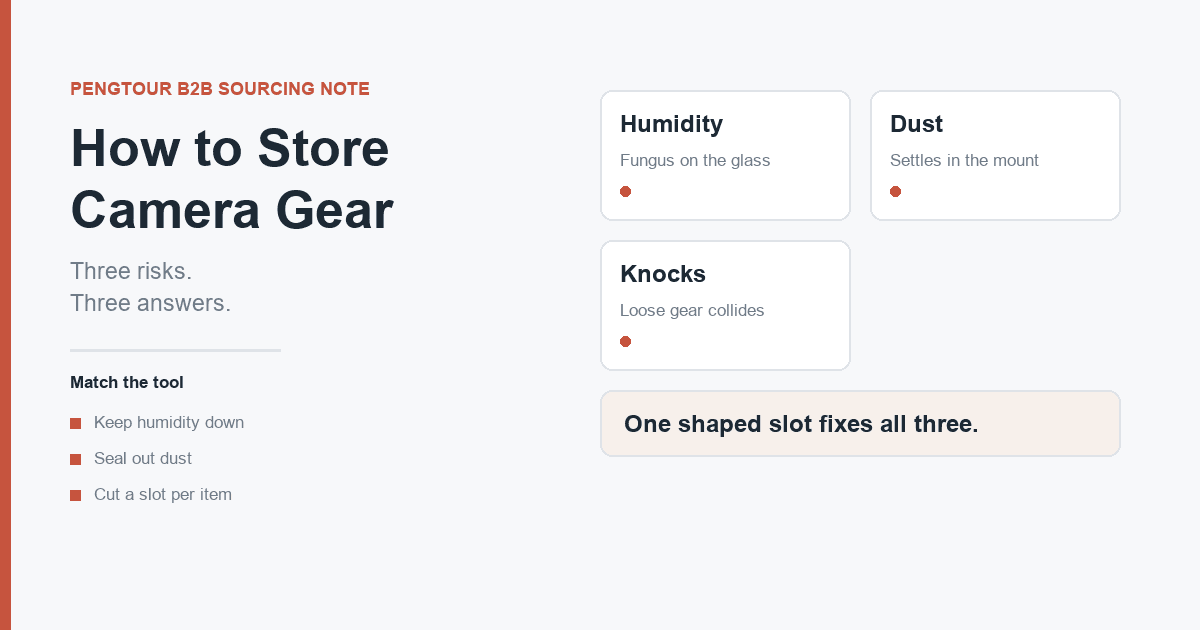
Stored cameras fail from three things in this order: humidity, dust and knocks. None of them announce themselves. A lens grows fungus over a quiet winter, dust settles into a mount you only open in spring, and a body sitting loose on a shelf meets a bag that tips over.
The fix is not a bigger cabinet. It is a short set of habits matched to the real hazards, and a container that holds each piece in a place of its own. Most of the advice online stops at "keep it dry and put a cap on the lens." That is true and incomplete. This page goes one step further: it turns each storage decision into something you can measure, and then into a case or insert you can order.
Know the Three Hazards Before You Buy Storage
Humidity is the one people get right in theory and wrong in practice. The problem is not the camera getting wet. It is relative humidity sitting high enough, for long enough, that fungus grows on glass coatings. A body or lens left in a 60% plus room for a season is the classic starting point for permanent optical damage. A sudden temperature drop adds condensation on top of that, which is why a cold bag brought into a warm room should stay closed while it warms.
Dust is quieter and spreads. It is not a one-time wipe but a running exposure, and the worst of it lands where you cannot see it: inside the mount, around buttons, under a lens cap left off.
Knocks are the one everyone understands but nobody prevents. A lens without a rear cap, a body stacked under a heavier lens, or two metal bodies touching in a shared bag all invite the one careless move that decides the rest.
Each hazard calls for a different answer. A cabinet solves humidity, a good seal and a clean surface solve dust, and a shaped slot solves knocks. Buy for the hazard you actually have.
Set the Environment, Then Add the Case
Measure before you spend. A cheap hygrometer left for a week tells you the room's real range, and the range matters more than any single reading. If the space stays below about 50% on its own, a clean ventilated shelf is plenty. If it climbs past 60% for part of the year, humidity control earns its cost.
Dry cabinets hold a set relative humidity, which is why pro kit lives in them. Desiccant works only inside something with a good seal, and it works only while someone recharges or replaces it on schedule. A pack tossed loose into an open box is decoration, not protection.
Three rules that survive every climate. Keep gear off the floor, away from outside walls and out of direct sun. Do not seal wet or cold gear inside a bag and leave it, because that traps the moisture you are trying to avoid. And take batteries out of anything that will sit unused for a while, so a leaking cell cannot eat a body from the inside.
Temperature, once extremes are avoided, matters less than people think. A stable, moderate room beats a heated cabinet if the heated one swings. The target worth aiming for is a consistent 40 to 55% relative humidity and a steady temperature that a person would keep anyway.
Give Every Lens a Place, Then a Case
The habit people skip is the one that prevents the most damage: every lens has a rear cap and a home. Detached lenses set on their sides, each in its own slot, never rattle. Two lenses in the same soft pouch is a gamble, because the glass of one rests against the barrel of the other.
A hard case with a custom insert changes that. The insert holds each body, lens and battery in a cavity cut to its outline, so nothing moves when the case is carried, stacked or opened. The cavity does the work that caps and discipline do alone, and it works the same on the hundredth use as the first. What a divider bag cannot stop, a shaped cavity mostly does.
Where inserts earn their keep are the deep, small items. A body released from its mount, a lens with a protruding front element, a flash kept on its side, a fragile eyepiece. The tool here is the same one that ships instruments and test gear: custom EVA protective cases with a foam core, an outer skin and a lining, holding a layout cut to your exact kit.
Order the Same Way You Use the Gear
The layout should follow the sequence you reach for things, not the alphabet. What you grab every time sits near the opening. What travels once a season sits deep. This sounds like tidying and it is also protection: the less digging, the fewer knocks.
Small parts are the real test. Batteries, cards, filters and straps vanish in a big empty volume, so give them shallow dedicated slots of their own. A slot that is exactly the size of the item also tells you, at a glance, what is missing.
Label from the start. A slot marked for a body, a filter or a spare battery turns the case into a checklist that is checked every time it closes. That one habit catches a forgotten rear cap better than any reminder.
Turn the Habit Into a Case Spec
Most photographers stop at the habit. This section is for the one who needs the habit to travel, to scale, or to become a product.
The storage need translates into a case the same way a kit list translates into an RFQ. The first question is what actually lives together: the body, which lenses, which chargers, whether the case must hold everything or travel light enough to carry. The second is access, because a case that protects but fights you every time you open it gets overridden. The third is the insert, because the cavities decide the protection more than the shell does.
Where a brand or a distributor comes in, the same logic scales. A rental house needs a layout its staff can inspect at a glance. A kit seller needs a boxed arrangement that presents well and survives shipping. An action-camera maker needs a co-kit with every mount in its own cavity, which is the exact problem the custom action camera case design guide walks through step by step: freeze the kit, group it, then map the kit into a custom case layout before anyone cuts foam.
The deliverables that matter on a custom job are a dimensioned list of what goes in, a note on access and carrying direction, and a sample filled with real gear. A photo of the layout is a start. A spec sheet with cavity depth and position is what survives a repeat order.
Store It, Then Check It, Not Instead of It
Storage is not a vault you fill and forget. The gear that comes out in six months should come out the way it went in, and the only way to know is to open it on purpose.
A simple rhythm does it. Inspect glass under light for haze or spots when the season changes. Cycle batteries so none sit deeply discharged or fully charged for months. Wipe surfaces dry before they go back in. Keep the humidity indicator visible and check it when you add or remove gear, not on a schedule you will forget.
None of this is about proving the case is sealed or waterproof. A storage case protects against day-to-day dust, humidity and handling. It does not, by itself, guarantee performance in a crash, under water or in transit, and no visual check produces that data. If a customer or a channel needs drop, ingress or climate results, that is a separate agreed test with a recorded outcome.
How Pengtour Approaches a Camera Storage Case
Pengtour is an OEM and ODM manufacturer of custom EVA protective cases and sewn bags. Camera is the first entry in its product line, so a storage case or insert is a normal ask rather than an edge case.
For a camera storage project, options that can be developed include an outer material, an EVA structural core, an inner lining, a zipper and a handle, with a foam insert cut to the customer's kit. What changes from project to project is the exact list of equipment, the access direction, whether the case travels or stays on a shelf, and the level of protection the customer needs. Dimensions, density, cavity layout and materials are confirmed per project, not quoted as a fixed formula.
Two things a storage case is not. It is not a humidity controller, so a case and a dry-cabinet plan work together rather than replacing each other. And it does not carry a performance guarantee unless a specific protection level is agreed and tested. For that, custom EVA case development starts from the gear list and the storage conditions, and a quote follows from the confirmed layout. To hand over your kit list and storage conditions directly, send the gear list for a case review.
FAQ
Should I store lenses attached to the camera body?
For short gaps it is usually fine, and it keeps the mount sealed. For anything longer, detach both when clean rear and body caps are available: it lowers strain and makes inspection easier. Either way, protect the mount from dust, and follow what your specific camera's manual says for its own components.
Is a dry cabinet necessary, or is silica gel enough?
It depends on your room's humidity, which you should measure rather than guess. If the space stays under about 50% on its own, silica in a well-sealed case with a charging routine can be enough. If the room climbs past 60% for stretches, or the collection is valuable, a dry cabinet that holds a set level is the more reliable answer.
Do I need a hard case if I only shoot once in a while?
The less often gear comes out, the more storage does the work, because dust and humidity do their worst in idle months. A hard case with a shaped insert is most worth it for the occasional shooter who will not notice a problem until long after it lands. A shelf in an open bag protects against almost nothing over a season.
Can the same case hold different lenses if I change my kit?
That is why custom inserts work. A cavity should be cut to the item, so when a lens changes, the insert changes with it. Rather than a universal foam that fits nothing well, the more practical path is a layout built from the current kit and updated when the kit does, which is a normal part of a custom order rather than a special request.
Key Takeaways
- Humidity, dust and knocks cause stored camera damage, in that order, and each calls for a different answer.
- Measure your room's humidity for a week before buying anything, and target a stable 40 to 55%.
- Every lens deserves a rear cap and its own slot; a shaped insert in a hard case does what caps and discipline cannot.
- Lay out the case in the order you use the gear, and cut exact cavities for the deep, small items.
- Turn the habit into a spec only when it must travel, scale or ship: a dimensioned gear list, an access note and a sample filled with real gear.
- A storage case protects against everyday hazards. It is not a humidity controller and it does not prove drop, water or transit performance without an agreed test.