

When comparing webbing straps for bags, start with the strap's job, not a fiber name. A carrying handle, an adjustable shoulder strap, and a short hardware loop may all use webbing, yet each one has a different job to do. The finished weave, hardware path, sewn attachment, use conditions, and hand feel can matter as much as whether the fiber is nylon, polyester, or polypropylene.
For a sewn functional bag, define the strap role first. Then compare material candidates and check the complete assembly on a sample. The aim is to give everyone evaluating the project a clear RFQ and give your team something specific to review.
What should buyers decide before comparing webbing materials?
Before comparing webbing for bags by fiber, write down what each strap does on the finished product. Do this before requesting swatches or choosing a material from a catalog.
Define the strap's job
- For a carrying handle, note how it will be picked up, folded, attached, and held.
- For a shoulder or crossbody strap, look at adjustment, contact with the user, hardware movement, and how the strap sits while the bag is carried.
- An adjustment tab needs to fold and pass cleanly through its slider, buckle, hook, or other fitting.
- A reinforcement or attachment loop needs a defined connection to the bag structure, including the stitch line and fold position.
- A decorative or accessory connection needs a clear visible finish, color, edge, and relationship to labels, trims, or accessories.
The same fiber can be made into very different finished webbings, so the material name is only one line of the specification. Include the strap location, expected handling, and the hardware or bag panel it connects to.
When the strap belongs to a larger sewn bag project, define it alongside the bag structure and intended use. Pengtour's functional bags page covers that broader product context. This guide stays with webbing selection and sample decisions.
Record the use conditions
The development team also needs to know:
- how the bag will be handled and carried;
- where the strap may rub against clothing, skin, hardware, or another panel;
- whether use is mainly indoors, outdoors, or across changing environments;
- whether the preferred hand feel is soft, firm, smooth, or structured;
- whether color, appearance, logo placement, or surface finish is part of the requirement;
- whether the strap must pass through a specific fitting or fold into a defined attachment.
These notes do not prove performance. They identify which candidates to compare and which questions still need a specification or test. An "outdoor" label, for example, is not proof of waterproofing, UV resistance, or abrasion life.
Nylon vs. polyester vs. polypropylene webbing: what changes the choice?
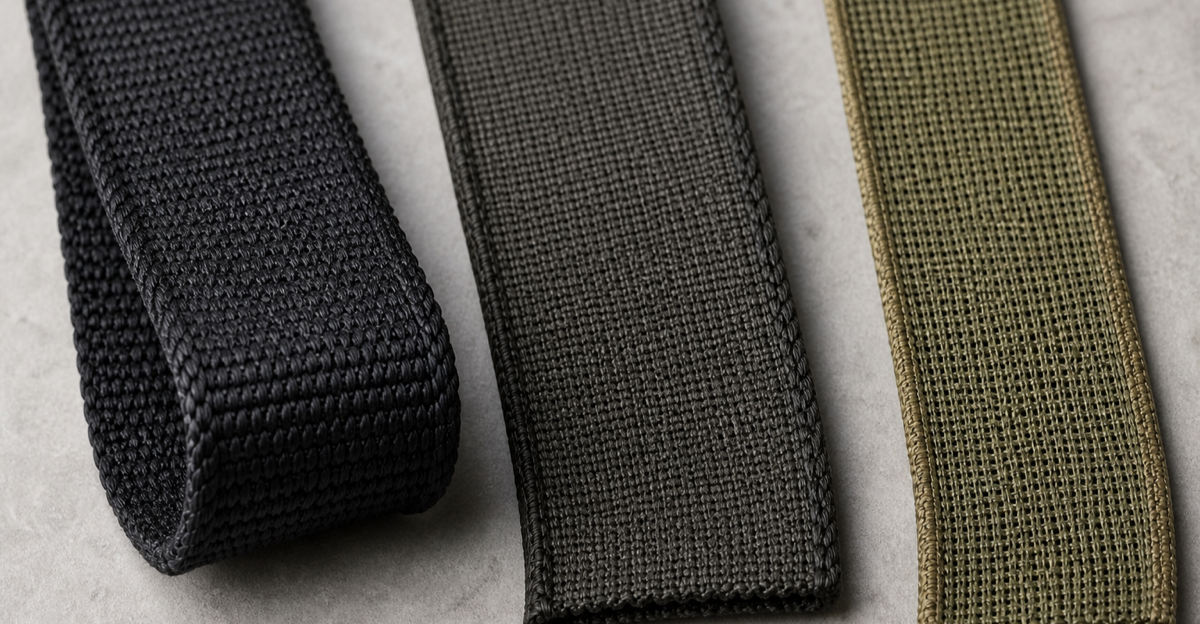
There is no material winner for every bag. Nylon, polyester, and polypropylene are starting candidates, and the right comparison depends on the finished strap and its use.
National Webbing makes the same point in its nylon vs. polyester webbing comparison: fiber alone does not define the finished webbing. Width, thickness, yarn, weave, edge construction, finishing, stitching, hardware, and service conditions can change the result. This is general comparison guidance, not a specification for a particular bag.
Nylon webbing as a candidate
Nylon often enters the discussion when some flexibility, movement, or a softer hand may suit the product. It generally has more elasticity than polyester. That movement can work in a dynamic assembly, but it may be a drawback when an adjustment needs to stay highly stable.
During development, check how much movement is acceptable, how the strap feels in the hand, and whether the selected weave and thickness fold cleanly through the hardware. The sewn assembly matters too. Edge construction and stitching can change how the material behaves after it is attached to the bag.
"More elastic" should not become a fixed stretch percentage or load rating. It also does not prove that nylon is stronger or weaker in every construction. Review the exact webbing and the complete assembly.
Polyester webbing as a candidate
Polyester is often compared when lower stretch or more stable positioning matters. Buyers also review it for products that may encounter moisture or changing outdoor conditions. The exact webbing, finish, construction, and test method still determine whether it meets the project requirement.
Ask whether stable adjustment matters more than a softer, more elastic feel. Record the moisture, cleaning, or environmental conditions the product must address, and check the surface wherever it touches the user or hardware. If a property matters to acceptance, define how it will be specified or tested instead of assuming it from the fiber name.
Polyester is not automatically waterproof, abrasion-proof, UV-proof, or suitable for every outdoor product. Each of those requirements needs its own method and acceptance standard.
Polypropylene webbing as a candidate
Polypropylene may be worth comparing when low weight, surface feel, or another project requirement points in that direction. Treat those points as questions for the actual construction. The weave, edge, hardware interface, and sewn attachment still need review.
On a sample, check whether the hand and appearance suit the product, whether the material folds and passes through the intended hardware, and whether it remains comfortable and visually consistent after stitching. Strength, wear, color, and environmental requirements need project-specific evidence when they are part of acceptance.
Keep polypropylene as a candidate until the finished construction has been reviewed. A general material description cannot replace the product specification.
Material comparison table
| Material candidate | Questions it may help answer | Finished-webbing variables that can change the result | Confirm during sampling |
|---|---|---|---|
| Nylon | Would controlled flexibility or a softer hand feel help this strap role? | Weave, yarn, thickness, edge, finish, hardware path, stitching | Hand feel, adjustment behavior, folding, attachment and use movement |
| Polyester | Would lower stretch or more stable positioning better fit the design? | Weave, thickness, finish, moisture exposure, hardware, stitch construction | Position stability, surface response, hardware passage and environmental requirements |
| Polypropylene | Would low weight or a particular surface feel support the product? | Weave, edge, finish, folding, hardware interface, stitch attachment | Appearance, hand feel, folding, passage and any required project tests |
Use the table to frame a comparison, not as a fixed performance chart. Request the exact construction and any applicable test or acceptance information for the sample being reviewed.
Which finished-webbing details affect strap fit and function?
Two webbings made from the same fiber can feel and function differently once they are folded, threaded through hardware, and sewn to a bag. A workable specification needs more than the fiber name.
Weave, thickness, hand feel, and edge construction
A roll sample may look right but feel too stiff after folding, too soft around a fitting, or uncomfortable against the user. Record the candidate weave, approximate thickness range, hand feel, and edge appearance, then check those details in the intended assembly.
Words such as "soft," "firm," "smooth," and "structured" are useful starting points. Pair them with a swatch, photograph, physical reference, or sample comment. They are not measurable specifications until the project defines how to check them.
Width and thickness as hardware-fit decisions
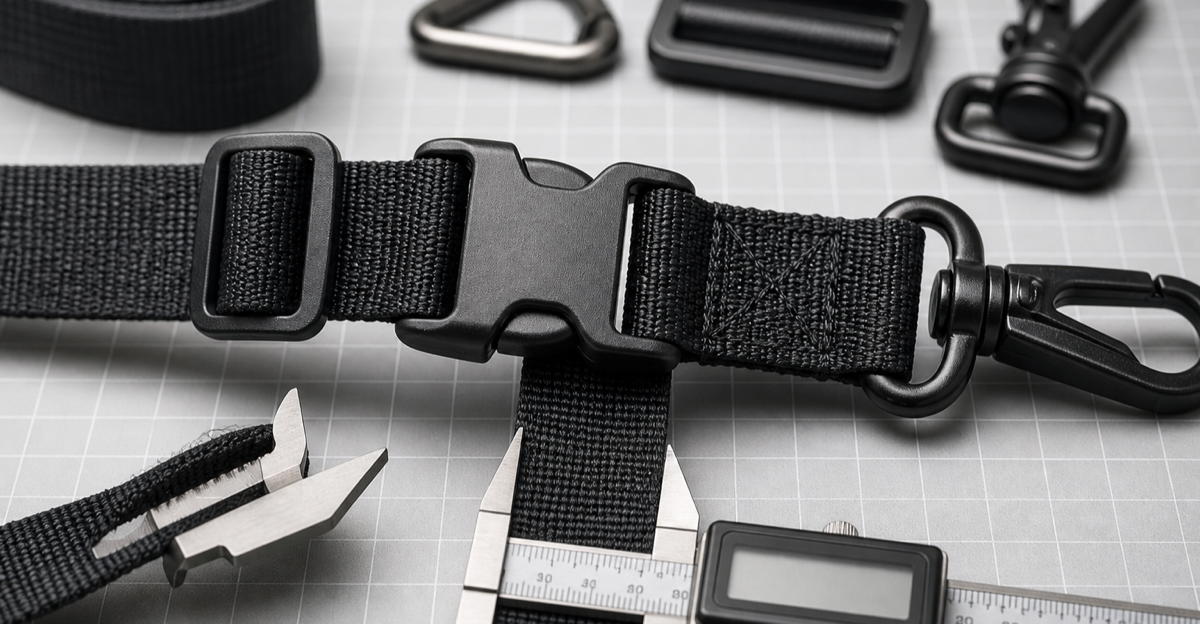
Width affects hardware passage, adjustment, folding, stitch placement, and the transition into the bag panel. Thickness changes how easily the webbing moves through a slider or buckle and how much bulk builds up at a folded end.
Rather than copying a generic width chart, check the clear opening in the selected hardware, the number of layers at each fold, and the planned stitch and reinforcement positions. Review comfort and appearance on the same sample. Confirm final width and thickness against the exact hardware and assembly.
Color, surface, and finish requirements
Record the color reference, visible face, logo or print position, and any finish that needs review. If the project uses a color standard, name the approved reference and inspection method. Do not promise a tolerance until one has been agreed.
Stitching, reinforcement, and attachment geometry
Webbing is only one part of the strap assembly. Folds, stitch paths, reinforcement pieces, hardware, and the bag panel all affect the finished result. Pengtour's stitching and seam reinforcement guide looks more closely at stress points and seam construction. For the webbing specification, include the attachment geometry from the start.
What should a webbing strap RFQ include?
The RFQ should describe the strap as part of the bag. Quoting a fiber name alone leaves too many construction decisions open.
| RFQ field | Buyer input | Why it matters | Confirm when |
|---|---|---|---|
| Bag use and strap role | Carrying handle, shoulder strap, adjustment tab, loop, or accessory connection | Establishes the job before material selection | At brief creation |
| Material candidates | Nylon, polyester, polypropylene, or another candidate | Keeps the comparison open until the project conditions are known | Before sample request |
| Width and thickness candidates | Proposed range or reference sample | Affects hardware fit, comfort, folding, and stitch placement | With hardware and sample |
| Weave, hand feel, and edge | Smooth, firm, soft, structured, edge reference | Translates the visual and tactile expectation into review points | During material review |
| Color, logo, and surface | Color reference, print or logo position, finish | Protects appearance and branding requirements | Before approval |
| Hardware interface | Buckle, slider, hook, ring, and clear passage dimensions | Determines whether the strap can fold, adjust, and move cleanly | Before assembly sample |
| Attachment and reinforcement | Fold, stitch path, reinforcement concept, panel location | Connects the strap decision to the bag structure | During construction review |
| Reference files | Sample, drawing, image, tech pack, or written notes | Gives reviewers a traceable comparison point | Before quotation or sampling |
| Sample observations | Appearance, hand feel, passage, movement, attachment, comfort notes | Converts physical review into actionable comments | During sample review |
| Tests or acceptance requirements | Requirements still to be confirmed | Prevents ordinary observation from being mistaken for formal testing | Before final approval |
You may not have every answer at the first contact. That is fine as long as the open fields are visible. The table separates settled decisions from items that still need a sample, specification, or discussion.
How should webbing straps be reviewed during sampling?
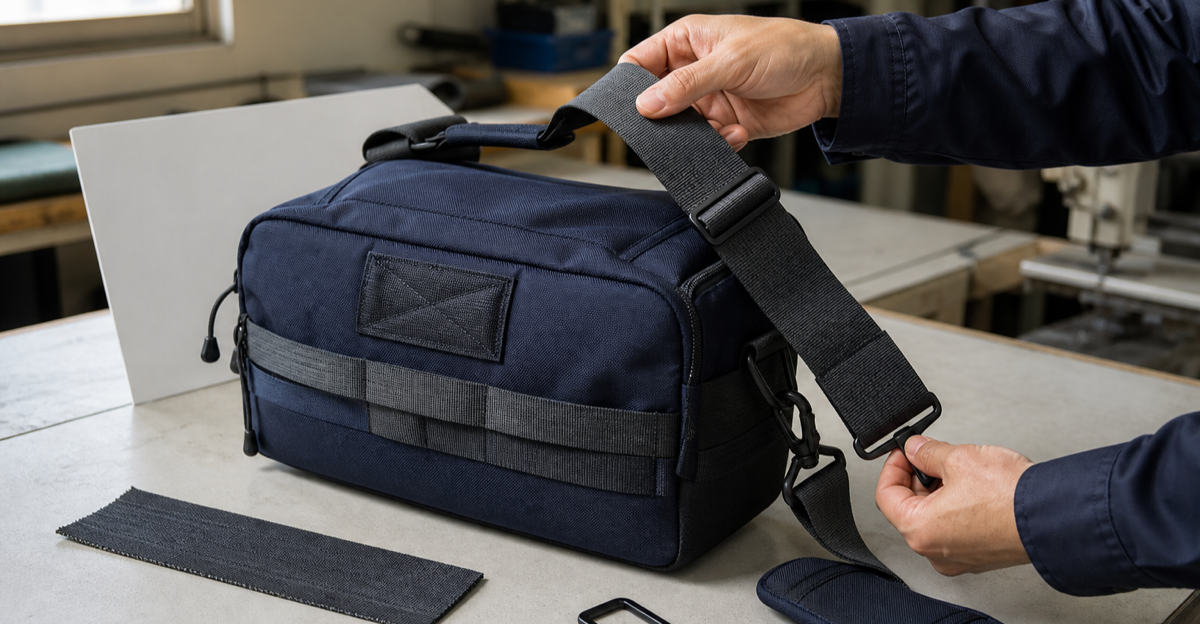
Review the loose material, the strap with its hardware, and the strap on the complete bag. A webbing sample can look acceptable by itself and still create problems after folding, stitching, or adjustment.
Step 1: Review the material or webbing sample
Compare the sample with the approved reference. Look at:
- visible color and surface;
- hand feel and edge appearance;
- candidate width and thickness;
- visible weave consistency;
- any finish, logo, or marking requirement.
Write down what you observed and what still needs measurement. Visual and tactile checks do not establish breaking strength, abrasion life, waterproofing, colorfastness, or compliance.
Step 2: Review the strap and hardware together
Thread the candidate webbing through the intended fitting. Check that it clears the hardware, folds without unwanted bulk, and adjusts as intended. Watch for edges that catch, twist, or interfere with the buckle or slider. The attachment and reinforcement should also sit in the planned position.
This assembly check often exposes fit or handling problems that are not visible on a loose swatch.
Step 3: Review the strap on the complete bag
Compare the attachment with the drawing or reference sample, then handle the bag as intended. Does the strap move, fold, and adjust correctly? Is it comfortable, and does it sit cleanly with the bag structure? Look at the webbing, hardware, seam, reinforcement, and panel as one assembly.
List any use or testing questions that the sample cannot answer. A bag sample supports a construction decision, but it is not a laboratory test or proof of a fixed load rating. These observations also do not amount to an AQL inspection or 100% inspection.
Step 4: Record the decision and open requirements
Keep the sample version, reference files, comments, decision, and unresolved items together. The record may include:
- the approved material or finished-webbing reference;
- the drawing, photo, or written specification used for comparison;
- the hardware and attachment configuration;
- comments that require revision;
- tests, tolerances, or acceptance standards still awaiting agreement;
- whether updated documents are enough for the next decision or another sample is needed.
For the wider sewn bag process, use Pengtour's sample approval checklist. The quality control checklist covers product checks beyond this webbing-specific review.
What must be confirmed before production preparation?
Before production preparation, the project record should identify:
- the selected material and finished-webbing reference;
- the candidate dimensions and hardware interface;
- the color, surface, finish, and approved visual reference;
- the fold, stitch, reinforcement, and attachment details;
- the approved sample, drawing, or written specification;
- any project-specific testing, tolerance, or acceptance requirements.
For a specific sewn bag project, Pengtour can evaluate materials, handles, accessories, structure, and samples. Depending on the project, Pengtour can assess customization options for materials, colors, logos, zippers, handles, internal components, accessories, and packaging. Production preparation may follow after the relevant samples, drawings, or written specifications are approved. Scope, documents, timing, commercial terms, and acceptance requirements must still be confirmed for each project.
When preparing an RFQ, share the bag use, strap role, material or dimension candidates, hardware details, reference files, and any open testing or acceptance questions. Review the functional bags product scope, or request a project quote when those inputs are ready.
Source for material context
This source provides general comparison context. It does not replace the specification, sample review, test method, or acceptance criteria for a particular bag project.