

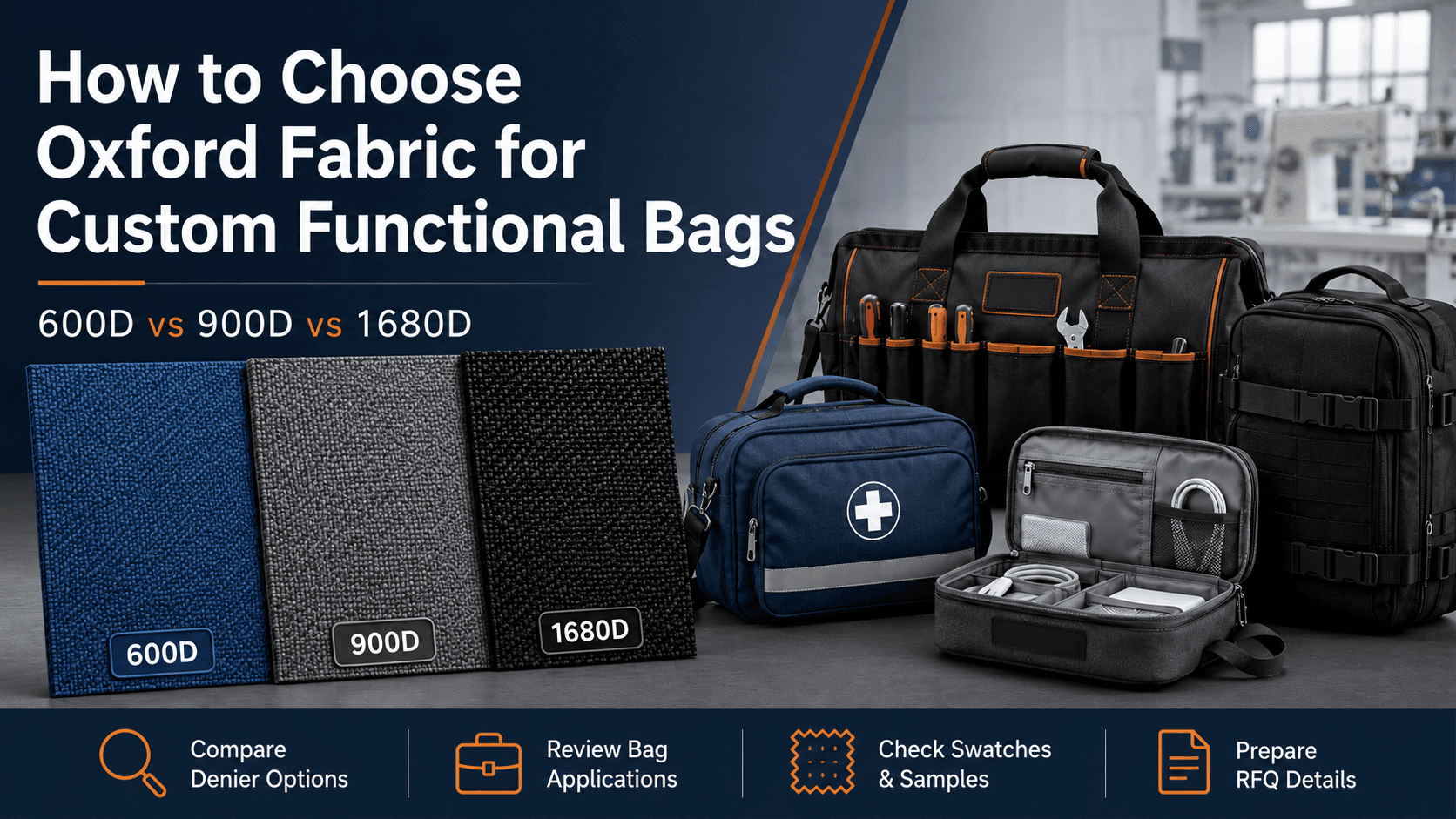
Choosing Oxford fabric for bags should not start with denier alone. For a custom functional bag project, 600D, 900D, and 1680D Oxford fabric can all be candidate options, but the right direction depends on the bag structure, intended use, coating, hand feel, lining, accessories, material availability, and manufacturing review. Pengtour can evaluate 600D, 900D, and 1680D Oxford fabric as candidate materials for custom sewn bag projects, subject to material availability, bag structure, intended use, and manufacturing review. Buyers can also provide samples, photos, dimensions, structure notes, or a tech pack before the final material direction is confirmed.
Pengtour can evaluate 600D, 900D, and 1680D Oxford cloth as candidate fabrics for custom bag projects, based on fabric availability, bag construction, intended use, and production process. Buyers can also provide samples, photos, dimensions, construction specifications, or technical data packages before finalizing the fabric selection.
Answer Summary
For B2B buyers, when selecting Oxford cloth for packaging, they should consider the intended use, denier, fiber, weave, weight, coating, lining, sewing, accessories, and inquiry requirements.
A higher denier number is not necessarily better. 600D Oxford cloth may be more suitable for lightweight or ordinary practical bags, 900D Oxford cloth is suitable for occasions that require stronger structure, while 1680D Oxford cloth can be used for heavier applications.
The final selection should depend on material availability, sample review, structural review, and project-specific testing requirements.
Key points summary
-
While the denier number of Oxford cloth is useful, it does not determine the performance of the finished bag.
-
600D, 900D, and 1680D Oxford cloth should be considered as candidate materials, rather than universally recommended materials.
-
The coating, lining, stitching, zipper selection, handles, padding, and bag structure all affect the final result.
-
Buyers should review the actual material color chart and finished product samples before approval.
-
The inquiry details should include: bag type, size, intended use, quantity, material preference, color, coating requirements, marking process, testing requirements, and packaging or accessory requirements.
-
Claims regarding waterproofing, abrasion resistance, tear resistance, load-bearing capacity, or durability should be supported by tests or reports specific to the project.
Is Oxford cloth suitable for making bag fabric?
Oxford cloth is often used as the outer fabric for sewing bags, but it is not a material with a fixed performance level.
In custom bag projects, "Oxford cloth" typically refers to a fabric structure or weave. The base fiber may vary, and the finished fabric's denier, weight, coating, surface feel, color, and backing may also differ.
For buyers purchasing Oxford cloth to make bags, the key point is that the fabric is only one part of the finished bag. Even if the fabric is the same, its performance will differ once it is combined with the lining, foam, filling, stitching, zippers, webbing, handles, hardware, binding, and the final bag structure.
Buyers can also refer to the comparison between PU leather and Oxford clothin this EVA headphone case product example when comparing the woven fabric outer layer and the smoother synthetic leather surface .
The final material selection still needs to be reviewed based on the current packaging bag design and usage requirements.
How can Oxford cloth be used in custom-sewn functional bags?
In custom-stitched practical bags, Oxford cloth is often considered as an outer or visible fabric layer.
It may meet requirements for appearance, structure, durability, and cost, but it does not define a complete product. The final effect of a medical bag, tool bag, sports bag, electronic product organizer, or travel organizer may also depend on internal compartments, reinforcement measures, padding, zipper layout, carrying method, and actual loading method during use.
Therefore, the selection of materials should be linked to product design, not just the material name.
Why can't performance be determined solely by denial?
Denier describes the thickness of yarn, and is therefore very useful when comparing 600D, 900D, and 1680D Oxford cloth.
However, denier value alone cannot determine whether a finished bag is suitable for a specific purpose. A higher denier value may affect the bag's thickness, weight, feel, stiffness, and durability, but the performance of a finished bag also depends on the fiber type, weave density, weight per unit area, coating, lining, stitching, filling, accessories, and end use.
For example, heavier fabrics may make a bag more sturdy, but they may also increase weight, affect folding, change the difficulty of sewing, or make the finished product feel too stiff for another project.
If buyers require a softer feel, lighter weight, easier folding, or more convenient packaging, then lighter fabrics may be more suitable.
For a more detailed understanding of the relationship between yarn size and material structure (rather than as a direct performance guarantee), buyers can refer to this guide on fabric denier and durability.
Denier number can affect the thickness, weight, stiffness, and feel of a fabric.
Buyers can compare 600D, 900D and 1680D as candidate materials, but they should not assume that the higher the denier number, the better the quality of each bag.
Fibers and weaving
Fibers and weaving methods can affect the surface feel, stability, appearance, and strength of a fabric.
Buyers should verify the actual fabric structure, as Oxford cloth should not be considered as a single fiber or a single fixed specification.
Weight and thickness
Weight and material thickness can affect the weight, shape, and appearance of the finished bag.
If possible, buyers should view actual material samples rather than relying solely on the stated denier number.
Coating
Coatings can affect the surface finish, feel, odor, and water resistance of materials.
PU, PVC, and other coating options should be determined based on the specific project requirements. Coating should not be the sole criterion for determining the waterproof performance of a finished bag.
Lining and padding
Linings and padding can affect protective performance, the shape of the bag, and the user's internal experience.
These components should be selected according to the carried items and bag structure. The outer fabric alone should not carry the complete performance claim of the finished product.
Stitching and Accessories
Stitching, zippers, handles, webbing, hardware, binding, and reinforcement may affect load handling, durability expectations, and usability.
Buyers should review these components together with the outer fabric. Load capacity or durability values should not be claimed without relevant project testing or reports.
Surface Condition
The surface condition can influence appearance and sample approval.
Material review may include cleanliness, stains, yarn defects, coating consistency, color consistency, and general surface quality. However, the exact inspection requirements should be confirmed for each project rather than treated as one universal standard.
If a project needs formal waterproof, abrasion, tear, or load claims, those claims should be confirmed with project-specific requirements and relevant reports.
A practical guide to materials for bags and cases also explains that material selection should be considered together with construction and use requirements. This is why Oxford fabric should be treated as one part of the complete bag specification.
600D vs 900D vs 1680D Oxford Fabric: How Buyers Should Compare Them
For custom functional bags, 600D Oxford fabric, 900D Oxford fabric, and 1680D Oxford fabric should be compared as candidate material directions.
All three options can be reviewed for custom sewn bag projects when the intended use, structure, and material supply conditions are clear.
The goal is not to rank them from worst to best. The better question is which option fits the bag's use environment, carried items, target appearance, structure requirement, cost direction, and sample approval criteria.
600D Oxford Fabric as a Candidate Option
600D Oxford fabric may be considered for regular functional bag projects where buyers want to balance weight, appearance, cost, and manufacturability.
Possible application directions include tool bags, medical bags, first aid kit bags, sports bags, electronics organizer bags, and travel organizer bags.
For these projects, buyers should review whether the material provides enough body and reinforcement for the carried items. Some heavier-duty structures may require additional padding, lining, webbing, reinforcement, or an alternative material direction.
These are candidate applications only and must be reviewed according to the actual project.
900D Oxford Fabric as a Candidate Option
900D Oxford fabric may be considered when a project needs more structure than a lighter fabric direction may provide while still requiring a practical balance of weight, cost, and sewing feasibility.
Possible application directions include sports backpacks, outdoor bags, large-capacity organizer bags, and functional bags that require a more structured body.
Buyers should review material, stiffness, sewing details, coating, lining, and accessory compatibility before confirming 900D Oxford fabric.
The final use depends on the actual design and material review.
1680D Oxford Fabric as a Candidate Option
1680D Oxford fabric may be reviewed for heavier-duty functional bag projects, such as heavy-duty tool bags, equipment bags, wheeled travel bags, medical equipment bags, or sports equipment bags.
This does not mean that 1680D is always the better choice.
It may provide a stronger or more structured appearance, but it can also increase weight, stiffness, material cost, sewing difficulty, and construction requirements.
Buyers should review whether the heavier material is compatible with the zipper, handle, webbing, hardware, lining, reinforcement, and intended carry method.
Practical Comparison of 600D, 900D, and 1680D
A 600D Oxford fabric may be suitable when the project needs to balance weight, cost, flexibility, and appearance. However, it may not provide enough body for some heavier-duty bag structures without additional reinforcement.
A 900D Oxford fabric may be reviewed when the buyer wants more body and structure than a lighter fabric may provide. However, material availability, stiffness, sewing feasibility, and cost should still be confirmed.
A 1680D Oxford fabric may be reviewed for equipment bags, heavy-duty tool bags, wheeled travel bags, or other structures where additional body may be useful. However, the additional weight, stiffness, cost, and construction impact must be considered.
None of these materials should be selected only by denier. Each option requires project-specific confirmation.
After comparing the candidate materials, buyers can review Pengtour's custom functional bag options to identify which bag category is closest to their project before requesting a material review.
How Different Oxford Fabric Options May Fit Selected Functional Bags
Oxford fabric selection becomes more useful when it is connected to the bag type.
A fabric that works for a soft organizer may not be the right choice for a tool bag. A material direction that looks strong on paper may also create weight, folding, sewing, or accessory issues during production.
The following application directions should be treated as starting points for discussion rather than fixed recommendations.
Tool Bags, Medical Bags, and First Aid Kit Bags
A 600D Oxford fabric may be reviewed when the project needs to balance usability, weight, and cost.
However, buyers should also review the carried items, reinforcement requirements, internal structure, zipper design, and carry method.
For bags carrying heavier tools or medical equipment, the factory may recommend additional reinforcement, padding, a stronger base structure, or another material direction.
Sports Bags, Electronics Organizers, and Travel Organizers
A 600D Oxford fabric may support regular functional use and a more flexible bag structure.
The final result may depend on the surface effect, lining, zipper, padding, internal dividers, handles, and accessories.
Buyers should review whether the finished bag needs to fold easily, maintain its shape, protect electronics, or support frequent carrying.
Sports Backpacks, Outdoor Bags, and Large-Capacity Organizers
A 900D Oxford fabric may provide more structure for selected designs.
However, buyers should confirm material availability, stiffness, sewing feasibility, padding, webbing, handle construction, and the overall weight of the finished bag.
A heavier fabric should not replace proper reinforcement or structural design.
Heavy-Duty Tool Bags, Equipment Bags, and Wheeled Travel Bags
A 1680D Oxford fabric may be reviewed when the project requires a heavier-looking or more structured exterior.
The main tradeoffs may include additional weight, higher material cost, greater stiffness, more difficult sewing, and potential compatibility issues with accessories.
The final design may still require internal boards, foam, reinforced stitching, strong webbing, hardware, or a structured bottom.
Medical Equipment Bags and Sports Equipment Bags
A 1680D Oxford fabric may be considered when the carried items require more support.
However, the outer fabric alone does not determine protection. Buyers should also review internal padding, dividers, foam inserts, lining, closures, handles, testing requirements, and the complete bag structure.
When a Heavier Fabric Can Create Tradeoffs
A heavier denier can create a stronger look and feel, but it can also influence the way the bag folds, turns, stitches, binds, and carries weight.
Thicker or stiffer fabric may require adjustments to the pattern, seam allowance, reinforcement, binding, zipper installation, corner construction, and sewing process.
If the requested material may create cost, structure, appearance, or sewing issues, the factory may propose an alternative material direction.
Any alternative should remain subject to the required function, appearance, structure, material availability, and project review.
For projects where the material choice is still open, buyers can request a material and project feasibility review before locking the fabric specification.
How Buyers Should Review Material Swatches and Samples
Before approving an Oxford fabric direction, buyers should review the actual swatch or sample whenever appearance, hand feel, odor, coating, or color matching matters.
Digital photos can help during the early discussion, but they should not replace actual material review when the material is important to the finished product.
What to Check in a Swatch or Sample
Material review may include:
-
Thickness
-
GSM
-
Hand feel
-
Stiffness
-
Odor
-
Coating
-
Surface condition
-
Yarn defects
-
Stains
-
Cleanliness
-
Color consistency
-
Compatibility with other materials and accessories
For projects using mixed materials or multiple accessories, buyers should compare the components under consistent lighting.
The final approval should be based on the actual material swatch or finished sample rather than only a Pantone reference, screen image, or digital photograph.
The approved sample and confirmed material and structure requirements should serve as the production reference.
However, exact tolerances, inspection methods, and acceptance standards should be confirmed according to the specific project.
Which Performance Claims Require Test Reports?
Buyers should be careful with claims such as waterproof, abrasion-resistant, tear-resistant, load-bearing, or heavy-duty tested.
Coated Oxford fabric does not automatically make the finished bag waterproof. The coating, seams, zipper, lining, construction, opening design, and test method all affect the final result.
If the finished bag needs a performance claim for packaging, sales materials, compliance documents, or product descriptions, the testing requirements should be defined according to the product and buyer requirements.
Performance claims should be supported by relevant reports or project-specific testing.
Environmental or performance testing may also be arranged through a qualified third-party laboratory when required by the buyer or target market. Buyers should not assume that every available material automatically meets every standard.
How to Choose Oxford Fabric Before Requesting a Quote
Use the following process to narrow the material direction before requesting a quotation.
This is a selection workflow rather than a fixed production rule.
For a broader view of how material decisions connect with sampling and production, review Pengtour's sampling and production workflow.
Step 1: Define the Bag Application
Explain the bag type, use environment, carried items, target market, and expected usage conditions.
The factory needs to understand what the bag will carry and how it will be used before recommending a material direction.
Step 2: Define the Main Priority
Decide whether the main priority is weight, structure, appearance, cost, hand feel, durability expectation, cleaning, storage, or ease of carrying.
Different priorities may lead to different material and construction recommendations.
Step 3: Compare Candidate Denier Options
Compare 600D, 900D, and 1680D as candidate options without treating denier as the only selection factor.
Consider the complete material specification, including fiber, weave, GSM, coating, thickness, backing, and surface finish.
Step 4: Review the Complete Bag Construction
Review the lining, padding, stitching, zipper, handles, webbing, hardware, logo method, binding, internal structure, and packaging.
A suitable outer fabric can still produce an unsuitable bag if the supporting components are not properly selected.
Step 5: Request Swatches or Samples
Request actual material swatches or sample review when appearance, hand feel, odor, color matching, component matching, or cost matters.
A sample can also help confirm whether the material works with the intended pattern and structure.
Step 6: Prepare the RFQ Information
Prepare the bag type, dimensions, quantity, intended use, material preference, color, coating, logo method, accessories, structure details, packaging, and testing requirements.
Providing more complete information can reduce misunderstandings before quotation.
Step 7: Let the Factory Review Feasibility
The factory should confirm material, structure feasibility, sewing availability requirements, project-specific testing requirements, and whether alternative materials are needed.
The final material direction should be confirmed through project review and sample approval.
When Buyers Should Ask the Factory for an Alternative
Buyers should ask for an alternative material suggestion when the selected fabric makes the bag too heavy, too stiff, too expensive, difficult to sew, difficult to source, or unsuitable for the target appearance.
An alternative may also be needed when the requested fabric does not work well with the zipper, binding, hardware, handles, logo method, pattern, or intended bag structure.
Material alternatives may help balance cost, appearance, structure, and manufacturing feasibility.
However, any alternative must remain subject to the actual function, appearance, structure, material availability, and project requirements.
What to Include in an Oxford Fabric RFQ
After the material direction is narrowed, the RFQ should give the factory enough information to review both the material and the structure.
The goal is not only to ask, “How much is this bag?”
The goal is to help the factory understand what the bag must do and what must be confirmed before quotation.
Bag Type and Intended Use
Provide the product category, use environment, carried items, and target market.
This helps the factory judge the structure and candidate material direction.
Dimensions
Provide the length, width, height, capacity, or a physical reference sample.
Dimensions affect fabric consumption, pattern development, construction, packaging, and quotation.
Product Photos, Samples, or Tech Pack
Provide clear product photos, a physical sample, structure drawings, or a tech pack .
A tech pack can help organize the dimensions, materials, structure, components, logo placement, packaging, and workmanship requirements.
These references can reduce misunderstandings before quotation and sampling.
Material Preference
Explain whether you prefer 600D, 900D, 1680D, another material, or whether you are open to factory recommendations.
The stated preference gives the factory a starting point but should not prevent an alternative material review.
Coating Requirement
Explain whether you need PU coating, PVC coating, a particular surface effect, an odor requirement, or whether the coating direction is still open.
The final option depends on material availability, use requirements, and sample review.
Color and Logo Process
Provide the required color, whether a stock or custom color is acceptable, the logo method, logo size, and logo placement.
Color and logo requirements may affect material sourcing, MOQ, sample approval, production feasibility, and cost.
Pantone references can be used as an initial reference, but the final approval should normally be based on the actual material swatch and finished sample.
Structure and Accessories
Explain the lining, padding, zipper, handles, webbing, hardware, dividers, pockets, binding, reinforcement, and packaging requirements.
These components influence manufacturing feasibility and cost.
Testing Requirements
Explain whether the project requires waterproof, abrasion, tear, load, environmental, or other testing.
The factory can then determine whether existing reports are relevant or whether project-specific third-party testing needs to be arranged.
Quantity
Provide the expected order quantity or purchasing forecast.
Quantity helps the factory review material purchasing, production planning, color requirements, and quotation.
MOQ and material purchasing requirements may depend on material availability, color, product size, material consumption, and whether stock colors are available.
They should not be assumed from denier alone.
If your project already has a production-ready bag tech pack, include it with the RFQ so the factory can review dimensions, structure, workmanship requirements, and material notes more accurately.
How Pengtour Reviews Material and Structure Requirements
For Oxford fabric projects, Pengtour can review the material direction together with the bag structure, intended use, color, coating, and sample requirements.
Buyers who already have clear project details can request a custom quotation.
Buyers whose material or structure direction is not yet final can first request a material and structure review.
The review may include candidate fabric options, bag structure, lining, padding, reinforcement, zipper, handles, accessories, logo process, sampling requirements, and manufacturing feasibility.
The final recommendation remains subject to material availability, project requirements, and sample approval.
FAQ: Oxford Fabric for Custom Functional Bags
Is 1680D Oxford fabric always better than 600D or 900D?
No.
A 1680D Oxford fabric may be reviewed for heavier-duty projects, but it is not automatically better.
Weight, structure, sewing feasibility, hand feel, cost, accessories, manufacturing requirements, and end use all matter.
Can the same Oxford fabric be used for every functional bag?
No.
A medical bag, tool bag, sports bag, organizer, and equipment bag may require different structures, linings, coatings, padding, accessories, reinforcements, and sample checks.
Material suitability should be confirmed according to the actual project.
Does coated Oxford fabric make a bag waterproof?
Not by itself.
PU or PVC coatings may be feasible, but the waterproof performance of the finished bag depends on the fabric, coating, seams, zippers, opening design, structure, and testing methods.
A specific waterproof rating should not be claimed without testing or related reports for a specific project.
What information should a buyer provide before requesting a quote?
Buyers should provide the bag type, size, photos or samples, intended use, quantity, material preference, color, coating requirements, marking method, structure, accessories, packaging requirements, and any testing requirements.
Technical data packages or physical reference samples can also help reduce misunderstandings.
When should buyers ask the factory to recommend alternative materials?
If the raw materials may cause conflicts in terms of weight, hardness, sourcing, cost, sewing, appearance, or performance, the buyer should request alternatives.
Alternative options should be evaluated based on their actual function, structure, appearance, accessories, and target cost.
Can you determine which Oxford cloth is suitable for making bags based solely on denier count?
No.
Oxford University describes a fabric or fabric structure, not a single fiber.
The base fiber can be polyester or nylon. Denier value should be evaluated in conjunction with basis weight, fabric density, coating, thickness, backing, construction, accessories, and end use.
A Gauteng number is not necessarily a better choice.
Ready to explore the various options available for Oxford cloth fabric in order to customize functional bags?
If you are comparing 600D, 900D, or 1680D Oxford cloth for custom functional bags, please have the bag type, size, intended use, material preference, quantity, construction details, color, marking method, and testing requirements ready.
You can explore Pengtour's custom sewing feature pack options, view available customization and material options, or submit your inquiry detailsfor project-specific review.
References and Further Reading
For more information on selecting materials based on bag construction and usage requirements, please refer to the TVF Practical Guide to Bags and Luggage.
除了