
Fabric denier (D) measures the mass density of individual threads used in the woven outer shell of a custom EVA case, directly determining its tensile strength, tear thresholds, and lifelong abrasion resistance. When specifying a semi-rigid protective housing, procurement managers must match the denier rating (ranging from flexible 600D polyester up to ultra-rugged 1680D ballistic nylon) to the case's intended field environment while accounting for how backing coatings like Polyurethane (PU) affect the heat-compression thermoforming process.
Quick Fabric Selection Highlights
Denier is a Mass Metric: It evaluates the weight of 9,000 meters of a specific yarn; it represents thickness and density rather than a direct evaluation of the underlying polymer's intrinsic durability.
Material Identity Overrules Denier Numbers: A 1680D polyester fabric does not possess the same tear strength or puncture resistance as a 1680D nylon fabric due to nylon’s superior molecular chain elasticity.
Backing Coatings Matter: The raw textile alone cannot be laminated to an EVA substrate; it requires a secondary backing—typically Polyurethane (PU) or Polyvinyl Chloride (PVC)—which dictates water resistance and heat-stamping structural retention.
Weight vs. Ruggedness Tradeoff: Increasing denier significantly enhances field life and survivability against concrete drops, but it adds structural weight and requires larger radius corners during tool molding.
What is Fabric Denier (D)? The Physics of Textile Measurement
For B2B procurement professionals and technical designers, understanding the precise engineering definition of "Denier" is essential for drafting accurate product requirement documents (PRDs). The letter "D" appended to numbers like 600D, 900D, or 1680D stands for Denier, a traditional unit of textile measurement used to determine the linear mass density of fiber filaments.
The Mathematical Definition of Denier
Technically, 1 denier is defined as the mass in grams of 9,000 meters of a continuous strand of yarn. The formula can be expressed as:
$$\text{Denier (D)} = \frac{\text{Mass of Yarn in Grams}}{\text{Length of Yarn in Meters}} \times 9000$$For example, if 9,000 meters of a specific nylon thread weighs exactly 1680 grams, it is classified as 1680-denier yarn. Consequently, a higher denier value directly indicates a thicker, heavier, and more substantial thread diameter. When these thicker threads are woven together into an outer fabric shell, they form a denser barrier that naturally offers greater resistance to punctures, cuts, rubbing, and general field degradation.
Why Higher Denier Doesn't Always Mean Better Quality
A common misconception among product product teams is that a higher denier number always correlates to a superior product. However, Denier only measures the weight and thickness of the thread, not its chemical composition or quality.
The underlying polymer type dictates the ultimate physical performance. For instance, nylon possesses significantly higher tensile strength, superior elastic recovery, and greater abrasion resistance than polyester at equivalent denier weights. A 500D nylon outer shell will regularly outperform a 600D polyester shell in standardized wear-cycle tests. Therefore, denier must always be analyzed in tandem with the specific polymer material and the weaving architecture (such as plain weave, ripstop, or double-thread basketweave).
Comparing Key Outer Materials for Custom EVA Cases
Selecting the correct outer textile layer for a custom EVA case shapes the user's initial perception of quality and dictates how well the internal components are shielded from field hazards. Below is a detailed breakdown of the primary textiles utilized in B2B engineering workflows.
1680D Ballistic Nylon: The Ultimate Industrial Standard
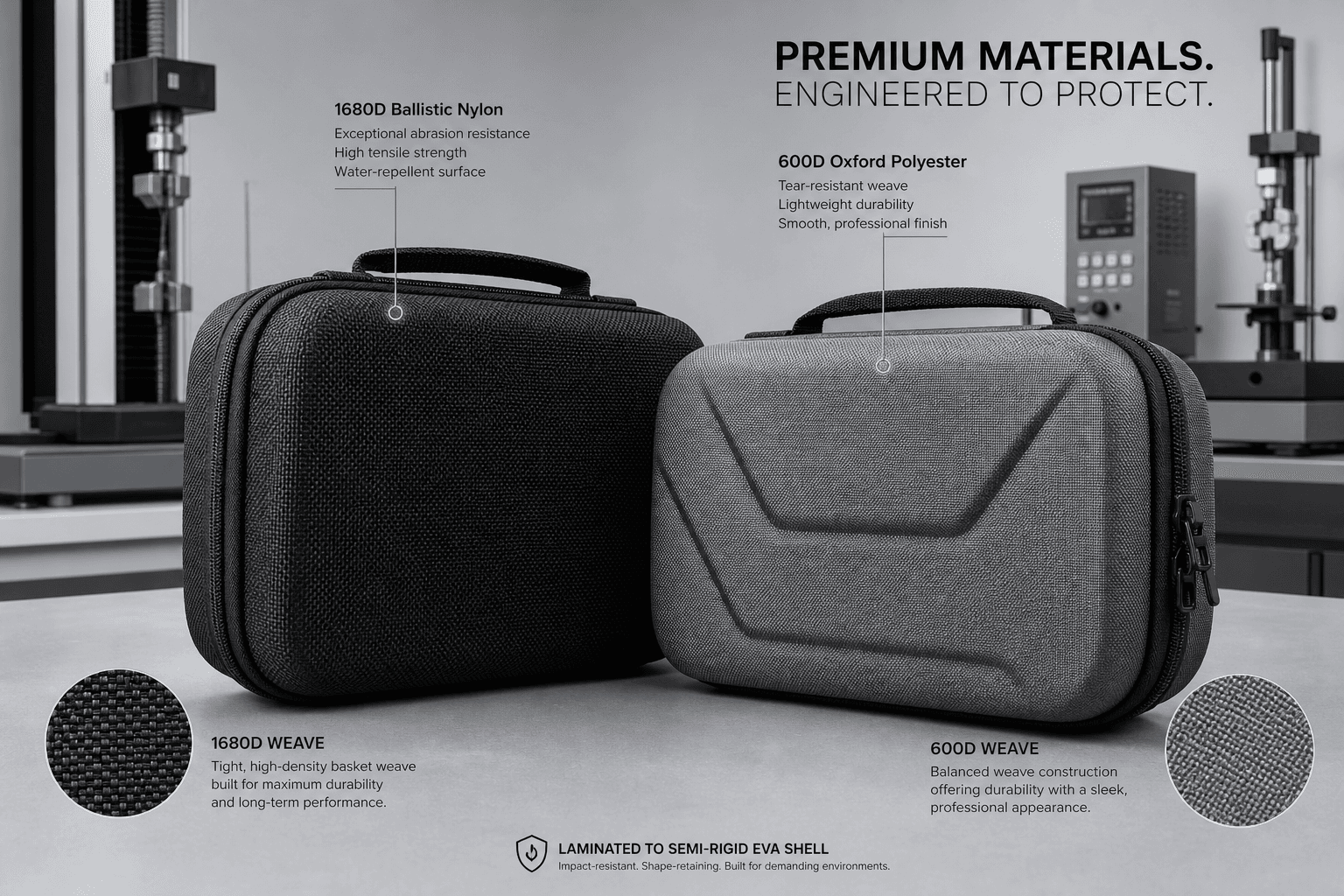
Originally developed by the DuPont corporation for military flak jackets during World War II, ballistic nylon represents the pinnacle of heavy-duty protective fabrics. Modern 1680D ballistic nylon utilizes a specific double-thread basketweave structure (a 2x2 weave layout), combining two thick twisted strands into a singular structural path.
Primary Advantages: Unmatched abrasion resistance, high melting point, and extreme tear threshold. It resists fraying even when dragged repeatedly across rough asphalt or concrete surfaces.
Best Suited For: Heavy industrial diagnostic equipment, military field gear, rugged automotive testing kits, and high-value power tools that operate in harsh outdoor climates.
Manufacturing Consideration: Due to its immense thickness and structural stiffness, 1680D ballistic nylon requires larger draft angles and broader corner radii in the thermoforming molds to prevent fabric puckering or thinning at the corners.
600D & 900D Oxford Polyester: Cost-Effective Versatility
Polyester is a highly versatile synthetic polymer characterized by excellent dimensional stability, natural resistance to ultraviolet (UV) radiation, and low moisture absorption rates. Oxford cloth refers to a specific weaving style where a warp yarn crosses two filled yarns in a checkerboard matrix.
Primary Advantages: Extremely cost-effective, lightweight, and highly receptive to custom color dyeing and crisp, detailed multi-color silk-screen logo printing. It maintains its shape well under humid conditions because polyester fibers do not swell when exposed to water vapor.
Best Suited For: Consumer tech electronics accessories, medical test strip kits, consumer drone cases, and general promotional corporate gifts where balancing tool cost and weight is a priority.
900D vs 600D: Upgrading to 900D polyester increases thread density by 50%, providing a visibly tighter weave texture, smoother hand-feel, and enhanced puncture resistance with only a marginal increase in raw material costs.
For a broader layer-by-layer view, the EVA case material selection guide explains how outer surfaces, the EVA core, linings, branding, and physical samples should be reviewed before production.
For sewn functional bag projects, use the Oxford fabric for bags guide to compare 600D, 900D, and 1680D options with coating, lining, structure, and sample approval requirements.
Polyurethane (PU) Leather & Vinyl: The Smooth Performance Option
For applications requiring a sleek, professional aesthetic or strict hygiene maintenance, traditional woven textiles are replaced with synthetic polymers like PU leather or Polyvinyl Chloride (PVC) vinyl coatings. These materials do not use a denier rating system; instead, they are evaluated by thickness in millimeters (e.g., 0.8mm to 1.2mm PU sheets).
Primary Advantages: 100% waterproof surface barrier, highly resistant to stains, oils, and grease, and completely seamless. Crucially for medical environments, PU leather can be cleaned repeatedly using aggressive medical-grade isopropyl alcohol or sanitizing wipes without degrading the surface finish.
Best Suited For: Surgical instrument modules, clinical diagnostic tools, high-end corporate presentation kits, and luxury consumer electronics.
Branding Capabilities: PU leather provides an excellent substrate for deep, highly defined blind debossing, creating a high-contrast premium logo presentation without the need for ink.
Jersey Knit & Multispandex: Tactile Comfort for Consumer Tech
Jersey and multispandex materials utilize fine, knit configurations rather than heavy woven matrices. They provide a soft, smooth texture that emphasizes ergonomics and a premium consumer experience.
Primary Advantages: Soft texture that minimizes friction, excellent stretch properties that follow complex mold contours perfectly, and a modern lifestyle aesthetic.
Best Suited For: Premium lifestyle headphones, handheld gaming consoles, virtual reality (VR) headsets, and everyday carry (EDC) organization pouches.
The Impact of Denier on EVA Thermoforming and Manufacturing
Integrating a thick woven fabric onto a semi-rigid EVA core is a complex thermodynamic process. The selected denier value directly affects how the raw components behave inside high-pressure production machinery.
[Raw Yarn Extrusion] ➔ [Basket/Plain Weaving] ➔ [PU/PVC Backing Coating] ➔ [Heat Lamination to EVA] ➔ [Hydraulic Thermoforming Mold]Step 1: Raw Fiber Extrusion and Weaving Structure
Synthetic polymers are melted and forced through spinnerets to form continuous multi-filament yarns of the target denier (e.g., 600 grams per 9,000 meters for 600D). These yarns are loaded onto industrial looms to execute specific weave geometries, such as a plain weave or a 2x2 basketweave.
Step 2: Backing Coating Application (PU vs. PVC)
Raw woven fabric cannot bond directly to raw Ethylene-Vinyl Acetate foam. The back of the fabric must be treated with a secondary coating.
Polyurethane (PU) Coating: Applied as a thin liquid layer that cures into a flexible, clear film. PU backing keeps the fabric pliable, acts as a reliable water barrier, and remains stable under high molding temperatures without emitting hazardous gasses.
Polyvinyl Chloride (PVC) Coating: A heavier, cheaper plastic backing layer. While it adds stiffness to the fabric, PVC is prone to cracking over prolonged cold-exposure cycles and can emit strong chemical odors when subjected to high-temperature thermoforming presses.
Step 3: Heat Lamination to the EVA Sheet
The coated fabric roll and the raw, flat EVA foam sheet are fed simultaneously into a continuous lamination machine. High-pressure rollers and controlled heat elements melt the PU backing layer slightly, fusing the woven fabric permanently to the EVA core substrate to form a uniform, multi-layer composite sheet.
Step 4: Compression Thermoforming and Tooling Control
The composite sheet is transferred to an oven to pre-heat the EVA core to its optimal softening window. Once pliable, it is placed inside a water-cooled aluminum or steel compression mold mounted in a high-tonnage hydraulic press.
The tool closes rapidly, forcing the material into the cavity shapes. Here, denier plays a critical role: an ultra-thick 1680D nylon fabric resists compression, requiring significantly higher clamping force and precise dwell times to prevent the outer corners from developing wrinkles or localized stress thinning.
Engineering Insights: Resolving Fabric Failure in the Field
From the Factory Floor: A prominent manufacturer of commercial geological surveying gear partnered with us after encountering high failure rates with their field equipment cases. Their existing supplier had utilized a standard 600D polyester oxford outer fabric over a mid-density EVA core.
The Failure Analysis: In rugged field environments, surveyors frequently dragged the cases over sharp granite, limestone, and wet soils. The 600D polyester threads suffered rapid abrasive wear, causing the thin PU backing to rupture. Water infiltrated the woven structure, causing the outer fabric to detach from the internal EVA core, exposing the raw foam to structural puncture failures.
The Engineered Redesign: Our technical engineering team overhauled the specification profile. We replaced the 600D polyester with an authentic, heavy-duty 1680D double-thread ballistic nylon sourced from verified textile mills. To combat environmental moisture ingress, we specified a triple-pass Polyurethane (PU) internal backing coating and added a durable water repellent (DWR) surface treatment to the exterior weave face.
Tooling Adjustments: Because 1680D nylon is substantially thicker than 600D polyester, our CNC tooling department modified the production molds, expanding the corner radii by 4mm to accommodate the bulkier composite profile.
The Results: Modified drop and drag testing achieved outstanding outcomes. Under standardized ASTM D3884 Taber abrasion protocols, the new 1680D ballistic nylon configuration survived over 5,000 continuous wear cycles before showing initial thread wear, compared to just 450 cycles for the previous 600D setup. Field failure rates dropped to absolute zero, saving the client thousands in warranty replacement costs.
Technical Specification Matrix for Outer Materials
To assist procurement managers and quality assurance teams in validating their custom designs, the comparative table below details the performance characteristics of various EVA outer coverings:
Material Classification Denier / Thickness Abrasion Resistance (Taber Cycles) Tear Strength (Newton Rating) UV Color Fastness Relative Material Cost Target Application Environment Ballistic Nylon 1680D 5,000+ 320 N Very Good Premium / High Rugged Industrial, Military Field Gear Oxford Nylon 840D / 1050D 3,200 240 N Very Good Medium-High Professional Audio, Scientific Equipment Oxford Polyester 900D 1,800 160 N Excellent Balanced Diagnostic Instrument Cases, Power Tools Oxford Polyester 600D 850 110 N Excellent Economical Consumer Tech, Drones, First Aid Kits PU Synthetic Leather 1.0mm thickness 2,200 190 N Good Medium-High Medical Diagnostics, Premium Consumer Tech Multispandex / Jersey N/A (Knit) 400 65 N Fair Low-Medium Headphone Cases, Gaming Consoles Quality Testing Protocols for B2B Fabric Procurement
Validating that your production run meets strict durability requirements requires standardized laboratory verification testing. A trustworthy OEM manufacturer should monitor these primary parameters:
Taber Abrasion Testing (ASTM D3884): A weighted abrasive wheel spins directly against the fabric face under a constant load (typically 500g or 1000g). The fabric is evaluated by the number of cycles it tolerates before a thread snaps or the backing layer becomes exposed.
Tensile Strength & Tear Resistance (ASTM D5034): Specialized machines pull a strip of the fabric from opposite directions until it ruptures, recording the maximum force threshold in Newtons. This testing ensures that high stress points, such as where carrying handles and shoulder strap D-rings are attached, will not tear free under heavy loads.
Hydrostatic Pressure Resistance (AATCC 127): Measures the fabric’s ability to resist water penetration under pressure. A column of water is applied to the coated fabric face at a constant rate until three leakage points appear on the back, confirming the reliability of the PU water-resistant coating.
Choosing the Right Denier for Your Target Market
Specifying the wrong material configuration can lead to bloated production costs or premature product failures. Align your material choices with your specific industry vertical:
Heavy Industrial and Field Operations
Baseline Standard: 1050D to 1680D Ballistic Nylon.
Key Requirements: Maximum crush resistance, structural protection against tool drops, oil-resistant exterior coatings, and heavy-duty #10 closure zippers. Weight is secondary to pure survivability.
Medical Devices and Clinical Environments
Baseline Standard: 0.8mm to 1.2mm Medical-Grade PU Leather.
Key Requirements: Smooth surface profiles with zero fabric weave cavities to eliminate bacterial harbor points. Must offer full chemical resistance to harsh surface disinfectants and match cleanroom environment rules.
Premium Consumer Tech and Lifestyle Brands
Baseline Standard: 900D Polyester, Smooth Matte PU, or Multispandex.
Key Requirements: Refined hand-feel, rich color fidelity, precise edge tolerances, and clean, high-definition logos (such as molded rubber badges or precision laser engraving).
Factory Direct Sourcing: Partnering for Manufacturing Success
Achieving an optimized custom EVA enclosure requires working directly with a manufacturer that controls the entire production workflow, from initial design concepts to the final box packaging. Working with direct factory teams eliminates middleman markups, gives you access to specialized engineering advice, and provides transparent control over material specifications.
At Pengtour, we focus on engineering high-precision, custom thermoformed EVA solutions tailored to strict global corporate standards. To learn more about our production lines, raw material quality controls, and advanced machinery setups, we invite you to review about our manufacturing standards. When you are ready to submit your initial design documents, 3D step files, or detailed fabric requirements for an expert evaluation, visit our contact our engineering team to request a comprehensive production review and initial prototyping quotation.
Frequently Asked Questions (FAQ)
What is the practical performance difference between Nylon and Polyester at the same Denier rating?
Nylon possesses a highly resilient molecular structure that delivers greater elasticity and tensile memory compared to polyester. Consequently, a 600D nylon fabric provides roughly double the abrasion resistance and significantly higher tear strength than a 600D polyester fabric. However, polyester offers superior resistance to UV fade and lower raw material costs, making it a highly effective solution for indoor or consumer applications where extreme friction is rare.
Can a higher denier fabric make the final custom EVA case heavier?
Yes, a higher denier rating means thicker, heavier yarns, which directly increases the total weight of the finished case shell. For example, substituting a 600D polyester weave with a heavy 1680D ballistic nylon across a high-volume production run of large equipment cases will visibly increase unit weight. Designers must balance the need for extreme field durability against portability and shipping weight constraints.
How does the choice of denier affect the outer logo branding options?
Lower denier fabrics (like 600D polyester) feature a flatter, tighter, and more uniform surface profile, making them ideal for high-definition silk-screen printing or detailed heat-transfer printing. Conversely, heavy 1680D ballistic nylon has a pronounced, bumpy basketweave texture that can cause fine printed lines to blur or bleed. For high-denier fabrics, we strongly recommend using deep debossed rubber patches, woven labels, or thick sonic-welded TPU plates instead of direct screen printing.
Does a water-resistant PU coating on the fabric protect the inner EVA core?
The Ethylene-Vinyl Acetate (EVA) core foam layer features an inherently closed-cell structure that is naturally 100% waterproof and cannot absorb water. The Polyurethane (PU) backing coating is applied primarily to safeguard the outer woven textile layer from absorbing water and holding moisture, which could otherwise lead to unsightly surface mold, stains, or localized fabric delamination over time.
For a fabric-covered EVA case with defined denier and coating requirements, review our custom EVA case development options before confirming materials for sampling.
Demystifying Fabric Denier and Durability in Custom EVA Cases

Written by
pengtour
Published
Jun 26 2026
- Buying Guide
- Custom Design Solutions
- Eva Case
Follow us
pengtour
OEM/ODM Custom EVA Cases & Sewn Bags Manufacturer
Custom molded EVA cases and sewn bags for consumer electronics, medical devices, travel, sports, outdoor, and lifestyle brands. Sampling in 7 days | EVA case MOQ: 100 pcs | Soft bag MOQ: 300 pcs | OEM/ODM design support
Tag:
Share On
Got thoughts or experiences to share? we'd love to hear from you!
Get A Free Quote
PREVIOUS
What Is a Golden Sample for Custom EVA Cases and Bags? A Buyer's Guide
Aug 19 2026
NEXT
How to get an accurate quote for a custom EVA protective case: What materials should buyers prepare before taking samples?
Aug 25 2026