

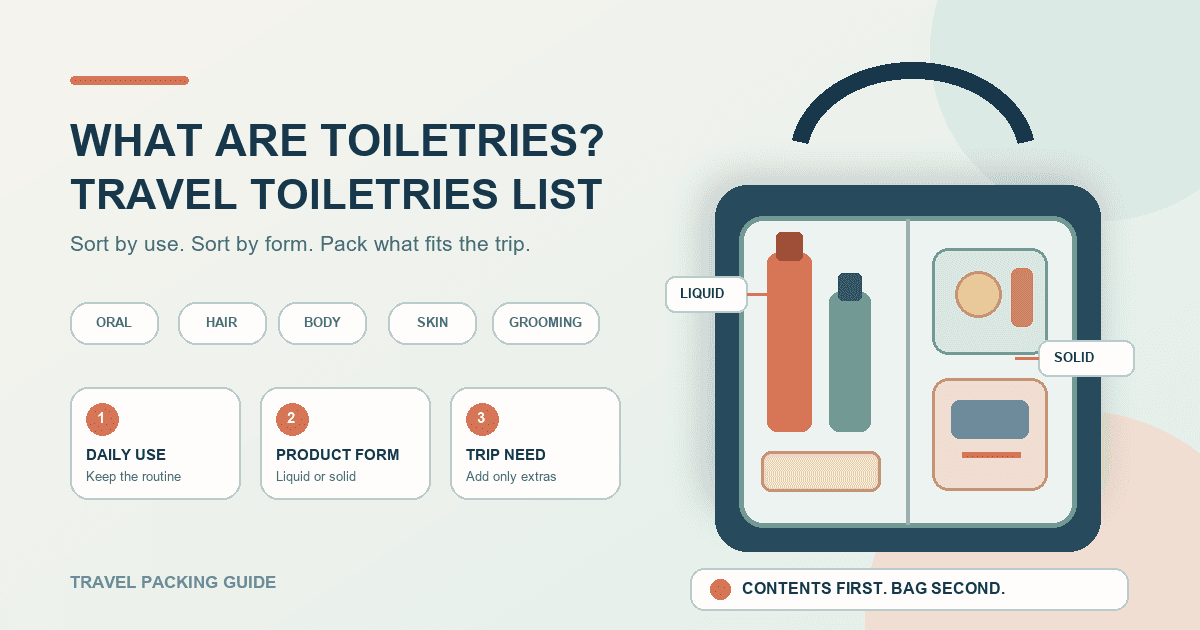
Toiletries are products used for personal cleaning, hygiene, grooming, and routine care. Common examples include a toothbrush, toothpaste, shampoo, soap, deodorant, face wash, moisturizer, sunscreen, shaving products, and menstrual care items.
A useful travel toiletries list should not be a copy of every product in your bathroom. It should reflect what you use, how long you will be away, what your accommodation provides, and whether you are traveling by air. Start with daily essentials, add only the products required by your destination or activities, and then sort everything by physical form before packing.
Medication, first aid supplies, electronics, and sewing tools may sit near a toiletry bag, but they are easier to manage as separate packing categories. Keeping those boundaries clear produces a shorter list and helps you choose a bag around the items that truly belong inside it.
Key Takeaways
- Toiletries are personal cleaning, hygiene, grooming, and routine care products.
- Build the list from daily use, not from an oversized universal checklist.
- Separate core items from optional and destination-specific items.
- Sort products again as liquids, gels, creams, pastes, aerosols, or solids before a flight.
- Medication and first aid supplies should have their own checklists.
- A carry-on liquids bag and an everyday toiletry organizer do different jobs.
- For product development, actual contents should determine bag size, opening, pockets, and loaded fit.
What Counts as Toiletries?
A product generally belongs on a toiletries list when its main purpose is personal cleaning, hygiene, grooming, or routine care. The category is broader than soap and shampoo, but narrower than everything you might use in a hotel bathroom.
|
Category |
Common Examples |
Packing Question |
|
Oral care |
Toothbrush, toothpaste, floss, mouthwash |
Which items do you use every day? |
|
Hair care |
Shampoo, conditioner, comb, brush, styling product |
Does the accommodation provide a usable alternative? |
|
Body care |
Soap, body wash, deodorant, lotion |
Is the product a liquid, aerosol, stick, or solid bar? |
|
Skin care |
Face wash, moisturizer, sunscreen, lip balm |
Which steps are essential for the trip length and climate? |
|
Grooming |
Razor, shaving product, tweezers, nail file |
Are any tools restricted in your chosen baggage? |
|
Menstrual and personal hygiene |
Pads, tampons, menstrual cup, personal cleansing items |
How much is needed, including delays? |
|
Contact lens care |
Lens case and solution |
Does the solution need to join the carry-on liquids group? |
Makeup may also travel with toiletries because it shares skin-care routines, liquid limits, and bathroom use. If makeup is a large part of your packing list, the detailed makeup carry-on rules explain how liquid, cream, powder, solid, and checked-bag items differ at a US checkpoint.
What Should Stay on a Separate List?
Travel checklists often become confusing because they call every small item a toiletry. A cleaner system gives these groups their own place:
- prescription and non-prescription medication;
- bandages, antiseptic supplies, and other first aid items;
- hair dryers, straighteners, shavers, and other powered devices;
- chargers and plug adapters;
- sewing kits and repair tools;
- food, utensils, and drink bottles;
- travel documents and valuables.
Some of these items may be stored beside toiletries for convenience. That does not make them toiletries. Medication may also be subject to destination, customs, labeling, or security requirements that are different from ordinary personal care products. A separate list makes those checks easier to see.
A Practical Travel Toiletries List
Use three levels rather than treating every item as equally necessary.
Core Daily Items
These are the products that support a routine you would normally complete every day:
- toothbrush and toothpaste;
- dental floss if used regularly;
- soap or body wash;
- shampoo and conditioner if they will not be available;
- deodorant;
- face wash;
- moisturizer;
- sunscreen when sun exposure is expected;
- menstrual care products as required;
- contact lens care if applicable;
- a razor and shaving product if needed during the trip.
The core list will differ by person. Someone with a prescribed skin-care routine may have more essential items than a traveler who can use hotel soap and shampoo. The right question is not whether an item appears on a popular checklist. It is whether missing it would interrupt a routine that matters during this trip.
Optional Routine Items
Optional items improve comfort or appearance but may not be needed every day:
- hair styling products;
- perfume or cologne;
- body lotion when a face-and-body product could cover both uses;
- mouthwash when brushing and flossing are enough for the journey;
- nail care tools;
- makeup and remover;
- face masks or extra skin treatments;
- a mirror when the accommodation has one.
Review this group after the core list. Optional products are often where full-size bottles, duplicates, and "just in case" items enter the bag.
Destination-Specific Items
The destination and planned activities can add a small number of items:
- higher-use sunscreen for outdoor or beach travel;
- insect repellent for the relevant location and season;
- richer moisturizer or lip care for dry or cold conditions;
- anti-chafe products for long walking days;
- preferred personal care products that may be difficult to replace locally.
Do not add an item only because a destination checklist mentions it. Check the weather, accommodation, activities, local availability, and your own routine first.
How to Reduce the List by Trip Length
Trip length changes quantity more often than it changes the basic categories.
For an overnight trip, a toothbrush, toothpaste, deodorant, face care, and one wash product may cover the routine. A weekend trip may need small amounts of shampoo, conditioner, and grooming products. A longer trip does not always require a proportionally larger bottle if laundry, shops, or refill opportunities are available.
Use this sequence:
- Write down the products used during one normal morning and evening.
- Remove products supplied by the accommodation if you are comfortable using them.
- Estimate how many uses the trip requires, including a reasonable delay.
- Choose a suitable container for that quantity.
- Remove duplicates that perform the same job.
- Add destination-specific products only after the daily list is complete.
Do not decant a product into an unsuitable or unidentifiable container. Keep enough labeling or a separate record to identify what is inside, especially when products look similar.
Sort Toiletries by Product Form Before a Flight
After sorting by purpose, sort again by physical form. This second pass determines what must enter a carry-on liquids group and what can remain in an ordinary toiletry organizer.
Typical form groups include:
- liquids, such as mouthwash or liquid foundation;
- gels, such as some styling products;
- creams and lotions;
- pastes, including toothpaste;
- aerosols and sprays;
- solids, such as a bar of soap;
- tools, such as a comb or tweezers.
Product names are not always enough. A deodorant might be an aerosol, roll-on, gel, cream, or solid stick. A cleanser might be a liquid, balm, wipe, or bar. Check the actual formula and the official item guidance for the airport where screening occurs.
At a US Transportation Security Administration checkpoint, carry-on liquids, aerosols, gels, creams, and pastes must follow the 3-1-1 liquids rule. Each container may hold no more than 3.4 ounces or 100 milliliters, and the covered containers must fit in one quart-sized bag. TSA rules apply to US screening. Other airports, transfer points, airlines, and destinations may use different procedures.
Carry-On Toiletries vs Checked Toiletries
The carry-on liquids bag is a security-screening tool. A regular toiletry bag is an organizer. They may work together, but they are not interchangeable.
Carry-On
Keep the regulated liquids group accessible. Check the labeled capacity of each container rather than the amount remaining inside. Place dry personal care items in a separate organizer when that makes the liquids bag easier to present and close.
Medication may follow separate procedures, so do not force it into the ordinary toiletries workflow without checking the applicable official guidance.
Checked Baggage
Checked baggage often allows larger containers, but "checked" does not mean every personal care product is unlimited. The Federal Aviation Administration's PackSafe guidance for medicinal and toiletry articles applies quantity and container limits to covered articles and requires aerosol release devices to be protected from accidental release.
Check the exact product, airline, and route. Moving a restricted item from a carry-on to a checked bag does not automatically make it acceptable.
Pack in Two Layers
A simple two-layer method keeps the task clear.
Layer 1: items controlled by the trip or screening process. This includes the carry-on liquids bag and any separately managed medication. Keep these items accessible where required.
Layer 2: the ordinary toiletry organizer. Use it for dry products, grooming items, and checked-bag toiletries that belong together. Arrange items by access frequency rather than creating a pocket for every object.
Before closing the bag:
- tighten caps and use built-in locks or protective covers;
- keep easily compressed tubes away from hard objects;
- separate wet or spill-prone containers when secondary containment is useful;
- place small items where they remain visible;
- check whether long tools interfere with the zipper path;
- confirm that the packed bag closes without forcing bottles into each other.
These steps can improve separation and access, but they do not prove that a bag or container will prevent every leak.
Choose a Toiletry Bag Around the Contents
The contents should come before the bag. Count the bottles and tools, note the tallest and widest items, and observe how the user reaches them in a bathroom.
A compact zippered pouch may suit a short routine with few products. A boxy or self-standing form can make upright containers easier to view. A wider opening may help when several items must be accessed without unloading the bag. A hanging format can help where counter space is limited, but its hook, attachment area, folding seams, pockets, and loaded shape need review with realistic contents.
If you are comparing structures for a private-label project, the custom toiletry bag buying guide covers bag format, sizing inputs, materials, branding, RFQ details, and first-sample review in more depth.
For Brands: Turn the List Into Product Inputs
A brand should not specify a toiletry bag with a generic capacity label or a copied compartment count. Start with a representative product list and record how those products are used.
Useful development inputs include:
- the dimensions and form of each representative container;
- which products must stand upright;
- which items need fast visibility;
- which liquids require a removable or separately handled area;
- the order in which users reach toothbrushes, skin care, grooming tools, and shower products;
- whether the bag sits on a counter, hangs, or remains inside luggage;
- whether long tools cross a fold or zipper path;
- where loaded pockets pull on seams, handles, or a hanging attachment;
- the intended retail set, packaging, and travel scenario.
These inputs help define usable opening size, pocket depth, divider placement, elastic organization, handle position, and loaded closure. Brands developing custom toiletry bags should approve the layout with actual products or size-accurate substitutes, not an empty sample alone.
Lining is another project decision, not a universal answer. Surface, construction, cleaning expectations, pocket use, and the stored products all affect the choice. The guide to bag lining material choices explains how to document that decision without treating one material as correct for every toiletry bag.
How Pengtour Supports Toiletry Bag Development
Pengtour can evaluate selected sewn toiletry bag projects from buyer samples, photos, dimensions, structure notes, or a tech pack. Depending on the project, possible directions may include a compact pouch, boxy or self-standing construction, a wider opening, internal pockets, mesh sections, elastic organization, a hanging hook, handles, or removable sections. Final feasibility depends on the actual contents, dimensions, materials, components, construction, and project requirements.
For a hanging design, the review may include the hanging attachment, top handle, folding seams, loaded pockets, zipper ends, mesh sections, and hook or buckle attachment points. A normal loaded-sample review can reveal visible loosening, deformation, access problems, zipper interference, or difficulty opening and closing the bag. It is not a formal load, cycle, or fatigue test, and it does not establish a universal weight capacity.
During custom soft bag development, use the approved product list and sample as project references. Check the bag while loaded, document revisions, and confirm the final construction for the specific order.
To discuss a private-label project, request a project-specific quote with the intended contents, container dimensions, travel scenario, target bag size, structure notes, reference images, preferred materials, logo file, quantity, and packaging requirements.
FAQ
Do Toiletry Bottles Have to Be Clear in a Carry-On?
Under the US TSA 3-1-1 rule, the covered containers must meet the size limit and fit in one quart-sized bag. The individual bottles do not have to be clear. Check the rules for the departure and transfer airports because procedures can differ outside the United States.
Should a First Aid Kit Go in a Toiletry Bag?
It can be stored nearby if that is convenient, but keep first aid supplies on a separate checklist. This avoids treating medication and medical items as ordinary toiletries and makes destination, labeling, and transport checks easier to complete.
How Large Should a Toiletry Bag Be for a One-Week Trip?
There is no universal size for a one-week trip. List the actual containers, tools, and refill plan, then test them in the intended layout. A short daily routine may fit a compact pouch, while multiple upright bottles or shared family products may require a larger or divided format.
Should I Bring Toiletries That a Hotel Provides?
Bring your own when you need a specific formula, have a sensitivity, or cannot confirm availability. Otherwise, using selected hotel-provided products can reduce bulk. Check the accommodation before removing an item from the list.