

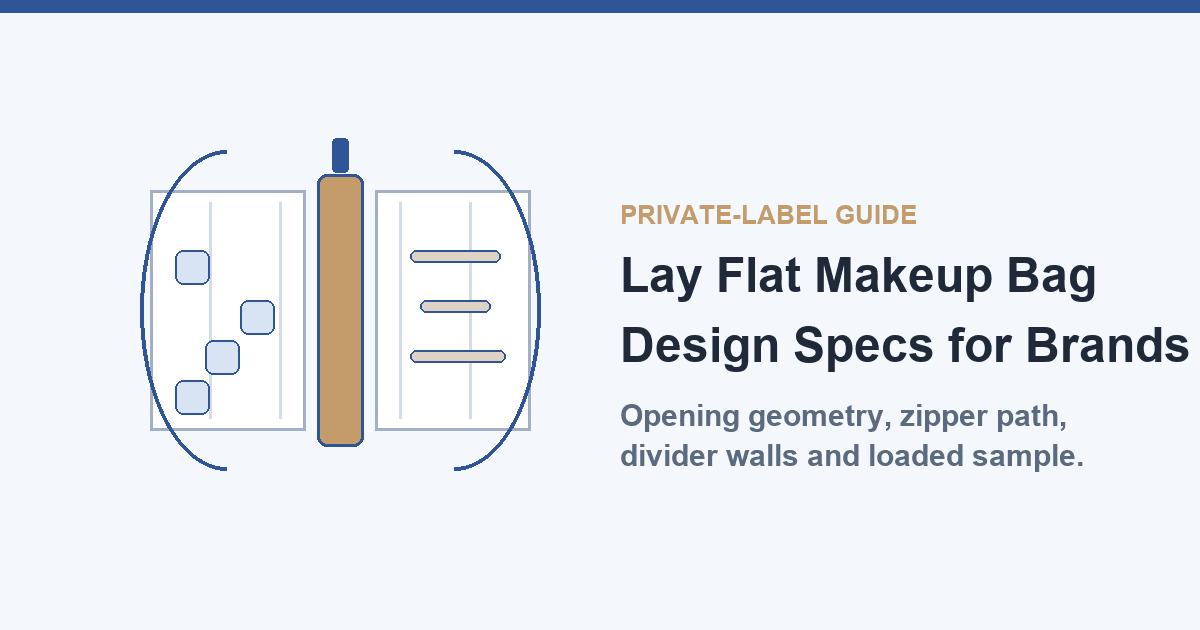
A lay flat makeup bag sounds like a simple product idea: open it wide, see the contents, and close it again. For a private-label brand, that sentence is not yet a production specification.
The factory still needs to know how far the bag should open, where the zipper should travel, how the corners should turn, how high the divider walls should be, what the bag will hold, and how the packed product must close. Those details decide whether the finished bag gives clear access or becomes a crowded pouch with items pressing into the zipper path.
This guide explains how to turn a lay-flat makeup bag concept into an RFQ, a sample review and a clearer approval record. It is written for beauty brands, importers, sourcing managers and product teams developing an OEM or private-label collection.
What Lay Flat Means in a Production Brief
"Lay flat" can describe more than one construction. A bag may open across a broad panel, unfold around a central divider, use a wraparound zipper, or spread into a shallow organizer. The product name does not tell the factory which structure you want.
Start by describing the user action:
- Does the bag need to open nearly flat on a counter?
- Should the contents remain in separate zones after opening?
- Should bottles stand, lie down or sit in elastic sections?
- Should the user see every item immediately, or only reach the lower area more easily?
- Does the bag need to close while the contents remain in their assigned positions?
Then describe the intended contents. A lay-flat cosmetic bag may hold palettes, brushes, bottles, tubes, compacts, lip products, sponges or small accessories. These items do not occupy space in the same way. A tall bottle can catch on the opening. A deep pocket can hide a small product. A thick group of compacts can change the closing line.
A broad comparison of pouches, wide-opening organizers, roll-up bags and structured cases belongs in a makeup bag format comparison. Once the brand has chosen the lay-flat route, this page focuses on the construction and sample questions that come next.
Define the Opening Before You Choose the Details
The opening is the main promise of a lay-flat bag. Write it as a function and a reference condition, not only as a product name.
Specify the Opening Behavior
Your RFQ should state:
- the intended opening direction;
- the surfaces that should rest on the counter when open;
- whether the bag should open to a broad flat panel or a shallow tray-like shape;
- whether a center divider, raised edge or lid section should remain upright;
- where the user should begin and end the opening motion;
- which contents must remain visible after the bag is opened.
Avoid treating "180-degree opening" as a complete specification by itself. The same phrase can describe different constructions. One sample may open wide but collapse at the center. Another may stay organized but leave a raised section that blocks access. The approval standard needs to describe what the user should see and reach after opening.
Use the actual counter or luggage scenario in the brief. A bag designed for a hotel counter may prioritize broad visibility. A set intended to sit inside a retail box may need a controlled folded profile. A professional beauty kit may need more separation and a more stable opening than a small promotional pouch.
Separate Visibility From Capacity
A large internal volume does not automatically create a useful lay-flat experience. Capacity can increase while access gets worse if the body becomes too deep or the divider walls become too tall.
One anonymized cosmetic organizer review at Pengtour found that small makeup items sank into a deep storage area and became difficult to see and remove. The layout was adjusted with separate sections to keep smaller products in more controlled positions after loading. This is a sample-review example, not a universal structure or a performance guarantee.
The lesson for a brand is practical: decide which products must stay visible before asking for the largest possible compartment. If the layout is designed around volume alone, the first sample may technically hold the contents while failing the access promise.
Set the Zipper Path, Corners and End Stops
A lay-flat design often puts more responsibility on the zipper than a simple top-opening pouch. The zipper may travel along long edges, turn around corners, meet another slider or finish near a thick stack of layers. These points should be shown in a drawing or described in the RFQ.
Record the Zipper Route
Define:
- the start point and end point of the zipper path;
- whether the path is straight, curved, wraparound or split into sections;
- whether one or two sliders are required;
- where the sliders should meet or stop;
- which areas need reinforcement at the zipper ends;
- whether the lining must remain clear of the slider during loading and closing;
- whether the zipper pull needs to be accessible from the open position.
The zipper length is not the same as the usable opening length. Turns, end treatments, reinforcement and nearby layers can reduce the opening available to the hand. A curved route can also behave differently after the bag is filled.
Do not select a zipper from a product name alone. Pengtour's manufacturing references include possible standard coil, reverse coil, waterproof-style, single-pull and double-pull zipper directions, but the correct choice depends on the bag structure, material, opening path and project requirements. A waterproof-style zipper also does not make the complete bag fully waterproof.
If the project has not yet established whether a zipper is the right closure route, first review zipper options before locking the opening path. That keeps the closure decision separate from the lay-flat geometry decision.
Check the Loaded Corners and Stops
An empty bag can make a zipper route look smooth. The loaded sample shows whether the route still works when pockets, bottles, palettes and dividers occupy the space beside it.
Open and close the bag with the intended contents inside. Watch for:
- a slider slowing at a corner;
- the lining entering the slider path;
- a divider pushing against the zipper tape;
- a hard product sitting directly beside a stop;
- a puller becoming difficult to reach after the bag is opened;
- the two sides of the bag pulling out of alignment;
- the closure line becoming curved or distorted under load.
These are sample-review observations, not proof of a fixed zipper life or formal test result. If the project needs a formal zipper test, define the method, sample construction, conditions and acceptance criteria separately.
Specify Divider Walls and Internal Access
The internal layout is what determines whether a lay-flat bag stays organized after it opens. The buyer should define the job of each divider instead of requesting "more compartments."
Give Each Divider a Job
A divider may separate bottles from powders, create a brush zone, stop small items from sinking, or let the user see one category without moving another. Write that purpose into the brief.
Useful fields include:
- the products assigned to each zone;
- the divider position and direction;
- the required wall height relative to the contents;
- whether the divider should be fixed, foldable or removable;
- whether the divider needs padding, a soft lining or a transparent panel;
- whether the top edge should remain below, level with or above the zipper path;
- whether the divider may bend when the bag is closed;
- how the divider should be cleaned, replaced or adjusted if relevant to the project.
A divider that is too low may allow products to migrate between zones. A divider that is too high may obstruct access or press into the closure line. The right height depends on the actual product set and the way the bag closes, so it should be confirmed through a loaded sample rather than copied from a catalog photo.
Possible sewn-bag organization options may include fabric dividers, mesh pockets, zipper pockets, elastic loops and removable organizer sections. They remain project-specific. The factory should review the material, dimensions, loading, hardware and construction before treating any option as feasible for the final design.
Plan for Small Products and Long Tools Separately
Small items and long tools create different access problems. Lip products, pencils and small accessories can disappear into a deep area. Brushes need enough length and a path that does not catch against the lid, divider or zipper.
List the longest, widest, tallest and smallest important items in the RFQ. Add their preferred orientation. If an item must remain upright, say so. If the user must be able to remove it with one hand, include that as a sample-review requirement rather than assuming the opening will provide enough clearance.
For a wider input list covering contents, structure, materials, branding and packaging, use a complete cosmetic bag design brief before asking for a quotation.
Check the Loaded Bag, Not Only the Empty Sample
A flat sample can look correct while the packed bag fails its main job. Sample approval should therefore use the complete planned contents or size-accurate substitutes.
Run the Review in Three States
- Open and empty: check the opening direction, resting surfaces, zipper path, lining coverage, divider position, logo placement and basic shape.
- Closed and loaded: place the complete contents in their intended zones. Check the closed thickness, bulging, pressure on the zipper line, product movement and whether the closure can be completed without forcing the bag.
- Open and loaded: open the bag in the expected user sequence. Check visibility, hand access, item migration, brush removal, pocket interference, divider behavior and the position of the zipper stops.
The key question is not only "Does everything fit?" It is "Does the bag still perform the access and organization job after everything is inside?"
Record Failure Modes Instead of Vague Feedback
If the first sample needs revision, write the problem in measurable terms:
- "Small lip products fall below the divider and cannot be seen from the open position."
- "The loaded palette presses against the zipper turn and slows the slider."
- "The brush section is shorter than the longest approved brush and catches the lining."
- "The closed sample becomes thicker on one side and pulls the zipper line out of alignment."
- "The divider bends into the closure path when the assigned bottles are loaded."
Then state the requested change, such as adjusting pocket depth, changing divider height, extending the brush section, moving the zipper stop or revising the closed profile. The revised specification, photos, video or another agreed approval record should identify which version was accepted.
A loaded makeup bag sample checklist can support the broader review. This lay-flat article adds the structure-specific questions about opening behavior, zipper turns, divider interaction and loaded closure.
Keep Fit Review Separate From Formal Performance Claims
A loaded sample review can show fit, access, closure behavior, appearance and packaging compatibility. It does not by itself prove leak resistance, impact protection, chemical resistance, colorfastness, long-term durability or a fixed zipper cycle result.
If the brand needs one of those claims, put the requirement, test method, sample construction and acceptance criteria into the project documents. Do not turn a successful loaded fit check into a wider performance promise.
Turn the Structure Into an RFQ
A useful lay-flat makeup bag RFQ should let the supplier separate fixed requirements from flexible choices. Include:
- intended user and sales scenario;
- complete contents list with dimensions, approximate weights and preferred orientation;
- open position and access sequence;
- outside dimensions and closed profile target;
- zipper route, slider count, puller direction and stop positions;
- divider positions, wall heights and fixed or removable status;
- pocket, mesh, elastic, brush and transparent-panel requirements;
- outer material and lining direction;
- logo artwork, location, size and preferred application method;
- packaging, labels, barcode and retail presentation requirements;
- target quantity and SKU or color split;
- what the first sample must demonstrate;
- which requirements are subject to material, hardware or construction review.
A simple RFQ table can use four columns:
|
Field |
Buyer input |
Supplier review |
Approval evidence |
|
Opening |
Open position, access sequence and resting surfaces |
Pattern, panel and zipper feasibility |
Empty and loaded opening photos or sample record |
|
Internal zones |
Contents assigned to each area |
Divider, pocket and elastic construction |
Loaded fit and visibility check |
|
Closure |
Zipper route, sliders and end stops |
Corner behavior, reinforcement and lining clearance |
Loaded open/close review |
|
Closed profile |
Contents and acceptable shape |
Bulk, panel balance and packaging fit |
Loaded closed sample and packaging check |
|
Branding |
Artwork, location and application |
Surface and construction compatibility |
Approved logo sample or photo |
Mark undecided items as open questions. A supplier can then quote a practical baseline and identify which choices may change price, material selection, sampling or packaging. Do not treat a broad product name as enough information for a reliable custom quotation.
How Pengtour Supports Lay-Flat Cosmetic Bag Projects
Pengtour can evaluate selected sewn functional bag projects using buyer samples, photos, dimensions, structure notes or a tech pack. For a lay-flat cosmetic bag, the review may cover the opening direction, zipper route, divider and pocket layout, lining, logo method, packaging and the intended loaded contents.
The project team can also review actual products or size-accurate substitutes before final sample approval. Pengtour's first-party cosmetic organizer evidence includes an anonymized case in which small items sank into a deep storage area; separate sections were considered to improve visibility and access after loading. That example supports the review method, not a fixed construction or guaranteed result.
The production team's general process may include requirement review, material selection, structure evaluation, pattern development, sample development, sample adjustment, order confirmation, production and quality inspection. Exact steps depend on the structure, materials, quantity and buyer requirements. A custom project should use the approved sample and confirmed specification as the production reference.
For eligible sewn bag projects, review the custom sewn bag programs. When you have the contents list, dimensions, reference images, preferred materials and packaging requirements ready, you can request a project-specific quote. Final feasibility, materials, hardware and commercial terms remain project-specific.
Frequently Asked Questions
Which organization details should be fixed for a flat-lay makeup bag?
Fix the intended contents, their dimensions and orientation, the opening behavior, zipper route, divider or pocket positions, closed profile and packaging space. This question comes from the China Handbag Factory flat-lay sourcing page, accessed 2026-10-15. The reason to define these fields together is that a change in one area can affect the others after loading.
How should access and zipper function be checked on a flat-lay makeup bag?
Review the zipper in the empty, closed-loaded and open-loaded states. Check the turns, stops, lining clearance, divider interaction and the user's ability to reach the puller and remove the contents. This question comes from the China Handbag Factory FAQ, accessed 2026-10-15. It is a sample-review method, not a fixed zipper-life claim.
What should a lay-flat sample prove before bulk production?
It should show the agreed opening behavior, loaded access, item separation, zipper operation, closed profile, logo placement and packaging compatibility. The approved sample and the written specification should identify the version that controls production. This question is drawn from the LEBON sampling/QC section and the Hetebag sample guide, accessed 2026-10-15.
Can a lay-flat makeup bag be approved from an empty sample?
Usually, an empty sample is not enough to approve the complete user experience. Use the planned contents or accurate substitutes to check visibility, divider behavior, closure pressure and loaded thickness. An empty sample is still useful for checking appearance and construction, but it cannot answer every loaded-fit question. This is a gap identified across the reviewed B2B pages and is supported by Pengtour's loaded cosmetic-organizer sample evidence.
Key Takeaways
- "Lay flat" is a product direction, not a complete production specification.
- Define the contents and user access sequence before finalizing pockets and dividers.
- Record the zipper route, corners, stops and lining clearance.
- Set divider jobs and wall heights against the actual contents and closure line.
- Review empty, closed-loaded and open-loaded sample states.
- Record failure modes as measurable revisions, not vague requests.
- Keep fit and access review separate from formal leak, durability or test claims.
- Send the complete structure and sample requirements with the RFQ.