

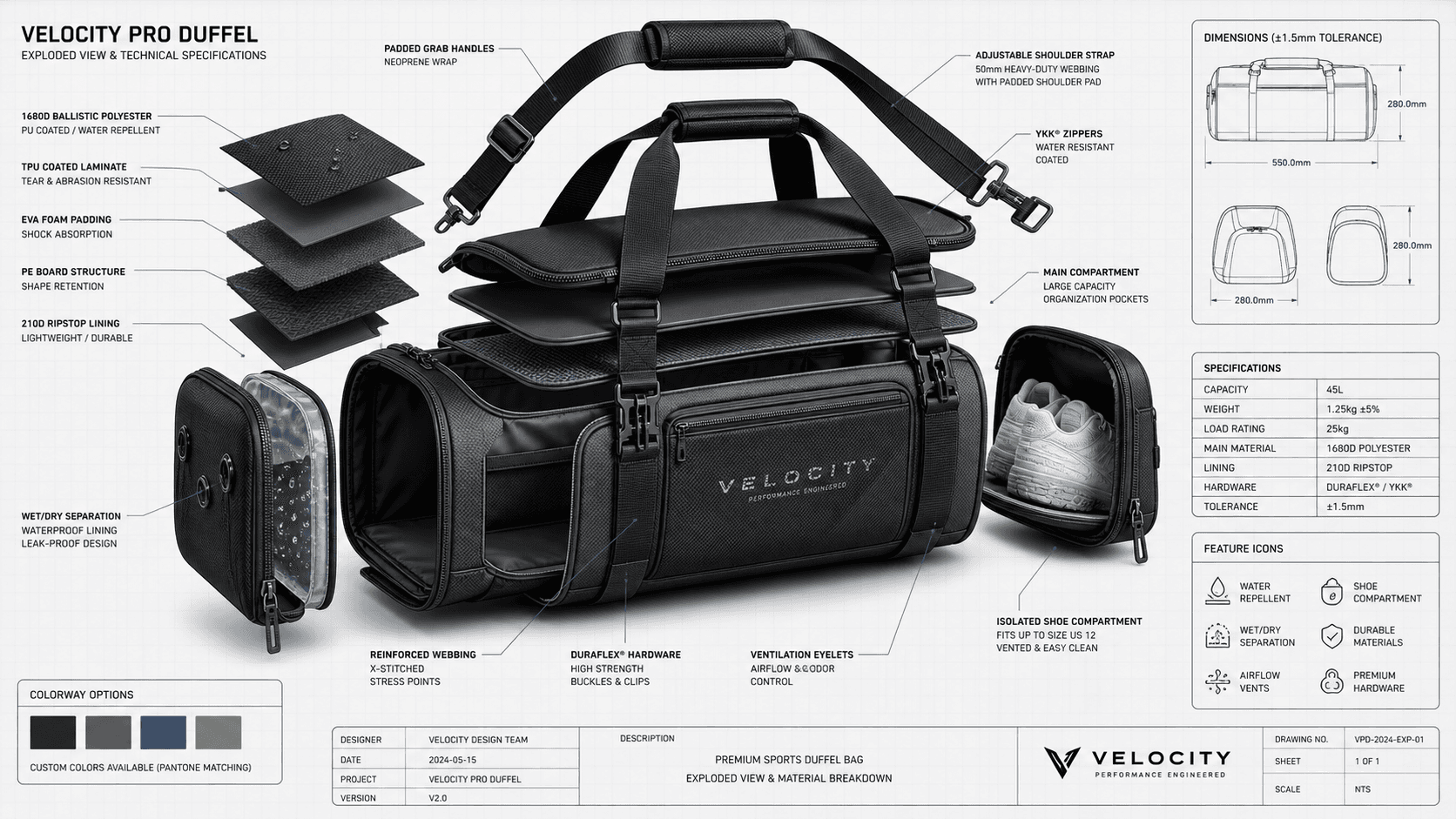
A bag tech pack (technical packet) is a comprehensive blueprint document that translates a design concept into concrete manufacturing data. It functions as the ultimate engineering guide for a factory, containing a complete bill of materials (BOM), detailed 2D or 3D technical drawings, precise dimensional measurements with tolerance thresholds, and hardware stitching specifications. Without a professional tech pack, a soft bag manufacturer cannot generate an accurate price quotation, engineer structural patterns, or guarantee quality consistency during mass production.
Core Sourcing Insights: Why Technical Documentation Rules the Supply Chain
When launching a new commercial soft bag collection, bridging the gap between creative design and mass manufacturing is the most common hurdle for B2B brands. Review these fundamental baseline rules for technical sourcing documentation before approaching an industrial production line:
-
Cost Control: A complete specification sheet eliminates the "guesswork" that forces manufacturers to inflate price quotes by 15% to 30% as a safety margin.
-
Sample Efficiency: Providing clear CAD schematics up front slashes pattern-making iterations from an industry average of 4 rounds down to just 1 or 2.
-
Regulatory Compliance: Documenting exact material classifications prevents catastrophic custom delays due to non-compliant chemical or textile treatments.
-
Defect Reduction: Quantified construction metrics ensure that multi-compartment functional bags perform identically across thousands of production units.
1. The 4 Indispensable Elements of a Production-Ready Bag Tech Pack
When corporate procurement teams ask exactly what goes in a tech pack, they must realize that a factory cannot work with a flat fashion illustration. A factory floor reads engineering data. To transform a creative mockup into a tangible, durable piece of luggage, your documentation must be broken down into four foundational components.
+--------------------------------------------------------------------------+
|                       PRODUCTION-READY TECH PACK                        |
+--------------------------------------------------------------------------+
|  1. COMPREHENSIVE BOM      |  2. DIMENSIONAL BLUEPRINTS                  |
|  - Raw Fabrics & Coatings  |  - Multi-Angle Orthographic Views           |
|  - Thread Specs & Hardware |  - Stitch-Per-Inch (SPI) Callouts           |
|  - Eco/Chemical Standards  |  - Hard Engineering Tolerances             |
+----------------------------+---------------------------------------------+
|  3. COMPONENT SCHEMATICS   |  4. BRANDING MATRICES                       |
|  - Zipper Pull Tension     |  - PVC/Sonic Logo Placements                |
|  - Webbing Load Capacity   |  - Precise XY Axis Grid Coordinates         |
|  - Reinforcement Layers    |  - UV Ink & Pantone Codes                   |
+--------------------------------------------------------------------------+
Comprehensive Bill of Materials (BOM) with Lamination Specifications
The Bill of Materials (BOM) is the absolute core of any professional handbag spec sheet. It must meticulously map out every single physical ingredient required to assemble the final product. A basic listing like "heavy canvas" or "black nylon" will stall your procurement cycle immediately.
Industrial soft bag manufacturing requires exact technical specifications. If you are sourcing an outdoor utility backpack or a technical instrumentation pouch, you must define the exact textile weave density, fiber composition, and inner backing treatment. For instance, a high-performance specification should read: 1000D Ballistic Nylon with a 0.5mm polyurethane (PU) water-resistant backing coating.
When Oxford fabric is listed in the BOM, buyers can use the Oxford fabric requirements guide to define denier, coating, lining, sample review, and testing cautions before sending the RFQ.
Furthermore, your BOM must call out global environmental compliance metrics. If your products are slated for distribution in Europe or North America, you must verify that all textile fibers, polymer backings, plastic buckles, and metal eyelets strictly adhere to the ECHA REACH SVHC compliance standards to eliminate the risk of heavy-metal or phthalate contamination.
To ensure the bag survives rigorous industrial or tactical deployment, specify fabric abrasion performance against industry benchmarks like the Martindale abrasion cycle tests, detailing exactly how many thousands of rub cycles the exterior material must withstand before structural breakdown occurs.
Dimensional Blueprints and Stitching Tolerances
A production-ready tech pack must feature multi-angle orthographic technical drawings. These drawings should display the front, rear, profile, top, bottom, and internal cross-sections of the bag. Every individual pocket, webbing strap, flap, and zipper entry needs clear, linear dimension callouts.
For duffel projects, use a duffel bag size specification to define the measurement condition, exterior dimensions, opening path, usable space, and loaded-fit requirements.
Because textiles are flexible materials that shift, stretch, and bend under industrial sewing machines, your blueprint must establish explicit engineering tolerances. For a high-quality functional utility bag, the factory standard for stitching tolerances should be capped at ±1.5 mm. Any variation larger than this threshold can throw off internal dividers or misalign multi-layered pocket compartments, rendering the bag defective.
Component Schematics, Trims, and Hardware Placement Sheets
Every buckle, D-ring, slider, zipper pull, and hook-and-loop strip must be designated with its exact material construction, dimension, and performance expectation. If your bag relies on heavy-duty performance, specify branded hardware standards (such as YKK reverse-coil zippers or Duraflex buckles) or detail the required structural parameters:
-
Zipper Gauge: Specify the exact chain width (e.g., #5, #8, or #10 heavy-duty).
-
Tensile Strength: Define the crosswise breaking strength required for the fastener tape.
-
Plating Standards: Call out salt-spray resistance hours for zinc-alloy hardware to avoid rust in coastal transit.
Hardware, Branding, and Logo Application Matrices
Your branding layouts cannot simply be casual graphic overlays. The tech pack must feature a dedicated logo placement map utilizing an XY axis grid coordinate system to pin down the exact distance of the logo emblem from the closest structural seams.
You must also explicitly state the physical application process. Whether your brand uses High-Frequency PVC Sonic Welding for rugged waterproofing, multi-color Industrial Silk Screen Printing with UV-curable inks, or deep mechanical debossing on leather accents, the tech pack must serve as the single source of truth for these treatments, complete with exact Pantone matching numbers.
Standard Spec Checklist vs. Factory Real-World Sourcing Requirements
To illustrate what a custom bag manufacturer actually looks for when evaluating your data sheets, refer to this breakdown comparing basic designer mockups with factory-level engineering realities:
2. Why Your Sourcing Factory Strictly Requires a Tech Pack Before Quoting
A common bottleneck in international trade occurs when an import buyer sends a single lifestyle photo of a bag to a factory and demands a firm per-unit price quote for 5,000 units. From an operational standpoint, this is an impossible request. Without an organized handbag spec sheet, a factory engineering department cannot accurately calculate raw material consumption or labor time.
+-----------------------------------------------------------------------+
|                THE COST QUOTATION ENGINEERING PIPELINE                |
+-----------------------------------------------------------------------+
|  [Step 1: CAD Nesting Optimization]                                    |
|   - Analyze vector shapes to calculate exact fabric nesting yields.    |
|   - Mitigate material scrap rates to lower structural component costs.|
|                                                                       |
|  [Step 2: Labor Cost Allocation]                                      |
|   - Map total line operations (SPI settings, machine types).          |
|   - Determine exact Standard Allowed Minutes (SAM) for production.    |
|                                                                       |
|  [Step 3: Component Sourcing Strategy]                                |
|   - Request bulk raw wholesale rates for exact BOM line items.         |
|   - Secure firm lead times with specialized textile mills.            |
+-----------------------------------------------------------------------+
Eliminating the "Guesswork" in Raw Material Costing
When our engineers calculate a price quote for functional soft bags and utility pouches, we perform a process known as CAD Nesting Optimization. We take the vector cut-sheets from your tech pack and arrange them digitally across the standard width of a fabric roll (typically 58 inches or 148 cm). This allows us to determine exactly how many linear meters of fabric are consumed per bag and analyze the scrap rate.
If we don't have those exact dimensions and fabric specs, we are forced to guess. To protect the factory from underpricing and losing money on a project, estimators will naturally quote a price that is 20% higher than necessary to cover potential material miscalculations. Providing an airtight tech pack ensures you get the sharpest, most competitive wholesale pricing right from the start.
Securing Your Lead Time and Defending Production Delivery Schedules
An incomplete tech pack is a primary driver of factory downtime. If a factory line starts production but has to halt because a zipper pull size or internal lining weight wasn't defined, the entire manufacturing schedule slips.
In industrial B2B production, every manufacturing run is scheduled to the minute based on Standard Allowed Minutes (SAM). A complete tech pack allows the factory manager to map out exactly how many sewing stations are required, what specialty folders or attachments must be installed on the industrial Juki machines, and how many units can realistically be completed per shift. This structural precision is what guarantees that your order ships on time, avoiding costly retail out-of-stock windows.
3. 3 Costly Sourcing Failures Caused by Incomplete Tech Packs
To appreciate the protective value of a robust tech pack, it helps to examine common issues that occur on the factory floor when production moves forward based on incomplete design documents. These three real-world manufacturing failures highlight the risks of skipping proper technical specifications.
Issue 1: Structural Deflection and Load-Bearing Sagging
This issue frequently occurs when a brand designs a high-capacity backpack tech pack or a technical tool organizer but relies on basic visual concept sketches. The designer focuses heavily on the pocket layout but leaves out the internal reinforcement layers.
       Visual Sketch Only (No Specs)            Tech Pack Engineered Construction

           |   |       |   |                         |   |=======|   |
           |   |       |   |                         |   |  PE   |   |
           |               |                         |   | Board |   |
           \___/       \___/                         \___/=======/___/
         [ Sagging & Seam Stress ]               [ Rigid Structural Integrity ]
When mass production fabricates the bag using nothing but soft 600D exterior nylon and a basic polyester inner lining, the bag will look fine when stuffed with paper tissue in a photo studio. However, once the end-user loads it with 8 kg of actual field gear, gravity takes over.
Without internal rigid PE (Polyethylene) reinforcement support boards or an EVA foam structural core specified in the blueprint, the entire bag sags downward. This deformation places intense, uneven mechanical stress directly onto the upper shoulder strap seams, causing the stitching to unravel and fail within weeks of use.
Issue 2: Stress-Point Tensile Failures and Exploding Seams
Functional bags designed to carry heavy items like tools, medical diagnostics gear, or tactical hardware must be built to rigorous tension standards. A common mistake occurs when a tote bag tech pack lists the exterior dimensions but doesn't specify the seam construction or the required Stitch-Per-Inch (SPI) count.
If the factory floor defaults to a wide, fast sewing speed with standard light-gauge thread, the seams will simply pull apart under a heavy load. Industrial functional utility bags must be engineered to resist high tensile forces, often aligning with safety benchmarks such as the ANSI/ISEA 121 industrial tool bag retention standards.
Your tech pack must explicitly specify the use of heavy bonded nylon thread (like #69 or #92) and mandate heavy-duty bar-tack reinforcements or structural box-stitching at every single load-bearing strap junction to prevent field failures.
Issue 3: Disastrous Visual Branding Misalignments and Rotational Offsets
When branding elements are integrated into a bag without explicit XY axis coordinate dimensions, the factory sewing team is forced to rely on visual estimation during assembly.
Because soft fabrics shift during high-speed handling under industrial sewing feet, a logo patch that looked centered on a flat screen can easily end up rotated 5 degrees off-center or shifted 2 cm too close to a pocket seam during mass assembly. A mistake like this can ruin the look of an entire batch of 3,000 bags. Having explicit placement grids in the tech pack gives the quality control team a clear, measurable metric to inspect against, allowing them to instantly reject any misaligned units before they make it into a shipping container.
4. How a Professional Tech Pack Cuts Your Sampling Cycle by 50%
The traditional development pipeline for a custom bag can be slow and frustrating. A brand sends an idea, the factory builds a sample, the brand points out corrections, and the cycle repeats over several months. This back-and-forth is costly and drains momentum from product launches. A comprehensive tech pack streamlines this process, moving production from development to delivery much faster.
 TRADITIONAL PIPELINE:
 [Idea Sketch] ---> [Sample V1 (Wrong Fabric)] ---> [Sample V2 (Wrong Size)] ---> [Mass Run]
 (Total Development Window: 60 - 90 Days)

 OPTIMIZED TECH PACK PIPELINE:
 [Airtight Tech Pack] ---> [Rhino 3D Surface Audit] ---> [Sample V1 (Approved)] ---> [Mass Run]
 (Total Development Window: 15 - 25 Days)
To see how an engineered tech pack optimizes development, follow this standard step-by-step product development workflow used by high-performance soft bag manufacturing facilities:
Step 1: Digital Engineering & Design for Manufacturing (DFM) Assessment
The moment a verified tech pack is received, the engineering team skips the guesswork and imports the vector cut-sheets directly into engineering software to verify the geometry, edge clearances, and assembly order.
Step 2: Advanced 3D Surface Modeling Optimization
For highly complex utility bags featuring organic contours, specialized dividers, or rigid structural bases, our engineering team utilizes Rhinoceros (Rhino) 3D surface modeling software. Rhino allows us to precisely map out complex fabric tensions, account for material thickness shrinkage factors, and construct an exact digital twin of the bag shell.
This step ensures that all pattern components align perfectly within a 3D space before cutting physical fabric, drastically reducing structural errors.
Step 3: Computer-Guided Precision Fabric Cutting
Instead of manually cutting fabric panels with handheld shears, the factory inputs the vector sheets into automated CNC knife cutters. This maintains a strict cutting tolerance of within ±0.5 mm, guaranteeing that every single fabric layer matches the master tech pack specification exactly.
Step 4: First-Run Prototyping and Performance Validation
The prototype assembly line uses the tech pack's material callouts, hardware specs, and SPI targets to construct the first sample. Because every variable was clearly documented up front, this initial prototype typically hits 95% to 100% of the brand's design expectations, allowing the project to move into mass production smoothly.
B2B Case Study: Precision Medical Instrumentation Soft Bag Development
An excellent example of this process involved a specialized project for a medical diagnostic equipment company that required a run of 2,000 custom functional utility bags to protect delicate sensor units in the field.
The client initially reached out with only high-resolution creative illustrations and basic outer dimensions. They lacked a standardized bag tech pack. The key technical challenge was that the interior padded foam compartments and hook-and-loop security straps had to align perfectly with the external zipper configurations to keep heavy testing tools from knocking into each other during transport.
Because a professional tech pack was missing, our sample room collaborated with the client to reverse-engineer the required structural specifications. Our engineering department created a comprehensive 3D surface model of the bag using Rhinoceros (Rhino). This allowed us to calculate the precise fabric tension and seam allowance adjustments required for the heavy-duty fabrics.
We generated a production-ready blueprint specifying a tight stitching tolerance of ±1.5 mm and added rigid internal PE support boards at all key load points to prevent the bag from sagging.
+--------------------------------------------------------------------------+
|                  CASE STUDY METRICS & QA BENCHMARKS                      |
+--------------------------------------------------------------------------+
|  - Production Volume: 2,000 Units         - Engineering Software: Rhino  |
|  - Stitching Tolerance: Max ±1.5 mm       - Load Test Target: 10 kg Pull |
|  - Prototype Approval: 1st Iteration      - Total Mass Lead Time: 35 Days|
+--------------------------------------------------------------------------+
By resolving these technical details during the digital design phase, the physical pre-production sample passed a rigorous 10 kg tensile pull test and a 1.5-meter multi-angle drop test on the very first try. This technical preparation eliminated the typical round of sample corrections, saving 12 days of development time and allowing us to complete mass production and delivery within a strict 35-day window.
To learn more about optimizing your broader procurement strategy and coordinating fabric selections, hardware criteria, and quality control systems with an industrial supplier, review our comprehensive custom bag manufacturing guide.
Technical Checklist: Auditing Your Blueprint Before Factory Submission
Before submitting your documentation to an industrial asset manager or a high-volume assembly plant, run through this comprehensive technical quality audit to ensure your file contains the data required for an efficient production cycle:
-
[ ] Vector Scalability: Are all design files and orthographic patterns saved in vector formats (.AI, .DXF, .PDF, or CAD-compatible .STEP/.STP layers)?
-
[ ] Fabric Characterization: Does your material list name explicit weave grades (e.g., Nylon, Polyester, Cordura) and include specific denier ratings, weight metrics (g/m²), and backing coatings (PU, PVC, TPU)?
-
[ ] Structural Component Mapping: Have you called out the exact thickness (mm) and material composition (open-cell vs. closed-cell foam, rigid PE or PP backing boards) for all internal support sections?
-
[ ] Stitching Specifications: Have you provided an explicit Stitch-Per-Inch (SPI) requirement for load-bearing areas, along with directions for reinforcement techniques like bar-tacking or double box-stitching?
-
[ ] Hardware and Fastener Classifications: Are all zipper tracks, sliders, buckles, and metal eyelets specified by their exact gauge dimensions, materials, and required load-bearing capacities?
-
[ ] Branding Alignment Data: Are logo placements clearly locked down with dimensional coordinates relative to major structural seams, along with clear printing or welding application methods?
-
[ ] Global Regulatory Compliance: Have you explicitly noted all required regional chemical and environmental safety standards (e.g., REACH, RoHS, Oeko-Tex) based on your destination market?
If your brand is currently preparing a complex product launch and requires professional support to finalize your specifications, our engineering team can help. We can review your blueprints and assess material performance options for your project. Explore our specialized production capabilities for manufacturing functional soft bags and utility pouches to see how we translate advanced designs into rugged, retail-ready products.
Structural Strategy: Optimizing Your Procurement Integrity
Establishing a professional tech pack protects your investment, secures production scheduling, and builds a dependable commercial relationship between your brand and your manufacturing partner. When you define structural tolerances, textile weights, and exact hardware specs up front, you take full control of your supply chain quality.
If you have a project ready for production or need a professional Design for Manufacturing (DFM) assessment of your current design files, our team is here to assist. Send your bag specifications directly to our engineering department to receive a technical layout analysis, material optimization suggestions, and a clear, factory-direct wholesale cost estimate within 24 hours.
Frequently Asked Questions (FAQ)
Q1: Can I send a hand-drawn sketch or a physical sample to the factory instead of a tech pack?
While sending a physical sample or a hand-drawn illustration can help communicate your initial product concept, it cannot replace a standardized tech pack. A physical sample does not detail internal fabric layers, material tolerances, or regulatory compliance standards. To minimize production risks and ensure an accurate quote, our engineering team can work with your sample to reverse-engineer a proper, production-ready tech pack.
Q2: Who is responsible for creating a bag tech pack—the buyer or the manufacturer?
The buyer is traditionally responsible for providing the tech pack via their internal industrial designers or external product developers. However, if you are a B2B sourcing manager with design concept files but lack engineering schematics, a premier OEM/ODM custom bag manufacturer can provide professional technical drafting services to convert your concepts into production-ready blueprints.
Q3: How does a factory protect my proprietary tech pack designs from being leaked?
A reputable B2B manufacturing partner treats your technical documents as valuable intellectual property. Before you share any custom pattern files, BOM structures, or proprietary dimensions, the factory should sign a formal Non-Disclosure Agreement (NDA). This legal framework ensures your custom designs remain completely confidential and are never shared with third parties or competitor brands.
Q4: Does a bag tech pack include packaging and shipping box specifications?
A professional tech pack can absolutely include a dedicated module for packaging specifications. This section details the exact thickness and material grade of individual protective polybags, retail hangtags, custom barcodes, and cardboard master carton dimensions, along with pallet packing arrangements to protect your goods during transit.
Q5: What is the standard minimum order quantity (MOQ) for an order with a custom tech pack?
Because setting up an industrial manufacturing run requires adjusting automated machinery, sourcing specific fabric dye lots, and setting up dedicated sewing lines, the standard minimum order quantity typically ranges between 500 and 1,000 units per design, depending on the material complexity and structural sizing of the bag.
When your tech pack is ready, use our submit a bag tech pack for quotation page to share the specifications, material choices, and target quantity for a manufacturing review.