

The main types of bag hardware include buckles, strap adjusters, D-rings, rectangle rings, snap hooks, swivel hooks, closures, rivets, and feet. A useful component list, however, needs more than names. Each fitting has to work with the strap or webbing, the attachment area, the available clearance, the way the bag will be used, and the checks planned for the sample.
For a custom functional bag project, start with the job that the hardware must do. Then record how it connects to the rest of the bag and which details are still open. This approach gives the product team, purchasing team, and bag developer a common specification to review. It also prevents a catalog image or a material label from being mistaken for proof that a fitting will perform as required in the finished bag.
What are the main types of bag hardware?
Bag hardware types are easier to compare when they are grouped by function. A buckle may close a strap or release it. A ring may create a fixed attachment point. A hook may make a strap detachable. Other fittings can support a closure, protect a contact area, or add a visual detail.
| Hardware group | Typical job in the bag | Interface to check | Project variables to confirm |
|---|---|---|---|
| Buckles and release fittings | Fasten or open a strap connection | Mating parts, webbing path, hand clearance | Type, material candidate, color, operation, attachment |
| Strap adjusters and slides | Change or hold strap length | Webbing width, thickness, fold and routing | Adjustment range, grip, orientation, sample behavior |
| D-rings and rectangle rings | Create an attachment or routing point | Strap loop, hook, tab and nearby panels | Shape, opening, orientation, finish, attachment area |
| Snap hooks and swivel hooks | Make a connection detachable or movable | Ring opening, gate clearance, strap end and rotation | Hook form, movement, finish, interference, attachment |
| Closures and related fittings | Open, close, locate or secure a section | Flap, panel, zipper area or mating component | Placement, operating direction, appearance, handling |
| Rivets, feet and trim fittings | Join, protect or finish a local area | Material stack, backing and contact surface | Construction role, position, finish, sample observation |
This map is a starting point, not a universal bill of materials. Two bags with similar dimensions can still need different fittings because their contents, carrying method, panel construction, and use conditions differ.
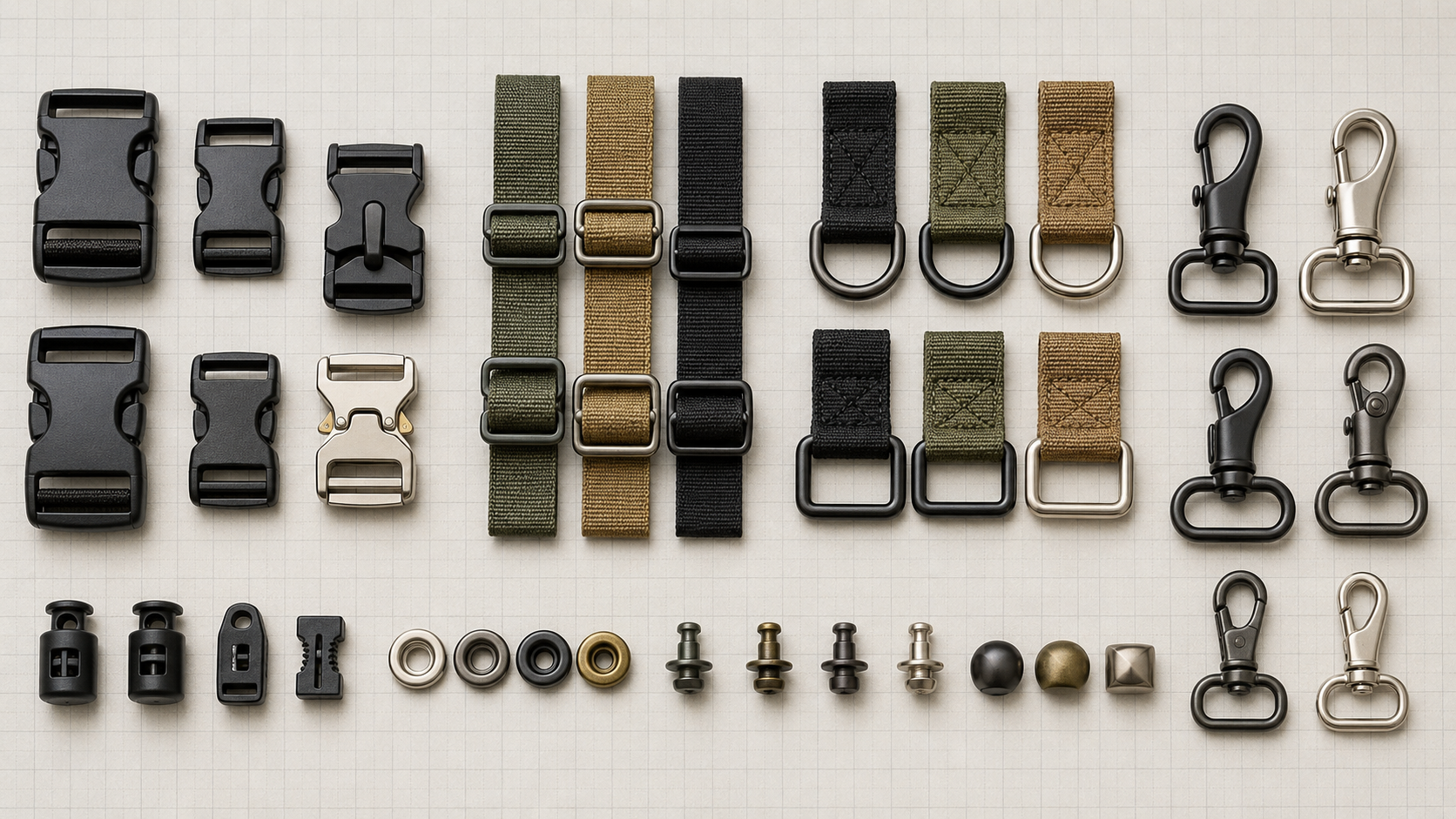
Buckles and strap adjusters
Bag buckles and strap adjusters solve related but different problems. A side-release buckle, for example, is chosen for an opening and fastening action. A slide or ladder-style adjuster manages strap length and helps hold the selected position. Some components combine parts of both jobs, so the RFQ should state the intended action instead of relying on the component name alone.
Review how the webbing enters and leaves the fitting. Look at folds, stitching space, adjustment direction, and whether the user can operate the part when the bag is packed. The final component, material, and interface remain project-specific. A plastic or metal label by itself does not establish suitability.
D-rings, rectangle rings, and other attachment rings
D-rings for bags often connect a detachable strap, handle, compression strap, or accessory. Rectangle rings can keep a wider strap flatter or create a more controlled routing path. The shape matters, but so do the opening, the strap angle, the hook that will connect to it, and the tab that holds the ring to the bag.
A ring can rotate or pull against the attachment in ways that are easy to miss on a flat drawing. Check its orientation with the bag filled, especially where a hook, strap, zipper path, or panel edge sits nearby. The sample should show whether the ring stays accessible and whether connected parts rub, twist, or interfere during normal handling.
Snap hooks and swivel hooks
Snap hooks for bags make straps or accessories removable. A swivel can also let the connection rotate, which may help a strap follow the user's movement. The hook opening must accept the selected ring, and the gate needs enough room to open without hitting the bag body or trapping nearby material.
Do not review the hook in isolation. Connect it to the actual ring and strap candidate, operate it from the expected direction, and turn it through the movement available in the assembled bag. A hook that looks suitable in a product photo can still be awkward once seams, padding, pockets, and strap angles restrict access.
Closures, rivets, feet, and related fittings
Other bag hardware names often appear as one long catalog list: magnetic or mechanical closures, snaps, locks, rivets, feet, zipper pulls, loops, and decorative fittings. Their construction roles are not interchangeable. A closure controls access, while a foot meets a contact surface. A rivet may form part of a local connection, but its exact role depends on the surrounding material layers and backing structure.
Include these fittings when they affect use, assembly, appearance, or sample approval. Record decorative parts separately from components that participate in carrying, opening, or attachment tasks. That distinction keeps appearance decisions from hiding structural questions.
Why a hardware tab is part of the attachment structure
A hardware tab is usually the material or webbing assembly that connects a ring, hook, or buckle to the bag body. It is not simply another metal or plastic item. Its dimensions, layers, fold, sewing area, position, and pull direction all influence how the fitting sits and moves.
Review the fitting and tab as one connection. The surrounding panel, lining, reinforcement layer, and stitch placement may also matter. For a closer look at this interface, see the custom bag stitching and reinforcement guide. The right construction still depends on the bag structure, carried items, material layers, loading direction, and any agreed project testing.
How should buyers match bag hardware to the bag structure?
Bag hardware selection works best as a sequence. Begin with the job, trace every interface, then review the variables that cannot be settled from a component picture alone.
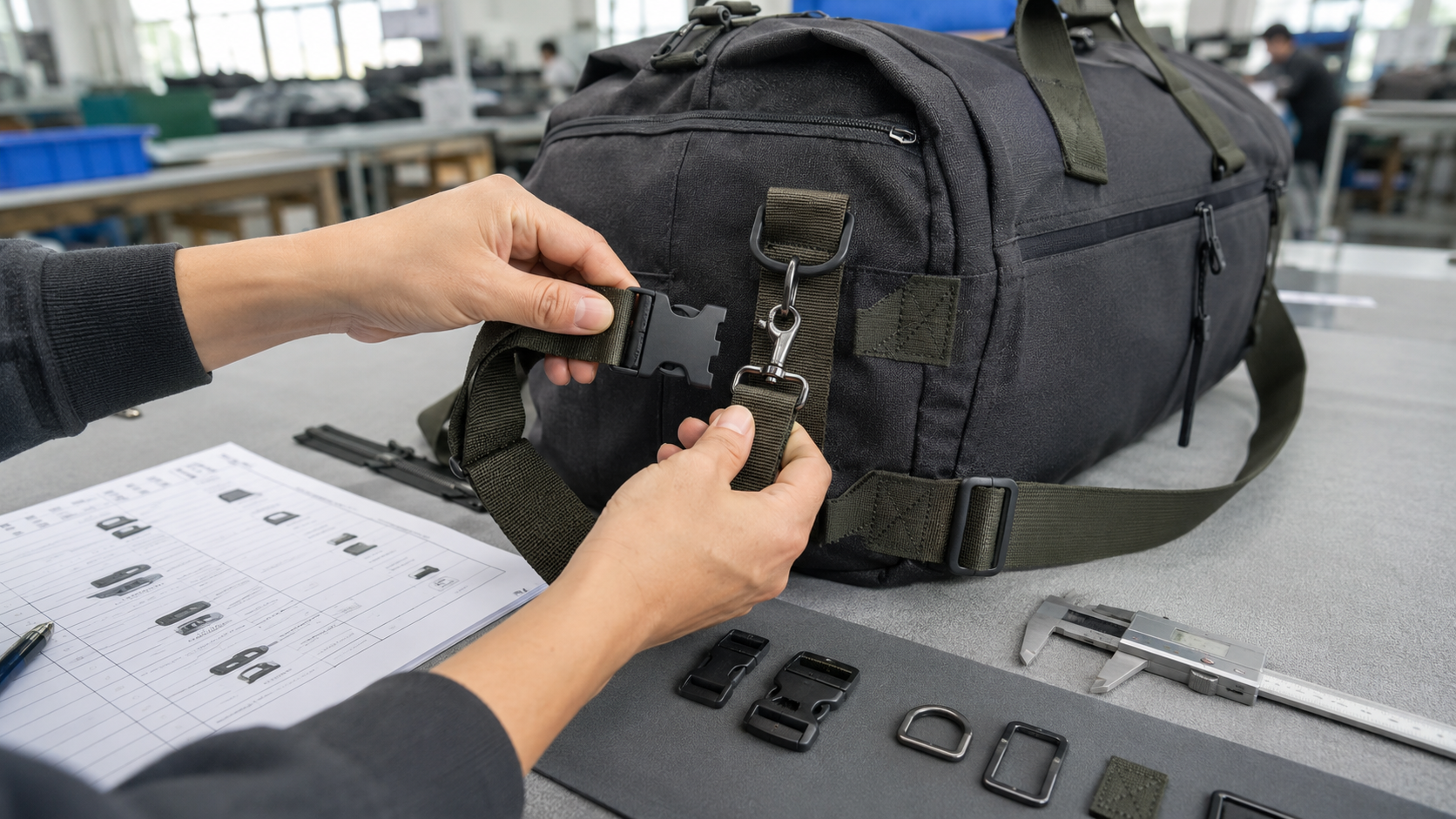
Start with the component's job and movement
Write one plain sentence for each fitting: "This buckle releases the shoulder strap," or "This ring provides a detachable handle point." State whether the part connects, adjusts, opens, closes, supports, protects, or decorates. Then describe its movement. Does it rotate, slide, fold, swing, or remain fixed?
This short description exposes unclear choices early. If two people describe the same component differently, the drawing or RFQ needs more detail before sampling.
Check the webbing, strap, and clearance interface
The fitting and webbing must be reviewed together. Record the proposed webbing or strap, the relevant width and thickness candidate, how it passes through the hardware, where it folds, and where it is sewn. Check whether the adjuster can move through the needed range and whether the loose end remains manageable.
Clearance deserves its own note. Fingers need room to operate a buckle or hook. A swivel needs space to turn. A ring should not disappear behind a padded panel when the bag is filled. These checks are more useful than assuming a standard size will work across different structures.
Treat material, finish, color, and exposure as project variables
Metal bag hardware is not always better than plastic hardware. Material choice can affect appearance, weight, feel, cost direction, operating behavior, and the questions that need to be checked for the intended environment. The answer depends on the component's job and the project's requirements.
Use the RFQ to record a material or finish candidate and any reference sample or color target. If corrosion resistance, coating performance, wear, or another measurable result matters, identify it as an open testing or acceptance item. Do not turn an ordinary visual review into a performance conclusion.
Review the attachment area, not only the fitting
Follow the expected force or movement from the hardware into the bag. Look at the tab, webbing end, panel layers, sewing area, and nearby seams. Ask whether the fitting changes angle when the bag is loaded and whether that movement pulls the tab in the direction anticipated by the drawing.
This review does not require the hardware article to duplicate a full stitching specification. It does require the connection to be visible in the RFQ, sample, and approval record. A fitting cannot be assessed responsibly while its attachment structure remains undefined.
What should a bag hardware RFQ or specification include?
A bag hardware specification should let another person understand the component's purpose, interfaces, references, and open questions. The table below can be copied into an RFQ, Tech Pack discussion, or sample review record.
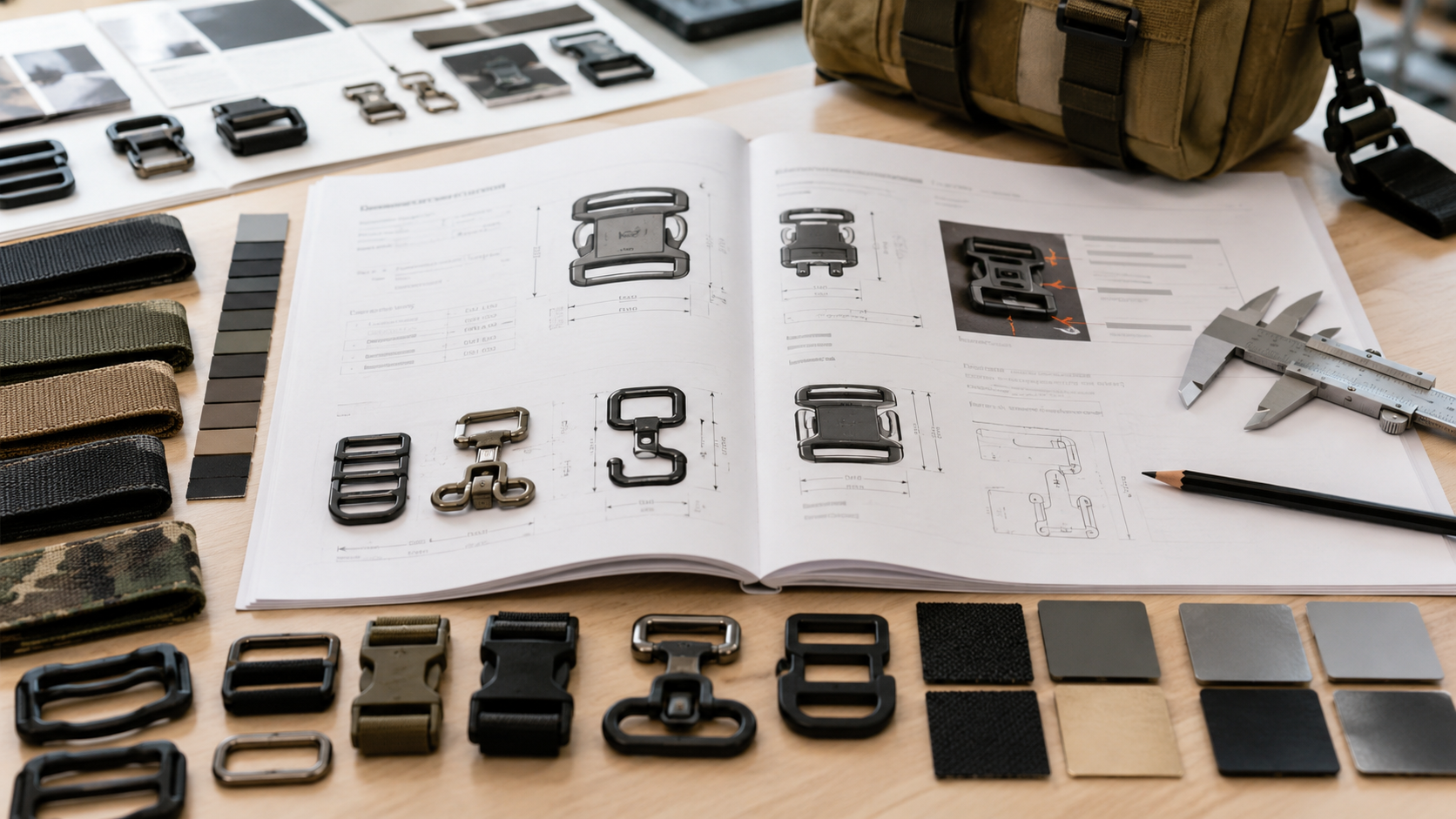
| Field | What to record | Why it matters |
|---|---|---|
| Component and function | Working name plus the job it performs | Prevents a name or catalog code from replacing the design requirement |
| Material and finish candidate | Proposed material, surface direction, color, or physical reference | Separates an initial candidate from a confirmed project specification |
| Strap or webbing interface | Proposed width and thickness, routing, folds, adjustment direction | Lets the component and strap be reviewed as an assembly |
| Opening and clearance | Gate or buckle access, movement space, nearby interference | Shows whether the user can operate the hardware in the finished bag |
| Attachment tab or area | Tab material, layers, position, orientation, sewing area | Connects the fitting decision to the bag structure |
| Use environment | Expected handling, contact, moisture or exposure concerns supplied by the buyer | Identifies conditions that may affect selection or testing needs |
| Visual reference | Drawing, annotated photo, physical sample, color reference | Reduces ambiguity between teams |
| Sample observation | Appearance, position, operation, routing, visible interference | Creates a clear list for ordinary sample review |
| Testing or acceptance open item | Result that needs a defined method, conditions, sample quantity and acceptance rule | Keeps formal proof separate from ordinary observation |
| Confirmation stage | RFQ candidate, sample revision, approved sample, drawing or written specification | Shows what is still open and what has been accepted |
Not every field will be complete at the first inquiry. Mark open items rather than filling them with assumptions. As the project moves into sampling, replace reference-only descriptions with the approved sample, drawing, or written specification used by both sides.
How should bag hardware be reviewed on a sample?
Sample review should move from simple observation to assembled use. Any formal performance requirement remains a separate, defined activity.
Check appearance, finish reference, position, and exposed edges
Start with the empty bag. Compare the hardware type, color or finish reference, quantity, orientation, and position with the current drawing or approved reference. Look for obvious surface issues, exposed edges, incorrect mating parts, or a component installed in the wrong direction.
These are visual and touch observations. They do not prove corrosion resistance, coating thickness, abrasion life, or long-term durability.
Operate buckles, hooks, rings, and adjusters with the intended strap
Open and close each buckle and hook in the assembled bag. Move adjusters through the intended range. Attach hooks to their rings and check whether swivels can rotate without catching nearby material. Watch the webbing as it passes through the fitting and note obvious slipping, bunching, jamming, twisting, or interference.
Record what you observed and under which setup. If operation changes when the bag is packed, that difference belongs in the sample review.
Review the attachment area with realistic contents
Load the actual product or realistic substitutes when the project provides suitable item and weight information. Lift, carry, open, close, and access the bag in ordinary use-like motions. Then check hardware tabs, strap ends, rings, hooks, buckle areas, and nearby seams for visible loosening, abnormal deformation, twisting, imbalance, or interference.
This is a practical loading and handling review. It is not a pull test, certified load test, fatigue test, or durability result. For the wider approval sequence, use the custom bag sample approval checklist.
Record approvals and unresolved test requirements
Finish the review by recording which component, appearance reference, position, operation, and attachment details are accepted. Link the decision to the approved sample, drawing, Tech Pack, or written specification that controls the next stage.
List unresolved tests separately. A useful test requirement identifies the test object, method, conditions, sample quantity, and acceptance rule. If those details are not yet agreed, keep the result open. Later production checks should remain tied to the approved basis; the custom bag quality control checklist covers that broader task.
How Pengtour supports hardware decisions for custom bag projects
Pengtour can review hardware as part of an eligible sewn functional bag project. The discussion can include the bag's intended use, carried items, structure, materials, straps, webbing, hardware candidates, attachment areas, sample, and packaging requirements. Plastic or metal buckles, D-rings, snap hooks, and other fittings can be considered when they fit the confirmed project scope.
Specific components, materials, finishes, colors, attachment construction, and checks are confirmed project by project. An approved sample, drawing, Tech Pack, physical reference, or written specification can provide the common basis for review. Where a measurable performance result matters, the testing and acceptance requirement also needs to be defined for that project.
Frequently asked questions
What hardware do I need to make a functional bag?
Start with the bag structure and the tasks the hardware must perform. List carrying connections, adjustable straps, detachable parts, closures, support or contact points, and any decorative fittings. Then match each item to its strap or webbing, attachment area, movement, clearance, and use conditions. The final list depends on the actual bag rather than a universal hardware set.
Is metal bag hardware always better than plastic hardware?
No. The better choice depends on the fitting's function, desired appearance and feel, weight considerations, use environment, cost direction, and project requirements. Compare actual candidates in the assembled sample. Define separate testing or acceptance requirements when the project needs proof of a measurable property.
How should D-rings, hooks, and buckles be matched to webbing?
Review the proposed fitting and webbing as one assembly. Check the relevant width and thickness candidate, routing, folds, adjustment direction, contact points, hook or ring opening, operating clearance, and attachment tab. Confirm the interface on the sample instead of applying one size rule to every bag.
Can ordinary sample checks prove load capacity or corrosion resistance?
No. Visual inspection, opening and closing, ordinary handling, and practical loading can reveal visible problems in a sample, but they do not prove load capacity, pull strength, corrosion resistance, cycle life, or long-term durability. Those claims require an agreed test object, method, conditions, sample quantity, acceptance rule, and appropriate records.
To discuss a bag hardware setup, send Pengtour the intended use, carried items, bag structure, strap or webbing information, hardware candidates, reference sample or drawing, and any unresolved testing requirements. These inputs give the project team a clearer basis for reviewing feasibility, sampling direction, and quotation boundaries through the quote request.