

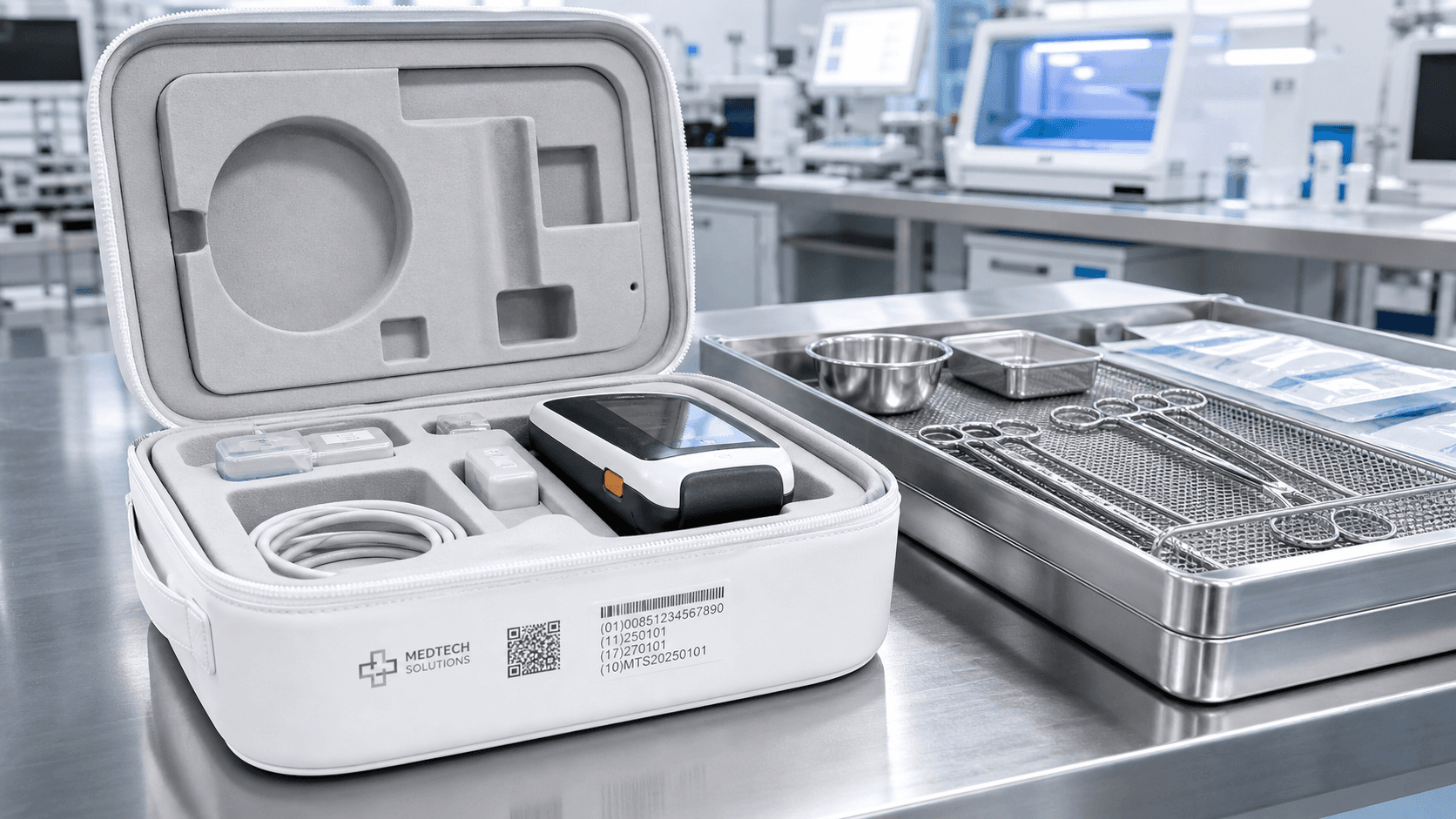
Medical sourcing compliance protocols require a structured, multi-layered risk-management approach to guarantee that secondary and protective packaging components do not compromise patient safety or device efficacy. For custom medical EVA cases housing surgical instruments, diagnostic monitors, or field emergency gear, compliance mandates strict adherence to ISO 13485 Quality Management Systems, documented ISO 10993 biocompatibility characterizations, validation of microbial barriers under ISO 11607, and clear EU MDR 2017/745 Unique Device Identification (UDI) labeling infrastructure.
Quick Regulatory Gateway Highlights
-
Zero Pre-Molded Placeholders: Off-the-shelf commercial components cannot bypass medical audits; all raw foam polymers, pigments, and adhesives require full chemical tracing.
-
Biocompatibility Shift: Current regulatory audits focus less on a generic checklist of completed tests and more on a holistic biological evaluation integrated directly into an ISO 14971 risk-management framework.
-
Cleanroom Verification: Cases used inside clinical environments or alongside sterile barriers frequently mandate structural assembly within ISO Class 7 or Class 8 cleanrooms to control bioburden baselines.
-
Traceability Thresholds: Failure to link an individual batch of finished case housings to its original raw material component lot can result in instantaneous regulatory non-compliance or product market freezes.
The 4 Critical Pillars of Medical EVA Case Sourcing
Engineering an enclosure for clinical environments requires transitioning from traditional commercial-grade standards to high-consequence medical materials. Four specific international regulatory frameworks govern this space.
1. ISO 13485 Quality System Integrity
Sourcing medical-grade custom EVA cases begins with verifying your supplier's operational infrastructure. An independent certificate is insufficient; the factory must demonstrate structured process validation, strict document change control, and absolute lot traceability.
Every modification to tool design, adhesive formulation, or textile backing layer must pass a rigorous change control review. If a vendor alters an outer PU leather supplier without issuing a formal engineering change notice (ECN), the downstream medical device manufacturer faces immediate regulatory exposure.
2. ISO 10993 Biological Characterization
Any casing or lining material that indirectly or directly comes into contact with clinical personnel or patients must undergo thorough biocompatibility profiling.
-
Cytotoxicity (EN ISO 10993-5): Evaluates if outgassing compounds or chemical residues from the compression molding adhesives cause cell lysis or inhibit cell growth in vitro.
-
Skin Irritation & Sensitization (ISO 10993-23): Verifies that the woven fabrics, soft microfiber linings, or synthetic leathers will not trigger an adverse localized dermal response during prolonged physical handling.
To evaluate potential chemical exposure hazards from extractable compounds found in synthetic case layers, toxicologists calculate the operational Margin of Safety :
Where represents the Tolerable Intake derived from empirical chemical characterization data under ISO 10993-17, and $ED$ represents the calculated Exposure Dose resulting from reasonably foreseeable usage or misuse scenarios. Sourcing compliance dictates a baseline metric where across all tested patient contact pathways.
3. ISO 11607 Sterilization Compatibility & Microbial Barriers
If a custom EVA case acts as a protective shield for a terminally sterilized medical device or procedure kit, it must meet the requirements of General Safety and Performance Requirement (GSPR) 11.1 under the EU Medical Device Regulation. The packaging matrix must ensure the contents remain sterile throughout transit and storage.
-
Ethylene Oxide (EtO) Penetration: The case material and internal die-cut foam arrays must withstand gas penetration cycles without absorbing hazardous chemical residues above permissible threshold levels.
-
Particulate Contamination Control: Woven materials must not generate loose lint, loose threads, or particulate matter that could settle onto surgical tools or inside sterile packaging fields.
4. EU MDR and FDA Traceability (UDI Infrastructure)
Under current regulatory structures, cases paired permanently with Class IIa and above medical equipment must incorporate integrated traceability markers. Unique Device Identification (UDI) sequences, combining a Device Identifier (UDI-DI) and a Production Identifier (UDI-PI), must be legibly and permanently applied to the exterior case shell via high-durability thermal transfer labels, direct laser etching, or sonic-welded custom tracking elements.
The Compliance Auditing Workflow for Custom Medical EVA Cases
Securing regulatory clearance for a medical case requires executing a methodical, transparent documentation and production workflow before initializing high-yield bulk production.
Engineering Insights: Resolving Cytotoxicity Failures in Surgical Cases
From the Factory Floor: A multinational medical diagnostics group approached our technical division after their custom-molded surgical instrumentation kit case failed a third-party in vitro cytotoxicity test (ISO 10993-5) during an FDA 510(k) submission review. The failure was jeopardizing an international market launch.
The Root Cause Analysis: Our engineering team performed a detailed gas chromatography-mass spectrometry (GC-MS) trace on the case layers. The chemical data indicated that the primary failure originated from a cheap, solvent-based neoprene contact adhesive used by a previous vendor to bond the interior microfiber lining to the thermoformed EVA core. When enclosed, the volatile organic compounds (VOCs) from the curing solvent outgassed inside the case, contaminating the interior foam cavities and depositing cytotoxic chemical residues directly onto the plastic handles of the surgical instruments.
The Engineered Remedesign: We overhauled the manufacturing process by introducing a 100% solvent-free, medical-grade thermoplastic hot-melt film adhesive. This structural bonding sheet is activated through precise heat lamination, completely eliminating liquid chemical cross-linkers and curing solvents. Additionally, we replaced the standard commercial EVA core with an ultra-clean, low-odor, medical-grade EVA matrix formulated with zero blowing-agent residues.
The Results: New sample production runs were executed inside our verified cleanroom cells and sent for independent laboratory reassessment. The re-engineered cases achieved an absolute zero reactivity score on all subsequent cytotoxicity evaluations, allowing the client to secure immediate FDA clearance and proceed with their global commercial rollout.
Technical Regulatory Compliance Matrix
To assist compliance engineers and medical procurement leads in specifying material requirements, the comparative matrix below matches specific clinical environments with their mandatory technical parameters:
| Compliance Parameter | Clinical Diagnostic Case | Surgical Instrument Module | Field Emergency Response Kit |
| Typical Risk Classification | FDA Class I / MDR Class I | FDA Class II / MDR Class IIa | FDA Class I / MDR Class I |
| Biocompatibility Minimums | ISO 10993-5, -23 (Indirect) | ISO 10993-1, -5, -10 (Direct Skin) | ISO 10993-5 (Indirect Contact) |
| Primary Material Shell | 1.0mm Anti-Microbial PU | High-Density 75C Medical EVA | 1680D Impermeable Nylon |
| Sterilization Suitability | Non-Sterile / Wipe Clean Only | Compatible with EtO / Gamma | Non-Sterile / Field Sanitization |
| Cleanroom Assembly Need | Recommended (ISO Class 8) | Mandatory (ISO Class 7) | Standard Controlled Environment |
| Sanitation Compatibility | Isopropyl Alcohol (70-90%) | Autoclave Wraps / Chemical Wipes | Aggressive Bleach Dilutions |
| Traceability Labeling | Laser-Etched UDI DataMatrix | Molded Direct UDI Tag | High-Contrast Thermal UDI Plate |
Validating Your Medical Supply Chain Partner
When sourcing custom protective solutions for highly regulated global healthcare industries, selecting an unqualified vendor introduces severe product liability and regulatory risks. Procurement teams should utilize a strict validation checklist during on-site supplier audits:
-
Do they maintain an active ISO 13485 certification? Ensure the scope explicitly covers custom manufacturing or cleanroom-based assembly operations.
-
Can they provide complete raw material source traceability? A compliant supplier must maintain documented links tracking every chemical ingredient back to its original manufacturing batch or chemical formulation run.
-
Are their production lines equipped for cleanroom assembly? Factories handling high-purity medical cases must operate physical environmental controls that restrict airborne dust, microbial bioburden, and particulate drift during critical lamination and lining processes.
Ready to secure a fully compliant, precision-engineered protective enclosure for your next medical hardware program? We invite you to explore our advanced manufacturing capabilities. Learn about our strict medical quality infrastructure by visiting our About Us Page to inspect our specialized machinery and cleanroom configurations, or navigate directly to our Contact Page to submit your component blueprints, material safety standards, or regulatory compliance lists for an expert engineering review.
When the medical packaging requirements and validation scope are defined, use our request a medical case quote page to submit the project details for review.
Frequently Asked Questions (FAQ)
Does a custom EVA case require an explicit cleanroom certification for all medical applications?
Not necessarily. If the custom case functions as an external shipping box, secondary storage sleeve, or non-invasive field organizer (e.g., paramedic gear bags), production inside a certified cleanroom is generally not required. However, if the case enters a sterile operating room environment or holds instruments that interface directly with surgical tools before sterile barrier prep, assembly inside a validated ISO Class 7 or Class 8 cleanroom is mandatory to satisfy strict regulatory bioburden limits.
Why do standard commercial-grade EVA foams frequently fail medical cytotoxicity reviews?
Commercial-grade EVA foams often incorporate cheap industrial blowing agents, chemical foaming accelerators, and heavy metal color stabilizers to reduce manufacturing costs. When raw components are heated during the thermoforming compression cycle, these trace compounds break down and leave volatile chemical residues that can cause severe cell damage during standard ISO 10993-5 laboratory cell assays. True medical-grade cases utilize pure, washed polymer matrices specifically cross-linked without hazardous chemical accelerators.
Can custom medical EVA cases withstand repeated automated autoclave sterilization?
Standard Ethylene-Vinyl Acetate (EVA) polymers possess a softening point that typically ranges between 65°C and 80°C. Because standard steam autoclave sterilization operates at a much higher temperature of 121°C to 134°C, a direct autoclave cycle will melt, deform, and structurally compromise the case shell. For medical items requiring sterilization within an assembled EVA case, you must utilize alternative low-temperature sterilization methods, such as Ethylene Oxide (EtO) gas or Gamma Irradiation processing.
What is the typical shelf life validation protocol for a medical EVA case?
Under ISO 11607 guidelines, packaging must demonstrate physical integrity over its stated shelf life (typically 3 to 5 years for durable medical devices). Manufacturers evaluate this by placing finished case assemblies into environmental ovens for accelerated aging studies, utilizing standardized mathematical models (such as ASTM F1980 protocols) to simulate prolonged shelf storage through exposure to elevated temperatures, followed by physical drop and peel strength testing to verify that zero structural degradation occurred.