

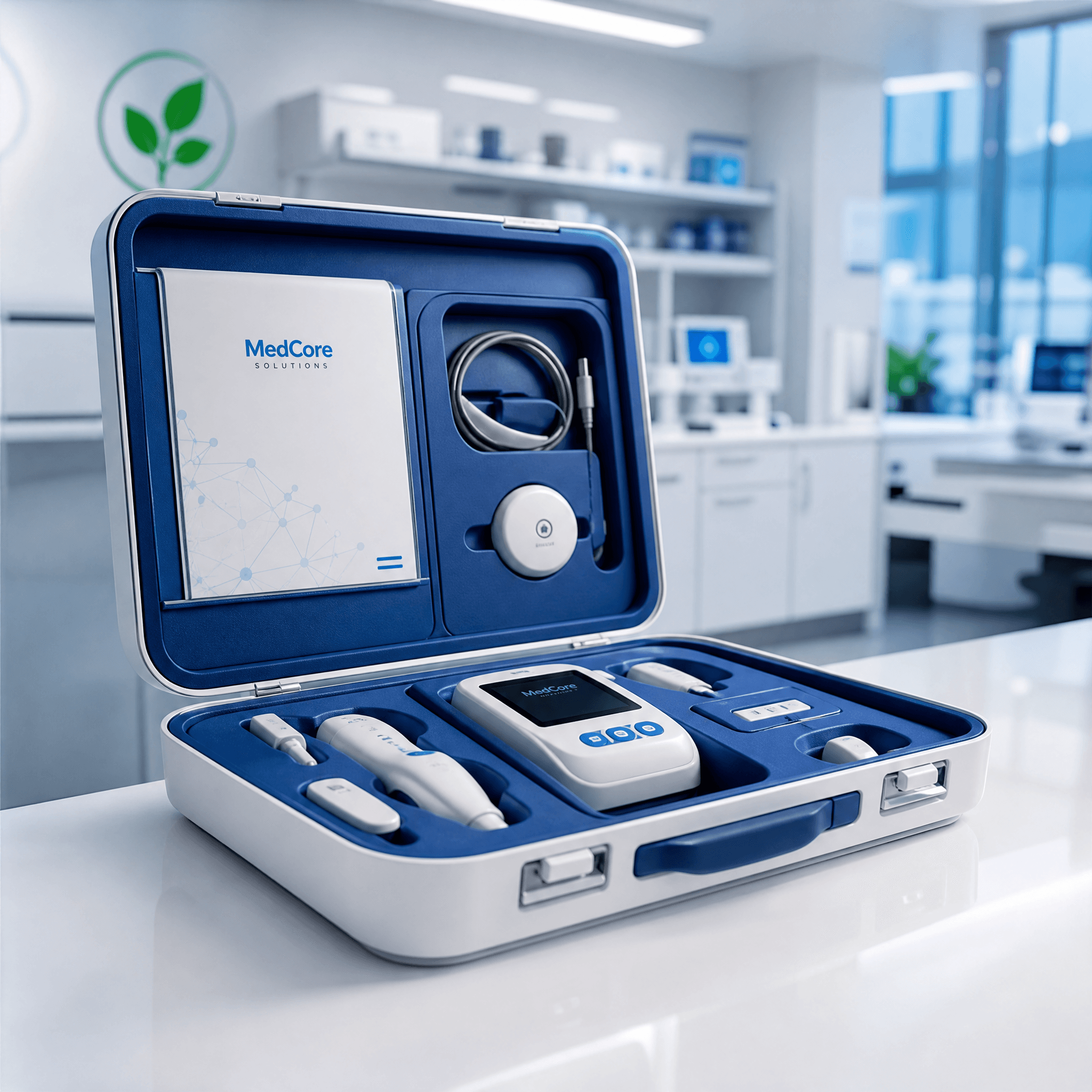
As the global healthcare landscape accelerates its strict requirements for infection control, environmental sustainability, and chemical traceability, the architectural demands on medical protective cases have transcended primitive shock absorption. Today, cleanability, recyclability, and uncompromising global compliance stand as the three non-negotiable structural paradigms for any successful medical device casing.
1. Cleanability: Eradicating Infection Control Blind Spots
In high-velocity clinical environments, emergency medical services (EMS), and decentralized telehealth settings, portable medical devices (such as handheld ultrasound probes, defibrillators, and multi-parameter patient monitors) encounter continuous exposure to biological pathogens on a daily basis.
The Fatal Vulnerabilities of Traditional Cut-and-Sew Enclosures
Legacy fabric-based, stitched carrying bags utilize porous woven nylon or canvas integrated with intricate zippers and standard seams. Under microscopic examination, these structural elements act as perfect biological traps for bacteria, viral strains, and bodily fluids. Compounding the risk, when clinical staff apply heavy-duty institutional disinfectants—such as high-concentration isopropyl alcohol, bleach, or hydrogen peroxide wipes—the chemical agents saturate the material core, rapidly degrading stitched threads and delaminating standard textiles within months, causing premature structural failure and foul odors.
Material Engineering Alternatives for Strict Disinfection
To establish a fully sanitizable, crevice-free architecture, modern medical casings are abandoning traditional textile construction in favor of advanced monolithic fabrications:
-
Thermoformed EVA Composites: Leveraging Ethylene-Vinyl Acetate (EVA) copolymer formulations laminated with smooth, dense, chemically inert outer membranes. These designs eliminate traditional needle-and-thread stitching entirely via laser-welded seams or specialized advanced bonding technologies.
-
Blow Molded and Rigid Injected Thermoplastics: Utilizing medical-grade Polycarbonate (PC) or High-Density Polyethylene (HDPE) allows engineers to achieve single-walled or double-walled structural shells. These designs are modeled with large radius-curved corners rather than sharp 90-degree internal angles, preventing debris accumulation and facilitating complete decontamination in seconds.
2. Circular Engineering: Shifting from Composite Layups to Mono-Materials
Global healthcare supply chains are aggressively adopting rigorous decarbonization frameworks and circular economy mandates. Historically, industrial instrument cases relied on an un-recyclable matrix of disparate materials—bonding polyester shells, polyurethane foam inserts, metal rivets, and toxic solvent-based adhesives together. This "sandwich" layout presents an insurmountable recycling bottleneck, forcing expired units straight to landfills or waste incinerators.
The Implementation of Mono-Material Architecture
To deliver true end-of-life recyclability, advanced industrial designers are shifting to mono-material product design. In this configuration, the external protective shell, internal impact-absorbing foam inserts, and structural latching components are engineered exclusively from the exact same plastic polymer ecosystem (e.g., 100% recyclable Polypropylene (PP) or fully circular Thermoplastic Polyurethane (TPU)).
Commercial Advantages of Closed-Loop Packaging
By engineering a zero-sorting, easily disassembled single-polymer assembly, medical device original equipment manufacturers (OEMs) easily satisfy the European Union's stringent Waste Electrical and Electronic Equipment (WEEE) Directive. Furthermore, it directly optimizes the manufacturer's scoring during hospital Green Procurement tenders, translating sustainability initiatives into definitive marketplace victories.
3. Deciphering Global Chemical Compliance: RoHS, REACH, Prop 65, and PFAS
For cross-border medical device deployment, international customs and healthcare regulatory bodies routinely block multimillion-dollar product shipments due to trace hazardous compounds hidden inside secondary case components. Navigating this legal minefield requires strict compliance across four foundational frameworks:
RoHS: Eliminating Heavy Metals from External Peripherals
Although the Restriction of Hazardous Substances (RoHS) Directive primary targets internal printed circuit boards and electronic assemblies, it rigorously extends to structural carrying enclosures, clip attachments, and zinc-alloy zipper sliders. Case components must pass analytical testing validating the total absence of lead, cadmium, mercury, and hexavalent chromium.
REACH and the Dynamic SVHC Registry
The European Union's REACH regulation maintains a constantly updating registry of Substances of Very High Concern (SVHC). Plasticizers and softeners routinely used to manipulate plastic flexibility—such as restricted phthalates (DEHP, DBP, BBP)—are major targets for enforcement. Case manufacturers must demonstrate strict supply-chain traceability, validating that SVHC concentrations remain securely below the 0.1% weight-by-weight (w/w) threshold.
California Proposition 65 (Safe Drinking Water and Toxic Enforcement Act)
Deploying medical devices into the Californian market demands meticulous material analysis. Even if the underlying diagnostic device is completely benign, if an unvetted carrying strap or printed logo overlay releases listed reproductive toxins or carcinogens without an explicit on-product warning label, the OEM faces severe litigation and punitive financial liabilities.
The Global Phasedown of PFAS (Per- and Polyfluoroalkyl Substances)
Historically praised for delivering superior oleophobic, hydrophobic, and stain-resistant coatings, PFAS compounds—famously known as "forever chemicals"—are undergoing sweeping international bans. Next-generation medical cases must utilize validated PFAS-free durable water repellent (DWR) alternative coatings and eco-friendly additives to ensure unimpeded global market entry.
4. Technical Blueprint for Product Managers: Evaluating Case Partners
Given the highly cross-disciplinary engineering required, medical device OEMs must stop treating custom case vendors as simple cut-and-sew factories. Instead, they should treat them as strategic engineering and compliance partners. When auditing potential suppliers, prioritize the following benchmarks:
-
Full Data Transparency: Can the partner immediately supply accredited RoHS, REACH, and biocompatibility documentation (e.g., ISO 10993) for every foam formulation, adhesive layer, and zipper pull?
-
In-House Testing Infrastructure: Do they possess validated laboratory setups to execute drop-testing, thermal cycling, and most importantly, Chemical Compatibility Testing to simulate thousands of heavy wipe cycles over extended lifetimes?
-
Process Agility: A tier-one partner should never push a one-size-fits-all manufacturing method, but must demonstrate verified expertise across thermoforming, injection molding, blow molding, and advanced sonic welding to adapt to unique clinical environments.
Conclusion
In the highly competitive medical device arena, the diagnostic or therapeutic device remains the ultimate hero—yet a masterfully engineered peripheral ensures it reaches the front lines safely. A custom protective case engineered with seamless infection control geometries, mono-material circularity, and pristine global compliance protects your hardware, elevates your brand authority, and removes regulatory friction on a global scale.
FAQ
Q: Why are modern medical carrying cases actively replacing traditional zippers and needle-stitched seams? A: Needle-punched holes and zipper tracks are prime harborages for biological micro-contamination and prevent complete sanitization. Modern solutions rely on seamless thermoformed EVA structures or high-frequency welded joints, providing smooth, non-porous outer surfaces that allow clinical personnel to execute 100% surface disinfection using institutional wipes in seconds.
Q: What exactly is the value of a "Mono-Material" configuration in medical case design? A: Mono-material engineering mandates that the protective shell, internal protective foam, and closures are constructed from the exact same polymer family (such as 100% Polypropylene). This removes the labor-intensive requirement to separate bonded materials during disposal, allowing hospitals to discard the entire assembly directly into standard polymer recycling streams.
Q: Why must an unpowered plastic instrument case comply with electronic frameworks like RoHS? A: Global custom offices and international health agencies audit protective cases as integral elements of the overarching medical device system. If an unvetted case handle, logo emblem, or strap contains restricted heavy metals or prohibited phthalates under RoHS/REACH, the entire medical device system faces customs impoundment or mandatory market recall.
For a medical-device case with defined cleaning and compliance requirements, use our request a medical case quote page to submit the device, material, and validation scope.