

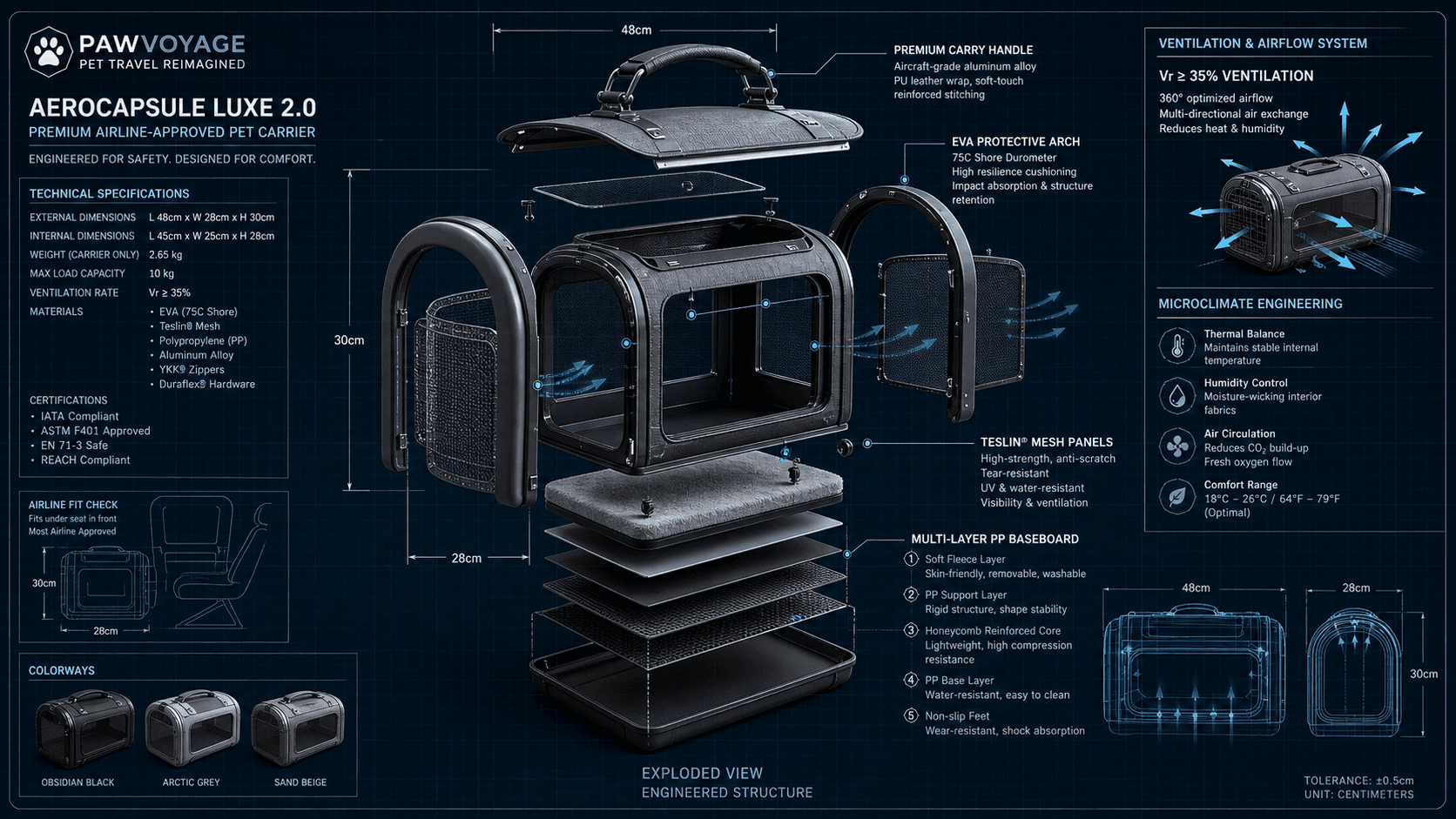
Engineering a premium custom pet carrier requires a precise synthesis of structural physics, textile durability, and biological safety. Unlike standard soft-sided luggage, a commercial pet carrier acts as a portable, load-bearing protective capsule that must support dynamic animal weights, resist clawing and chewing forces, maintain an optimal microclimate, and ensure absolute escape-proof security. For product managers and procurement teams, mastering these structural parameters is critical to launching a successful, compliant product in the global pet market.
Quick Engineering Checklist
-
Structural Rigidity: Utilize 65C to 75C Shore durometer EVA panels to prevent the carrier sidewalls from collapsing inward under external forces or during transport.
-
Ventilation Sufficiency: Ensure the continuous mesh cutout configuration meets or exceeds standard airline and veterinary safety airflow metrics.
-
Hardware Interactivity: Specify exclusively auto-locking zipper sliders that cannot be forced open by internal muzzle pressure or paw manipulation.
-
Chemical Safety Compliance: Guarantee that all interior linings, base pads, and structural bonding agents undergo strict certification testing to ensure they are free from toxic off-gassing.
1. Structural Architecture: Molded EVA vs. Wire/Fabric Frames
The foundation of a pet carrier's safety profile is its structural architecture. Traditional pet carriers generally fall into two sub-optimal categories: completely rigid injection-molded plastic crates (which are heavy, bulky, and uncomfortable for human transport) and flimsy wire-and-fabric bags (which consistently sag, crowding the animal and risking suffocation during movement).
Premium product engineering relies on a hybrid approach using thermoformed Ethylene-Vinyl Acetate (EVA) structural panels.
Core Benefits of Thermoformed EVA Shells
By laminating high-density fabrics directly onto a semi-rigid EVA core, manufacturers can create a custom molded case shell that yields excellent performance characteristics:
-
Symmetry Retention Under Load: The compression-molded sidewalls act as a protective arch, redistributing external impacts and preventing the carrier from compressing when lifted by the handles or secured with a vehicle seatbelt.
-
Substantial Weight Reduction: High-density EVA provides structural memory identical to rigid plastics at roughly 45% less physical mass, reducing user fatigue during transit.
-
Acoustic and Thermal Dampening: The closed-cell polymer structure of EVA naturally attenuates external industrial noises (such as airport terminal clamor or traffic hums), lowering stress and anxiety scores in transported animals.
Specifying Shore Hardness for Pet Carriers
For the structural side panels and base platforms of custom pet carriers, engineers should specify a Shore C durometer rating between 65C and 75C. Anything lower than 60C will exhibit structural sag when a 10kg animal moves dynamically inside the unit.
2. Ventilation Dynamics and Mesh Engineering
Maintaining a continuous supply of fresh oxygen and facilitating rapid heat dissipation are the most critical safety aspects of pet carrier design. Animals under stress exhibit elevated respiration rates, generating localized humidity and carbon dioxide accumulation if ventilation is restricted.
The Ventilation Area Ratio Formula
To validate a design for international travel or airline approval, engineers use a standardized calculation to determine the Ventilation Area Ratio . Let represent the total surface area of all unblocked, open mesh cutouts, and let represent the cumulative surface area of the carrier's external shell. The ratio is expressed as follows:
-
Urban/Short-Commute Standard: Designs must achieve a minimum , spread across at least two opposing vertical faces to facilitate basic cross-ventilation.
-
Long-Haul/Airline-Approved Standard: International travel guidelines regularly require a minimum , distributed evenly across three or four distinct vertical planes to prevent airflow blockages if one side of the carrier is pushed against a vehicle seat or luggage compartment wall.
Polymer Mesh Selection Matrix
Standard nylon or polyester apparel mesh is entirely inadequate for pet applications; an anxious animal can shred thin fibers within minutes. Engineers must specify reinforced, industrial-grade alternatives:
[Standard Nylon Mesh] ➔ Fails quickly under claw scratching and biting.
[PVC-Coated Polyester Mesh] ➔ High tensile strength; excellent baseline for urban use.
[Teslin Mesh / Rubberized Vinyl] ➔ Maximum puncture resistance; ideal for professional carriers.
-
PVC-Coated High-Tenacity Polyester: A cross-woven polyester core encapsulated in a thick Polyvinyl Chloride coating. This configuration prevents individual threads from separating or fraying when subjected to localized claw scratches.
-
Teslin Mesh: A premium fabric woven from vinyl-coated polyester yarns. It features exceptional dimensional stability, is practically impossible for domestic animals to tear, and allows for clean die-cutting without edge unraveling.
3. Ergonomics, Load-Bearing Mechanics, and Hardware Integrity
A premium carrier must safely balance the physiological needs of the pet with the ergonomic requirements of the human operator.
Baseboard Stabilization and Center of Gravity
To prevent the "hammock effect"—where the base of a soft carrier sags under the pet's weight, forcing its limbs together and causing spinal stress—the lower platform requires a multi-layer composite setup.
The engineered baseline utilizes a solid, high-impact Polypropylene (PP) or lightweight plywood internal board wrapped inside a shock-absorbing layer of Expanded Polyethylene (EPE) foam. This composite board is enclosed in a waterproof, removable, and machine-washable interior sleeve. The rigid core keeps the floor perfectly flat, providing a stable foundation for the animal to stand, turn around, and lie down naturally.
Auto-Locking Hardware Engineering
Hardware failures in transit can lead to dangerous pet escapes. Standard zipper sliders shift when constant internal force is applied to the zipper track.
-
Auto-Locking Sliders: Custom carriers must incorporate specialized auto-locking zipper tracks (such as verified YKK or equivalent premium industrial configurations). These sliders feature an internal pin mechanism that locks onto the zipper teeth automatically unless the user manually pulls the external metal tab. Internal pushing or prodding by the animal cannot move the slider.
-
Reinforced Anchor Point Geometry: Shoulder strap D-rings and hand-strap terminations must be anchored directly into the structural EVA shell or reinforced with heavy-duty box-X stitching backed by internal synthetic leather washers to distribute pulling forces across a broad surface area.
4. Engineering Insights: Resolving Stress-Fractures in Premium Pet Backpacks
From the Factory Floor: A leading luxury pet lifestyle brand contacted our technical engineering division after launch to resolve a critical structural issue with their newly introduced molded pet travel backpack. Field reports indicated that when transporting pets weighing over 8kg, the upper arch of the backpack began to buckle downward, which compressed the internal cabin space and caused the main zipper track to bind up and jam.
The Failure Analysis: Our engineering team conducted a thorough tear-down review. The previous manufacturer had utilized a lightweight 50C density EVA foam core to achieve a soft exterior feel, and had placed the heavy-duty ventilation mesh directly adjacent to the main load-bearing zipper seam without any internal structural support. When loaded, the weight of the pet pulled down on the base, causing the soft 50C upper sidewalls to cave inward under the tension.
The Engineered Redesign: We redesigned the backpack's structural matrix by upgrading the perimeter core to a dual-density system. We specified a rigid 75C Shore durometer EVA frame for the structural spine and side arches, while maintaining a softer 60C EVA layer for the front non-structural panels.
We also integrated a concealed, lightweight spring-steel internal wire hoop directly inside the zipper fabric seam, anchoring it securely down into the rigid base platform.
The Results: Laboratory load testing demonstrated that the reinforced frame structure could withstand a continuous vertical load of 22kg before showing any measurable structural compression. This completely eliminated the zipper binding issue and guaranteed a secure, spacious internal cabin environment for the pet under all normal operating conditions.
Technical Specifications Comparison Table
To assist B2B procurement managers in aligning material specifications with their target market tier, the matrix below outlines the typical engineering standards across various product classes:
| Performance Parameter | Everyday Urban Carrier | Airline-Approved Carrier | Rugged Outdoor Cabin Backpack |
| Target Pet Mass Range | 1 – 6 kg | 1 – 10 kg | 5 – 14 kg |
| EVA Core Density | 60C – 65C Shore Durometer | 65C – 70C Shore Durometer | 70C – 75C Shore Durometer |
| Ventilation Ratio ($V_r$) | $\ge 25\%$ | $\ge 35\%$ | $\ge 30\%$ |
| Mesh Specification | 450D PVC-Coated Polyester | High-Strength Teslin Mesh | Reinforced Rubberized Vinyl Mesh |
| Zipper Specification | #5 Standard Auto-Lock | #8 Heavy-Duty Auto-Lock | #10 Rugged Dual-Lock Track |
| Base Stabilization | Thin PE Board + PU Foam | Rigid PP Board + 10mm EPE | Reinforced Ply-Composite Floor |
| Interior Lining Textile | 210D Polyester Taffeta | Antimicrobial Microfiber | Washable Waterproof TPU Film |
5. Chemical Compliance, Toxicity Safeguards, and Quality Testing
Because animals are enclosed in a confined space where they may lick, chew, or rub against the interior surfaces, chemical compliance testing is a paramount legal and ethical requirement for international brands. All raw components—including the core EVA sheets, liquid bonding adhesives, fabric dyes, and hardware plating—must undergo independent laboratory verification.
Key Regulatory Frameworks
-
REACH Compliance: Ensures that all plasticizers and synthetic textiles are completely free from Substances of Very High Concern (SVHC), such as toxic phthalates or heavy metals, satisfying the strict requirements of the European Chemicals Agency REACH Directives.
-
RoHS Standards: Validates that any integrated electronics (such as built-in ventilation fans, interior LED lighting systems, or temperature sensors) are free from restricted hazardous materials in accordance with international RoHS Guidelines.
-
Formaldehyde-Free Certification: Ensures that the thermal lamination adhesives used to bond the outer fabric to the EVA core do not release volatile organic compounds (VOCs) when exposed to high temperature and humidity levels inside the carrier cabin.
Rigorous Physical Testing Standards
Prior to final manufacturing sign-off, production batches should undergo extensive mechanical stress testing:
-
Static Load Testing: The carrier is loaded with 200% of its rated maximum pet weight and suspended by its handles for 72 continuous hours to verify that no seams pull apart and no hardware deforms.
-
Dynamic Oscillation Testing: Simulates the continuous bouncing motion experienced when a human walks with the carrier, validating long-term handle and strap resilience over thousands of motion cycles.
-
Claw Abrasion Replication: A mechanical test jig uses weighted steel picks to simulate animal scratching across the ventilation mesh panels, ensuring the weave resists tearing under active stress.
Sourcing and OEM Manufacturing Partnerships
Transforming a conceptual sketches into a market-ready, structurally sound custom pet carrier requires a manufacturing partner with deep expertise in both advanced thermoforming and heavy-duty textile assembly. Partnering directly with an asset-equipped OEM factory ensures that complex design features, such as draft angles, structural durometer transitions, and escape-proof hardware integrations, are executed flawlessly.
At Pengtour, we specialize in engineering high-performance, custom thermoformed EVA solutions and complex carry systems that meet strict international corporate standards. To learn more about our factory capacity, machinery setups, and quality management protocols, we invite you to explore our manufacturing capabilities. When you are ready to submit your engineering blueprints, 3D step files, or material requirement documents for a comprehensive review, please visit our engineering contact portal to initiate a collaborative prototyping review and formal production quotation.
Frequently Asked Questions (FAQ)
What makes a custom pet carrier officially "Airline Approved"?
While individual airlines retain specific dimensional rules, general airline-approved criteria require a carrier to fit seamlessly beneath a standard cabin seat. The design must feature ventilation mesh on at least three distinct sides, incorporate water-resistant base linings to prevent fluid leaks, and utilize full auto-locking zippers. Additionally, the carrier must remain structurally sound when lifted while retaining enough flexibility to compress slightly under seat clearance limits without harming the pet.
Why is a dual-density EVA layout recommended for larger pet backpacks?
Larger animals generate significant localized downward force on the base of a carrier during transport. A single soft EVA grade cannot support this load without bowing, which pulls the side panels inward and compromises the pet's space. A dual-density layout uses an ultra-high-density EVA frame (75C) along the main structural spine and base to absorb load stresses, while utilizing a lighter, more flexible EVA grade (60C) on the entry panels to reduce overall weight and improve user comfort.
How can we integrate custom branding onto a high-ventilation pet carrier?
Because a large percentage of the carrier surface area is dedicated to ventilation mesh, branding should be placed on the rigid structural EVA panels or webbed strap paths. Highly effective B2B branding options include deep blind debossing directly into PU leather coverings, sonic-welded molded rubber (TPU) badges, custom-engraved metal alloy zipper pulls, or high-density embroidery along the primary carrying handle straps.
How do you prevent fabric delamination on a carrier that is frequently cleaned?
Pets can introduce moisture, mud, and organic waste into the carrier environment. To prevent the exterior and interior textiles from delaminating from the internal EVA core during wash cycles, the factory must use cross-linked, heat-activated Polyurethane (PU) lamination adhesives rather than cheap water-based glues. For medical or premium hygiene applications, the interior should be lined with a waterproof TPU film or non-porous PU leather that allows for seamless surface disinfection without moisture seeping into the internal stitch lines.
For a carrier with specific cleaning, ventilation, and material requirements, use our request a pet carrier quote page to submit the intended structure and order details.