

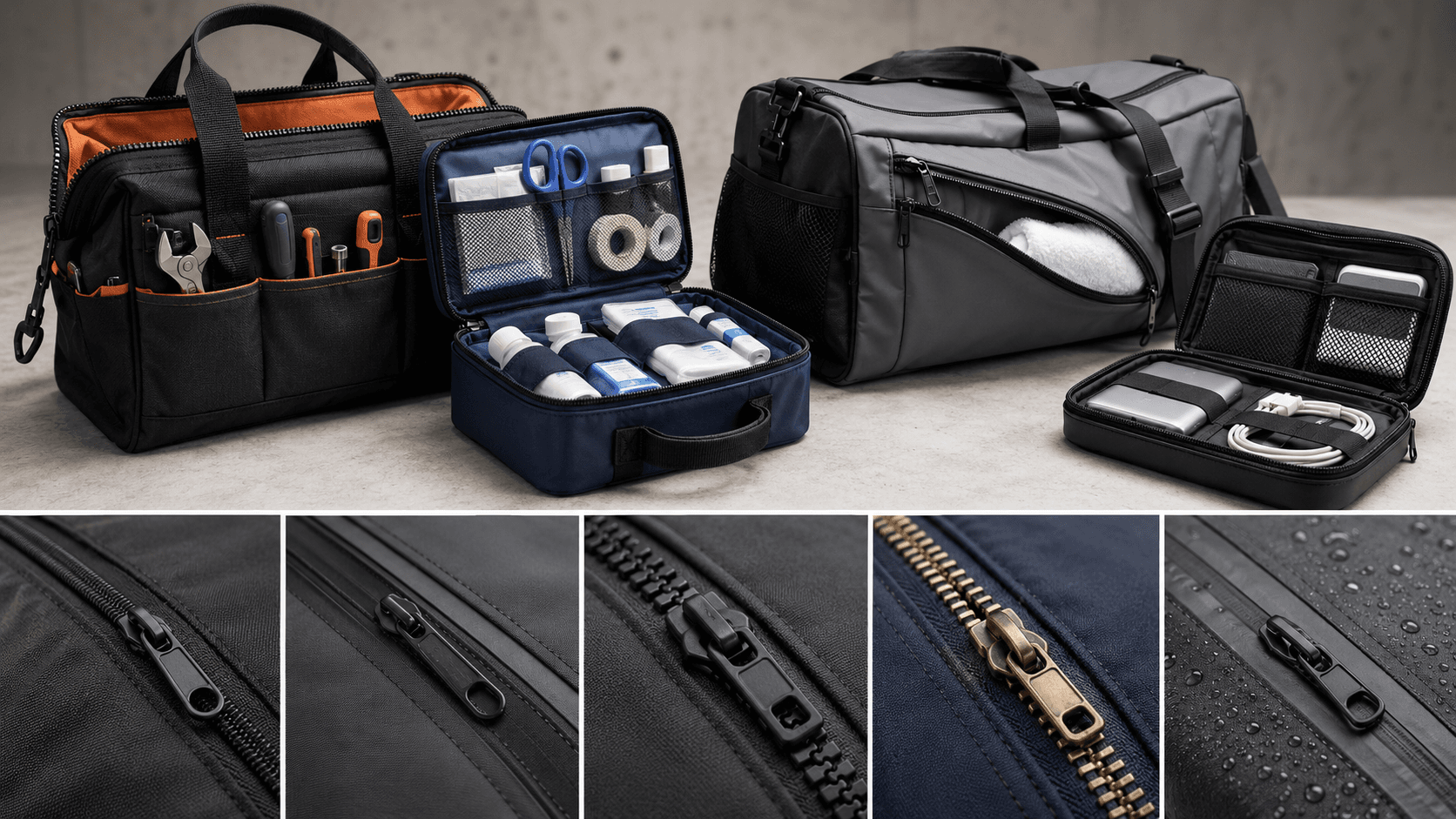
Choosing a zipper for a custom functional bag should not begin with appearance or price alone. Buyers need to review the zipper construction, chain size, opening path, slider configuration, zipper tape, puller design, water-resistance requirement, outer material, lining, padding, and intended use as one complete system.
A zipper that operates smoothly on a flat travel pouch may not perform the same way around a padded tool bag, medical organizer, sports bag, or electronics carrying case. The correct zipper should therefore be selected according to the finished bag structure and confirmed through an actual sample.
Article Summary
For most custom functional bag projects, buyers can begin by comparing coil, reverse coil, molded plastic, metal, and water-resistant zipper options.
For the difference between a water-resistant zipper component and whole-bag performance, see whether a waterproof zipper makes a bag waterproof.
Coil zippers may be considered when flexibility, lower weight, color matching, or curved openings are important. Reverse coil zippers provide a cleaner exterior appearance. Molded plastic zippers offer more visible zipper elements and may support an outdoor or technical design. Metal zippers can create a premium appearance but may add weight and require additional finish review.
Water-resistant zippers can help reduce water penetration, but they do not automatically make the finished bag waterproof. The fabric, seams, zipper ends, stitching holes, opening direction, lining, and test method also affect the final performance.
The zipper should always be reviewed on the complete sample while the bag is both empty and loaded.
Key Takeaways
-
Select the zipper according to the complete bag structure, not only its material or appearance.
-
Coil, molded plastic, and metal are the main basic zipper construction categories.
-
Reverse coil describes how a coil zipper is installed and displayed, not a completely separate zipper material.
-
A larger zipper number does not automatically mean it is suitable for every heavy-duty bag.
-
Water-resistant zippers should not automatically be described as waterproof.
-
Curved openings, padding, lining, piping, and internal pressure can affect zipper operation.
-
Slider configuration and puller design should match the user’s access requirements.
-
The finished approved sample should become the reference for mass production.
Buyers developing a broader sewn bag project can also review Pengtour’s custom bag manufacturing guide to understand how zipper selection connects with materials, sampling, stitching, and production approval.
What Are the Main Zipper Types for Functional Bags?
The first step in custom bag zipper selection is to separate the basic zipper construction from its coating, installation direction, slider, and puller.
According to YKK’s explanation of zipper construction, the three main zipper families are metal, coil, and injection-molded plastic zippers.
| Zipper option | Main characteristics | Possible bag applications | What buyers should confirm |
|---|---|---|---|
| Standard coil zipper | Flexible resin coil attached to textile tape | Organizers, medical bags, sports bags, equipment pouches | Curve operation, chain size, slider, tape and color |
| Reverse coil zipper | Coil faces inward for a smoother exterior | Electronics bags, sports bags, modern functional bags | Sewing direction, slider compatibility and exterior appearance |
| Molded plastic zipper | Separate molded resin elements attached to tape | Outdoor bags, backpacks, equipment bags | Element size, flexibility, opening geometry and appearance |
| Metal zipper | Metal elements attached to textile tape | Premium travel bags, PU bags and branded organizers | Weight, finish, oxidation, fabric compatibility and puller |
| Water-resistant zipper | Zipper with a coated tape or water-repellent construction | Outdoor bags, travel organizers and splash-resistant bags | Required resistance level, seams, ends and testing method |
These categories provide a starting point. Final suitability depends on the product being carried, the bag pattern, the surrounding materials, and the actual opening structure.
Standard Coil Zippers
A coil zipper uses a continuous resin coil attached to zipper tape. It is frequently considered for sewn functional bags because it can provide a relatively low-profile appearance and may be easier to integrate into long or curved openings than some larger molded constructions.
Possible applications include:
-
Electronics organizers
-
Travel organizers
-
Sports and gym bags
-
First aid bags
-
Medical organizers
-
Tool pouches
-
Cosmetic and toiletry bags
-
Padded equipment bags
However, the term “coil zipper” does not define the complete specification. Buyers must still confirm:
-
Zipper chain size
-
Tape width
-
Tape color
-
Slider type
-
Single- or double-slider configuration
-
Puller design
-
Opening length
-
Installation direction
-
Required water resistance
-
Supplier or brand requirement
The same coil zipper may perform differently when it is sewn into different bag structures.
Reverse Coil Zippers
A reverse coil zipper places the zipper coil toward the inside of the bag, creating a smoother and less visible zipper surface on the outside.
YKK explains that a reverse-use coil zipper uses a coil construction but changes how the zipper is installed and displayed.
Reverse coil zippers may be considered when buyers want:
-
A cleaner exterior appearance
-
Less visible zipper elements
-
Better integration with Oxford fabric or polyester
-
A more modern technical look
-
A smoother visual line around the opening
Reverse coil should not be confused with a fully concealed zipper. It also does not automatically provide water resistance unless the zipper includes a suitable coating or film.
For bags using Oxford fabric, the zipper should also be selected together with the fabric weight, coating, lining, and structure. Buyers can review the Oxford fabric selection guide for custom functional bags before confirming the full component combination.
Molded Plastic Zippers
Molded plastic zippers use individual plastic elements molded directly onto the zipper tape.
They may provide a more visible and structured appearance than standard coil zippers and can be considered for:
-
Outdoor bags
-
Sports bags
-
Equipment bags
-
Tool bags
-
Backpacks
-
Large-capacity organizers
-
Products with a technical or rugged visual direction
Before approving a molded plastic zipper, buyers should evaluate:
-
Whether the opening includes tight curves
-
Whether the bag body is soft or rigid
-
Whether the zipper element size matches the bag dimensions
-
Whether the slider remains smooth after the bag is loaded
-
Whether the zipper can be sewn without distorting the surrounding panel
-
Whether the appearance matches the outer material and hardware
A molded plastic zipper should not be selected simply because it looks stronger. The zipper still needs to work with the actual opening path and bag construction.
Metal Zippers
Metal zippers can create a more premium, traditional, or fashion-oriented appearance.
They may be considered for:
-
PU leather travel bags
-
Branded corporate bags
-
Premium organizers
-
Fashion-oriented toiletry bags
-
Selected luggage or accessory bags
Metal zippers may add more weight than some coil options. Their finish should also be reviewed according to the intended environment.
YKK notes in its handbag zipper selection guidance that metal zipper elements and finishes require appropriate consideration, including possible color changes or oxidation over time.
Buyers should inspect:
-
Metal color
-
Surface finish
-
Slider smoothness
-
Zipper weight
-
Puller size
-
Contact with PU or coated fabric
-
Exposure to moisture or chemicals
-
Whether the puller can scratch the bag surface
-
Whether the zipper appearance remains consistent after handling
Metal zipper specifications should be confirmed through actual material and sample review rather than digital images alone.
How Should Buyers Choose the Zipper Size?
Zipper size usually refers to the width of the zipper chain when it is closed.
YKK’s zipper size explanation shows that zipper size is related to chain width. However, buyers should not treat the size number as a complete strength or quality rating.
The suitable size depends on:
-
Overall bag dimensions
-
Opening length
-
Outer fabric thickness
-
Padding thickness
-
Piping
-
Seam allowance
-
Expected load
-
Opening shape
-
Desired appearance
-
Slider size
-
Puller size
-
Available sewing space
A large zipper may look disproportionate on a compact electronics organizer. A smaller zipper may look too light on a large tool bag, but replacing it with the largest available zipper does not automatically solve structural or load-related problems.
The zipper size should be reviewed together with the bag pattern and all supporting materials.
How Does the Opening Shape Affect Zipper Selection?
The zipper path has a major effect on zipper performance.
Common opening structures include:
-
Straight top opening
-
U-shaped opening
-
Three-sided clamshell opening
-
Circular opening
-
Deep corner opening
-
Double-layer compartment
-
Multiple independent compartments
-
Thick padded lid
When the zipper passes through a curve, the slider must pull the two sides of the zipper chain together while the outer material, padding, lining, piping, and seam allowance remain aligned.
Poor pattern or assembly control can create:
-
High resistance around corners
-
Wavy zipper tape
-
Fabric caught in the slider
-
Misaligned panels
-
Uneven gaps around the opening
-
Zippers that work when empty but become difficult when loaded
-
Excessive tension at the zipper ends
-
Lining entering the zipper path
There is no universal minimum corner radius that works for every bag. The acceptable curve depends on the zipper type, chain size, panel structure, padding, sewing method, and finished dimensions.
The most reliable method is to check the actual zipper path during sample development.
Single Slider or Double Slider?
Slider configuration affects how the user accesses the bag.
Single-Slider Zipper
A single slider may suit:
-
Small pouches
-
Compact organizers
-
Simple top openings
-
Bags with one clear opening direction
-
Products where fewer components are preferred
A single slider can simplify the opening and reduce the number of pullers.
Double-Slider Zipper
Double sliders may be useful for:
-
U-shaped openings
-
Clamshell bags
-
Medical bags
-
Tool bags
-
Travel organizers
-
Large equipment bags
-
Bags requiring access from either side
Two sliders can improve accessibility, but buyers should confirm:
-
Whether both sliders meet correctly
-
Whether the pullers overlap
-
Whether the sliders interfere with handles or webbing
-
Whether one slider moves more smoothly than the other
-
Whether the opening remains aligned when loaded
The slider may also use locking or non-locking structures. A non-locking slider may be easier to operate for frequently accessed bags, while some projects may need additional control or security.
The correct choice depends on the user, bag application, access frequency, and security requirement.
How Should Buyers Choose a Zipper Puller?
The zipper puller affects grip, branding, noise, appearance, and accessibility.
Possible puller options include:
-
Standard metal puller
-
Rubber puller
-
Molded logo puller
-
Rope or cord puller
-
Webbing loop
-
PU leather tab
-
Custom metal puller
-
Puller with an attachment opening
A longer or textured puller may help users wearing gloves or accessing a medical or tool bag quickly. A small metal puller may create a more refined appearance but may be less convenient on a large equipment bag.
Buyers should confirm whether the puller:
-
Is easy to grip
-
Can be used with one hand
-
Hits the bag body during movement
-
Creates excessive noise
-
Scratches nearby materials
-
Becomes caught in webbing or handles
-
Matches the slider and zipper finish
-
Displays the logo clearly
-
Remains securely attached
-
Works with the intended opening direction
The puller should be approved on the finished sample rather than as an isolated component.
Is a Water-Resistant Zipper Waterproof?
No. Water-resistant and waterproof do not mean the same thing.
A water-resistant zipper may use a coating or film to reduce water penetration. YKK distinguishes between water-resistant and waterproof zipper products.
The water resistance of the finished bag also depends on:
-
Outer fabric
-
Fabric coating
-
Zipper tape
-
Stitch holes
-
Seams
-
Zipper ends
-
Opening direction
-
Piping
-
Lining
-
Binding
-
Overall construction
-
Test method
-
Exposure duration
A coated zipper does not automatically make the complete bag waterproof.
Instead of making a general waterproof claim, buyers should define the actual requirement, such as:
-
Protection from occasional splashes
-
Light rain exposure
-
Short outdoor transport
-
Wipe-clean surface
-
A specified laboratory test
Environmental or performance testing can be arranged or verified through qualified third-party laboratories when required by the buyer or target market. The exact requirement should be confirmed for each project.
Zipper Priorities for Different Functional Bags
Different bags may require different zipper priorities even when they use similar outer fabrics.
| Bag application | Main zipper priorities | Sample approval questions |
|---|---|---|
| Tool bag | Loaded operation, reinforced opening and large grip | Does the zipper remain smooth when the bag is filled? |
| Medical or first aid bag | Fast access, clear opening and lining control | Can users reach the required compartment quickly? |
| Sports bag | Long opening, moisture exposure and puller grip | Does the zipper remain smooth when clothing presses against it? |
| Electronics organizer | Compact proportion and controlled opening | Can cables, mesh, or lining enter the slider path? |
| Travel organizer | Frequent opening and double-slider alignment | Do both sliders meet and operate consistently? |
| Cosmetic or toiletry bag | Compact curves, appearance and easy cleaning | Does the zipper distort the bag around the corners? |
| Equipment bag | Thick padding, large opening and load pressure | Does internal pressure affect zipper alignment? |
These are review directions rather than fixed specifications. Final selection should remain project-dependent.
Buyers can view Pengtour’s custom functional bag categories to compare the different structures that may require individual zipper and opening solutions.
Custom Bag Zipper Sample Approval Checklist
Zipper approval should be completed after the zipper has been sewn into the finished sample.
1. Test the Zipper While the Bag Is Empty
Open and close the zipper slowly and then at normal speed.
Check for:
-
Catching
-
Uneven resistance
-
Misalignment
-
Sudden tight areas
-
Tape distortion
-
Slider vibration
2. Test the Zipper With the Intended Load
Place the actual product or a representative load inside the bag.
A zipper may operate correctly while the bag is empty but become difficult when the bag is filled and the internal pressure changes.
3. Inspect Every Curve
Check whether the slider passes each corner without excessive force.
Pay particular attention to:
-
Thick padding
-
Piping
-
Rigid inserts
-
Multiple fabric layers
-
Sharp changes in direction
-
Reinforced seams
4. Inspect the Zipper Tape
The tape should not be:
-
Twisted
-
Excessively stretched
-
Wavy
-
Unevenly exposed
-
Pulled away from the surrounding fabric
5. Check the Chain Alignment
The two zipper sides should meet consistently throughout the opening.
Look for areas where the zipper is pulled at an angle or where the chain appears uneven.
6. Check the Zipper Ends
Confirm that the slider reaches the correct stopping position and that the top and bottom stops are secure.
7. Review Slider Alignment
For double sliders, confirm that:
-
Both sliders move consistently
-
They meet at the intended position
-
The pullers do not interfere with each other
-
The zipper can be opened from either side
8. Inspect the Puller
Check:
-
Grip comfort
-
Puller length
-
Logo clarity
-
Attachment security
-
Noise
-
Contact with the bag surface
-
Accessibility while wearing gloves, where relevant
9. Inspect the Lining
The lining, mesh, thread, binding, or internal pockets should not enter the slider path.
10. Review Component Colors
Compare the zipper tape, slider, puller, outer fabric, piping, webbing, lining, and logo under consistent lighting.
11. Confirm Performance Requirements
When the project requires water resistance, repeated-operation testing, load testing, or another measurable claim, the test method and acceptance criteria should be confirmed before production.
12. Record the Approved Specification
The final bag tech pack or component specification should record:
-
Zipper construction
-
Zipper size
-
Tape color
-
Chain or element color
-
Slider configuration
-
Puller design
-
Opening length
-
Installation direction
-
Supplier or approved equivalent
-
Required test or inspection method
The approved sample should then become the production reference.
What Information Should Buyers Include in a Zipper RFQ?
Buyers do not need to know the final zipper model before contacting a supplier. However, the RFQ should include enough details for the zipper to be reviewed together with the bag.
| RFQ item | Information to provide | Why it matters |
|---|---|---|
| Bag type | Tool, medical, sports, travel or another bag | Defines application |
| Carried product | Size, shape, weight and access requirements | Affects opening and load |
| Bag dimensions | Length, width, height and capacity | Affects zipper length and proportion |
| Opening structure | Straight, U-shaped, clamshell or multi-compartment | Affects zipper path |
| Reference files | Photos, drawings, sample or tech pack | Reduces misunderstanding |
| Preferred zipper | Coil, reverse coil, molded plastic, metal or open | Provides a starting direction |
| Appearance | Exposed, reverse, color-matched or contrasting | Guides visual selection |
| Slider configuration | Single, double, locking or non-locking | Affects access |
| Puller | Standard, rubber, rope, webbing, PU or custom | Affects usability and branding |
| Water exposure | Indoor, splash, rain or defined test | Prevents unsupported claims |
| Outer material | Oxford, polyester, nylon, PU or other material | Helps review sewing compatibility |
| Quantity | Expected order volume | Supports sourcing review |
| Target market | Country, industry and user type | May affect testing and documentation |
| Packaging | Individual bag, carton or other requirement | Supports complete quotation |
For projects where the full material and structure have not yet been confirmed, buyers can submit their information through Pengtour’s customization service for an initial feasibility review.
How Pengtour Reviews Zipper Requirements
Pengtour can review the zipper direction together with the outer fabric, lining, padding, internal structure, handles, webbing, hardware, logo process, and opening pattern.
Buyers can provide:
-
Product photos, drawings, samples, or a tech pack.
-
Bag dimensions and intended contents.
-
Opening direction and access requirements.
-
Preferred outer fabric and lining.
-
Zipper type or appearance preference.
-
Single- or double-slider requirement.
-
Puller and logo requirements.
-
Quantity and target market.
-
Water-resistance or testing requirements.
-
Packaging requirements.
Pengtour can then evaluate possible zipper and structure combinations, subject to material availability, component sourcing, sample development, and project review.
When the project requirements are sufficiently clear, buyers can use the request a custom quotation page to submit dimensions, quantities, reference materials, and other specifications.
FAQ About Zippers for Custom Functional Bags
Which zipper is best for a custom functional bag?
There is no universal best zipper. The correct option depends on the bag type, opening path, outer material, padding, load, appearance, water exposure, user access requirements, and sample performance.
Is a larger zipper always stronger?
A larger zipper number generally represents a wider chain, but it does not automatically guarantee better finished-bag performance. Construction, slider, tape, stitching, geometry, and application also matter.
Are coil zippers suitable for curved openings?
Coil zippers may be considered for curved openings, but the curve radius, chain size, padding, panel alignment, and sewing method must be checked on the actual sample.
What is the difference between standard and reverse coil zippers?
Both may use a coil zipper construction. A reverse coil zipper faces the coil inward to create a smoother exterior appearance.
Does a reverse coil zipper make a bag water-resistant?
Not automatically. Water resistance depends on the zipper coating or film as well as the bag’s seams, fabric, opening structure, and test method.
Does a coated zipper make the whole bag waterproof?
No. The zipper is only one component. Stitch holes, seams, fabric coating, zipper ends, lining, opening direction, and construction affect the finished result.
Should a functional bag use one or two sliders?
A single slider may suit a simple compact opening. Double sliders may improve access on wide U-shaped or clamshell openings. The correct option should be confirmed according to actual use.
Can buyers specify YKK zippers?
Yes, a buyer may request YKK or another specified brand. The exact model, size, color, slider, puller, availability, and sourcing requirements should be confirmed for the project.
What should buyers approve before mass production?
Buyers should approve the finished sample, zipper construction, size, color, slider, puller, opening length, installation direction, curve operation, loaded operation, appearance, and required test standards.
Final Zipper Selection Process
Use this process before approving a zipper:
-
Define the bag application and carried product.
-
Confirm the opening shape and required access.
-
Compare coil, molded plastic, and metal constructions.
-
Decide whether standard or reverse appearance is preferred.
-
Select the chain size according to the complete bag structure.
-
Confirm single- or double-slider operation.
-
Select the puller and branding direction.
-
Define water-resistance or testing requirements.
-
Install the zipper in the complete sample.
-
Test the sample while empty and loaded.
-
Record all approved component details.
-
Use the approved sample as the bulk-production reference.
The correct zipper is not simply the largest, heaviest, or most expensive option. It is the option that operates consistently with the finished bag’s pattern, materials, structure, user requirements, and intended environment.