

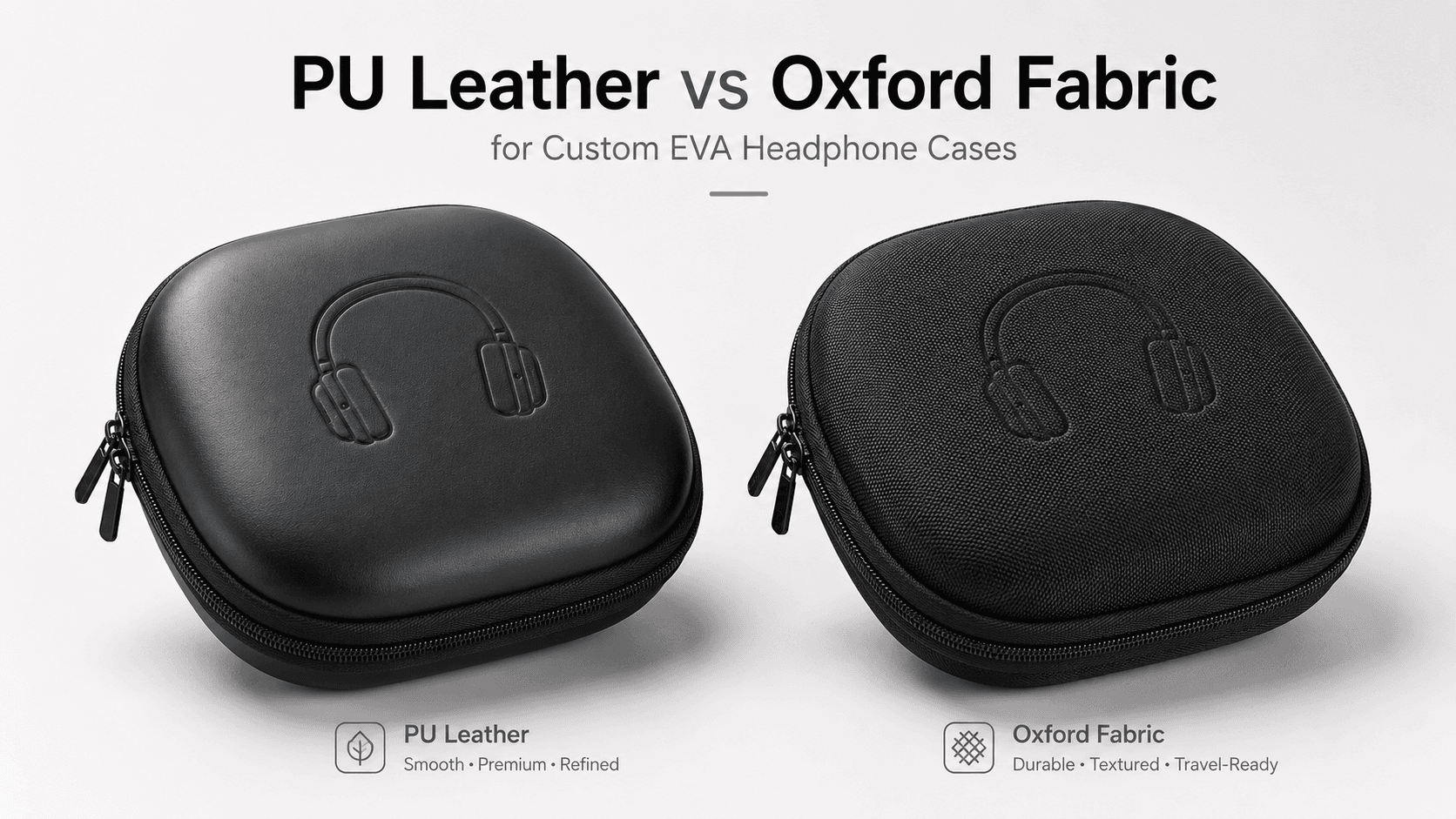
For projects that need more than a PU-versus-Oxford comparison, the EVA case material selection guide covers the outer surface, EVA core, lining, branding, loading information, and physical sample review.EVA case material selection guideAnswer Summary:
PU leather is often suitable for custom EVA headphone cases that need a smooth, refined, and retail-oriented appearance, while Oxford fabric is usually better for frequent carrying, travel use, and abrasion-conscious projects. PU leather is easier to wipe clean but can be more sensitive to scratches, creases, and molded curved areas. Oxford fabric is generally more wear-resistant and works well with rubber patches or screen printing. The final choice should be confirmed through material swatches and a finished sample, not only by material name or Pantone color reference.
Key Takeaways
- PU leather and Oxford fabric are exterior surface materials; EVA remains the main structural layer of the headphone case.
- PU leather usually gives a smoother and more refined appearance, but it is more sensitive to scratches, creases, wrinkles, and stretch marks around curved molded areas.
- Oxford fabric is generally more suitable for travel, frequent handling, and abrasion-conscious headphone case projects.
- PU leather is often better for debossing, embossing, and metal badges, while Oxford fabric is commonly suitable for sewn rubber patches and screen printing.
- Black PU leather and black Oxford fabric usually start from 500 pcs MOQ, while custom colors need project-based MOQ review because material purchasing and leftover material risks may differ.
What Is the Difference Between PU Leather and Oxford Fabric?
When buyers compare PU leather and Oxford fabric for custom EVA headphone cases, they are usually comparing the outer surface material, not the protective structure itself. In most molded EVA headphone cases, EVA forms the semi-rigid structural shell, while the exterior material is laminated or bonded to the outside to create the final appearance, texture, and branding surface.
This distinction is important because the same EVA case structure can feel very different when covered with PU leather, Oxford fabric, polyester, nylon, or another exterior material. The exterior material affects the case’s visual style, surface feel, logo method, cleaning method, color result, sampling risk, and sometimes the practical MOQ.
What Is PU Leather?
PU leather is a synthetic leather-like material often used when buyers want a smoother, cleaner, or more refined surface. It may have a smooth, matte, glossy, grained, or embossed finish depending on the selected material.
For custom EVA headphone cases, PU leather is usually chosen when the product needs a more retail-oriented appearance, a cleaner brand presentation, or a surface suitable for debossing, embossing, or metal branding.
However, PU leather is not one single material. Different PU materials may vary in:
- surface texture;
- thickness;
- backing material;
- flexibility;
- gloss level;
- scratch sensitivity;
- molding behavior;
- color availability.
For this reason, buyers should not approve a project only by saying “use PU.” The exact PU sample, color card, surface texture, and finished case sample should all be checked before bulk production.
What Is Oxford Fabric?
Oxford fabric is a woven textile material, commonly made from polyester or nylon yarns. It usually has a visible fabric texture and is often selected for travel, outdoor, sports, or practical storage products.
For headphone cases, Oxford fabric is often considered when the buyer wants:
- stronger fabric texture;
- more practical daily-use appearance;
- better abrasion-conscious performance;
- rubber patch branding;
- screen printing;
- a more functional or travel-oriented product style.
Oxford fabric can also have different denier levels, coatings, textures, and backing constructions. A fine Oxford fabric may look cleaner, while a heavier Oxford fabric may look more rugged and functional.
For broader sewn functional bag projects, the Oxford fabric for bags guide explains how to compare 600D, 900D, and 1680D material directions before sample review and quotation.
Is PU-Coated Oxford Fabric the Same as PU Leather?
No. This is a common source of confusion.
PU leather and PU-coated Oxford fabric are not the same thing. PU leather refers to a leather-like surface material. PU-coated Oxford fabric is still a woven Oxford fabric, but with a PU coating applied to improve certain surface properties.
For RFQ communication, buyers should clearly state whether they want:
PU leather exterioror:
Oxford fabric exterior with PU coatingThese two options may look, fold, mold, print, and price differently.
Material selection is only one part of the complete custom EVA headphone case OEM design requirements, which also include dimensions, inner layout, branding, sample approval, and packaging.
PU Leather vs Oxford Fabric at a Glance
The right material depends on the buyer’s product positioning, target use, logo process, color requirements, and budget. The table below gives a practical comparison for OEM headphone case projects.
| Comparison Point | PU Leather | Oxford Fabric |
|---|---|---|
| Surface appearance | Smooth, refined, leather-like | Woven, textured, practical |
| Common positioning | Retail, urban, premium, business | Travel, sports, outdoor, frequent use |
| Main structure | Exterior covering over EVA | Exterior covering over EVA |
| Molded curve behavior | More sensitive to wrinkles, stretch marks, and uneven areas | Usually more tolerant of a fabric-style surface appearance |
| Abrasion-conscious use | Depends heavily on PU grade and surface finish | Generally more suitable for frequent carrying |
| Cleaning | Usually easier to wipe | Depends on fabric texture and coating |
| Scratch / crease risk | More visible on some surfaces | Less likely to show leather-like creases |
| Logo compatibility | Debossing, embossing, metal badges | Rubber patches, screen printing, woven labels |
| Color approval | PU color card and finished sample | Oxford fabric color card and finished sample |
| Suitable direction | Refined brand presentation | Practical travel and daily storage |
| Final approval | Finished case sample | Finished case sample |
This table should not be understood as an absolute rule. A high-grade Oxford fabric can be more expensive and visually stronger than a basic PU material. A premium PU leather can perform better than a low-grade textile surface. Buyers should compare actual material samples and finished case samples before making the final decision.
Which Material Creates a More Premium Headphone Case?
Many buyers assume PU leather automatically looks more premium than Oxford fabric. In many headphone case projects, PU leather can indeed create a smoother, cleaner, and more refined appearance. It often works well for audio brands that want a case with a retail-friendly or urban product style.
A PU leather exterior can support:
- a smoother surface;
- a more controlled visual finish;
- debossed or embossed branding;
- metal logo plates;
- a more refined product presentation;
- matching with velvet or microfiber lining.
This makes PU leather suitable for headphone cases sold as a branded accessory, premium product bundle, or upgraded storage solution.
However, premium appearance is not created by PU leather alone. The final result also depends on the EVA shell shape, zipper quality, stitching, logo placement, lining material, color matching, packaging, and sample finishing.
Oxford fabric should not be treated as a lower-end option by default. A good Oxford fabric can create a strong, durable, and functional appearance. For travel headphone cases, gaming headset cases, children’s headphone cases, and outdoor-oriented audio accessories, Oxford fabric may fit the product image better than PU leather.
Oxford fabric can communicate:
- durability;
- practicality;
- sporty styling;
- outdoor function;
- travel readiness;
- frequent-use reliability.
So the better question is not “Which material is more premium?” but:
Which material matches the headphone brand, product use, logo style, target price, and buyer expectation?
For a business-style headphone case, PU leather may be more suitable. For a travel or sports-style headphone case, Oxford fabric may be the better match.
How Do PU Leather and Oxford Fabric Behave on Molded EVA Shells?
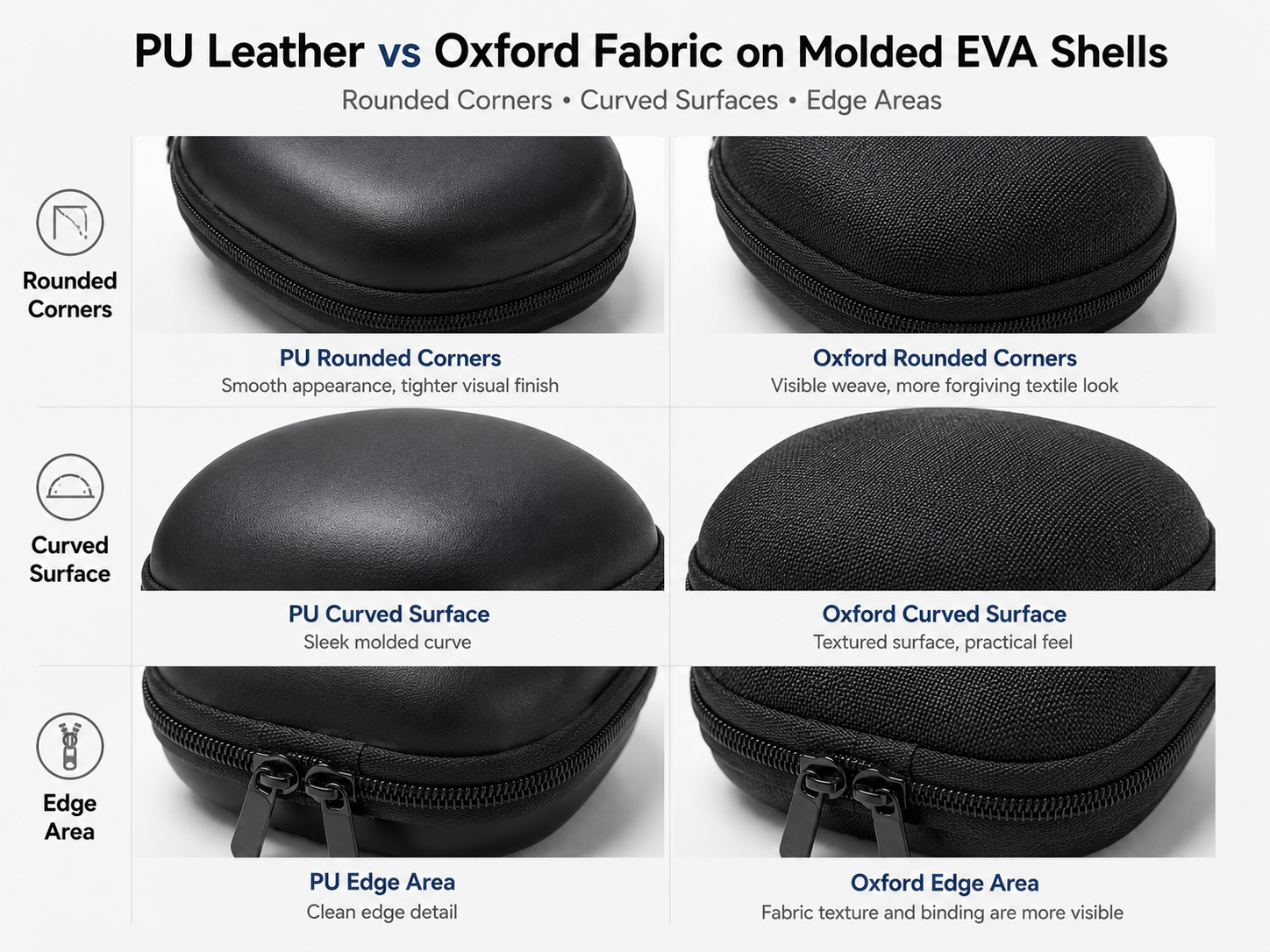
A custom EVA headphone case is not a flat product. It usually includes rounded corners, curved shells, zipper edges, hinge areas, and molded depth. Because of this, the exterior material must be judged after it is applied to the finished case, not only as a flat swatch.
In Pengtour’s production-side experience, PU leather is generally more sensitive than Oxford fabric around curved, deeply molded, or edge areas. Wrinkles, stretch marks, or uneven surfaces may appear if the PU material, backing, thickness, heating conditions, and forming depth are not well matched.
This does not mean PU leather is unsuitable for EVA headphone cases. It means the project team must pay attention to:
- case height;
- shell depth;
- corner radius;
- PU thickness;
- backing flexibility;
- heat-forming conditions;
- edge finishing;
- molding pressure;
- finished sample appearance.
Oxford fabric usually has a more forgiving textile appearance because its woven texture can visually absorb small surface variations. For practical headphone cases, this may be an advantage. But Oxford fabric can still have its own challenges, especially around cutting, fraying, coating behavior, stitching, and edge binding.
Material changes after modeling should also be treated carefully. If a case is first developed using Oxford fabric and later changed to PU leather, the final appearance may not be identical. The same applies when switching from PU leather to Oxford fabric. A new material may affect the molded surface, edge finishing, logo method, and final sample approval.
For this reason, buyers should confirm the exterior material before final sample approval whenever possible.
Which Material Is Better for Daily Handling and Travel?
For headphone cases that are frequently carried in backpacks, luggage, school bags, or travel kits, daily handling performance matters. The case may rub against other items, be taken in and out repeatedly, or be exposed to hand oils, dust, and surface friction.
Based on Pengtour’s practical material experience, Oxford fabric is generally more suitable for frequent carrying and abrasion-conscious use. It is often selected for travel-oriented or functional headphone cases because the woven surface can better match repeated handling conditions.
Oxford fabric is commonly used when the project needs:
- frequent travel use;
- backpack or luggage storage;
- a more rugged surface style;
- sports or outdoor positioning;
- rubber patch branding;
- practical daily handling.
PU leather, on the other hand, is usually easier to wipe clean because of its smoother surface. This can be useful for retail headphone cases, office-use accessories, or products that need a clean visual appearance.
However, PU leather can be more sensitive to:
- scratches;
- creases;
- pressure marks;
- sharp object contact;
- surface folding;
- long-term visual wear.
This is especially true for some smooth or flat PU surfaces. Textured PU may perform better visually than very smooth PU because texture can help reduce the visibility of minor surface marks.
The safest B2B wording is not “Oxford is always stronger” or “PU is always easier to maintain.” A more accurate conclusion is:
Oxford fabric is generally more suitable for frequent carrying and abrasion-conscious projects, while PU leather is usually easier to wipe clean but requires more attention to scratches, creases, and surface marks.
If the buyer needs quantified abrasion comparison, the supplier and buyer should agree on a specific test method before production. A textile abrasion method such as ISO 12947-2 can be used as a reference for discussion, but it should not be assumed unless it is included in the project specification.
Which Material Works Better With Different Logo Methods?
Logo method is one of the most important reasons to choose PU leather or Oxford fabric. The same logo artwork may look very different depending on whether it is applied to a smooth PU surface or a woven Oxford fabric surface.
| Logo Method | PU Leather | Oxford Fabric | Practical Suggestion |
|---|---|---|---|
| Rubber Patch | Medium to high compatibility; can be sewn and may be evaluated with other fixing methods depending on material and structure | High compatibility; usually sewn around the edge | Often suitable for travel, outdoor, sports, and functional cases |
| Screen Printing | Possible, but requires suitable ink and adhesion testing | Suitable when the fabric texture is not too coarse | Useful for simple logos, slogans, and cost-controlled branding |
| Debossing / Embossing | Generally suitable; can create a clearer leather-like branding effect | Usually not suitable for long-lasting raised or recessed texture | PU leather is usually preferred |
| Metal Badge | Often suitable with proper fixing structure | Needs support; direct installation may be unstable on soft fabric | Oxford body + PU patch + metal badge can be a balanced solution |
| Woven Label | Possible but may not always match the refined PU style | More naturally compatible with textile surfaces | Suitable for lightweight, casual, or sports-style cases |
In Pengtour’s logo selection experience, PU leather generally works better for debossing, embossing, and metal badges. Oxford fabric often works well with sewn rubber patches and screen printing when the fabric texture is not too coarse.
A common balanced solution is:
Oxford fabric body + PU logo patch + metal badge or printed logoThis combination keeps the practical textile surface while creating a stronger logo area.
Buyers comparing rubber patches, screen printing, debossing, embossing, metal badges, and other branding options can review the complete custom EVA case logo options guide.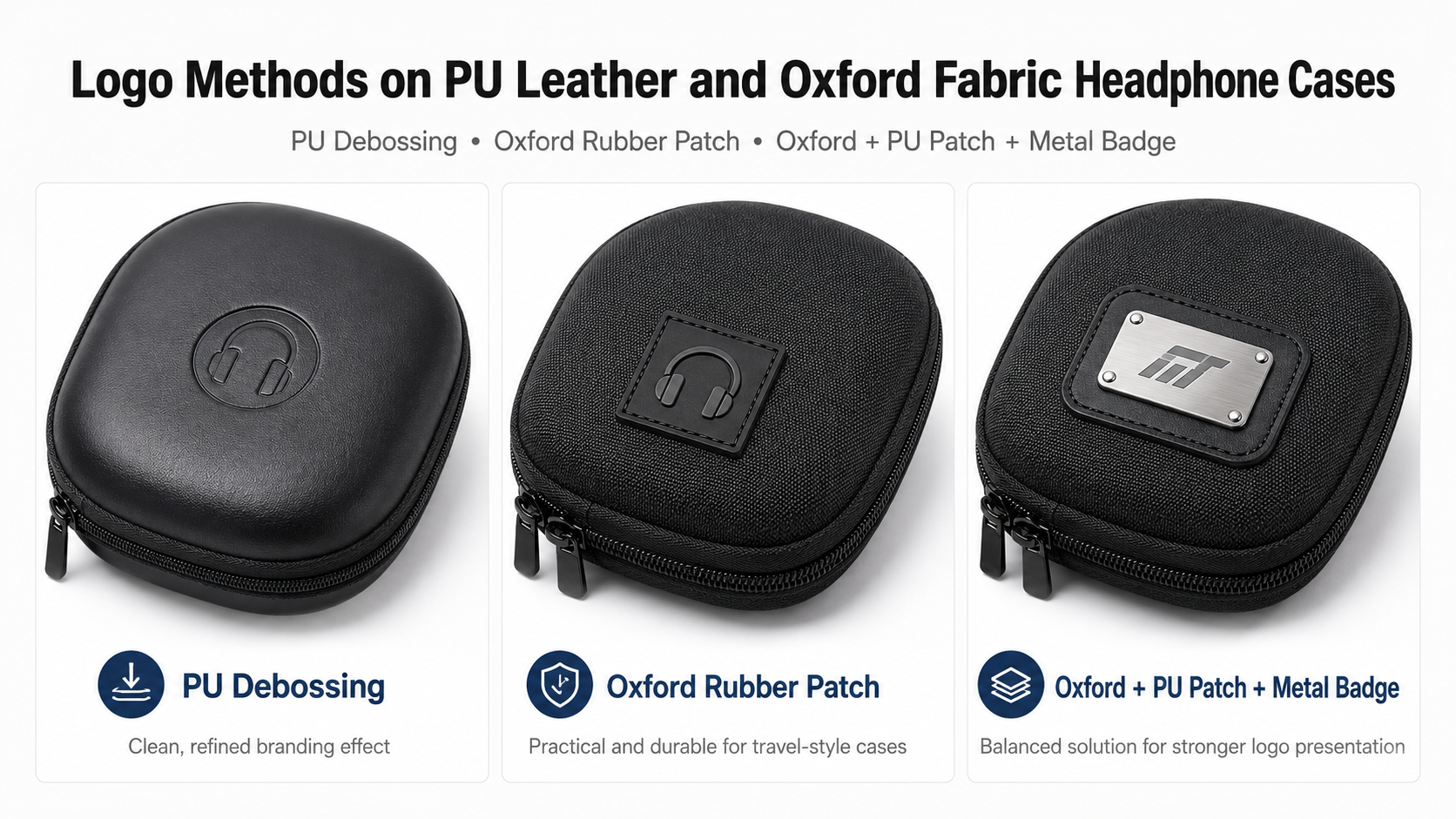
How Do Color and Surface Texture Affect the Final Result?
Color approval is another important difference between PU leather and Oxford fabric. The same color reference can look different on a smooth PU surface and a woven Oxford surface because surface texture, gloss, reflection, and coating all affect the final visual result.
For example, a dark color may look deeper on PU leather because of its smoother surface. A bright color may look more textured or slightly muted on Oxford fabric because the woven surface changes how light reflects. A matte PU, glossy PU, coated Oxford, and uncoated Oxford may all show different visual results even when the buyer provides the same initial color reference.
Pengtour uses separate PU leather and Oxford fabric color cards. When a buyer provides only a Pantone reference, the team normally matches it with the closest available PU or Oxford swatch. The Pantone number is treated as an initial color direction, not as a guarantee that the final material will look exactly the same.https://www.pantone.com/color-systems/for-textiles
A practical color confirmation process is:
Pantone reference
→ closest PU or Oxford material swatch
→ buyer confirmation
→ finished case sample approval
→ bulk production reference
Pantone can help communicate the initial color direction, but material texture, coating, gloss, and lighting may change the final appearance. For custom EVA headphone cases, final color approval should be based on the selected material swatch and the finished physical sample. A screen image, product photo, or Pantone number alone is not enough for production approval.
How Do Material Choices Affect MOQ and Quotation?
Material selection can affect the quotation and MOQ of a custom EVA headphone case project. This is especially important when buyers request special colors or non-standard material finishes.
For black PU leather or black Oxford fabric, the standard MOQ usually starts from 500 pcs. Black is a regular material color and can often be shared across different projects. This means a single order does not always need to consume an entire batch of black material.
For other colors, MOQ needs to be reviewed based on product size, material consumption, dyeing or purchasing requirements, and whether the remaining material can be used for future orders.
Pengtour’s material purchasing logic can be understood this way:
| Material / Color Situation | MOQ or Purchasing Logic |
|---|---|
| Black PU leather | Standard MOQ usually starts from 500 pcs |
| Black Oxford fabric | Standard MOQ usually starts from 500 pcs |
| PU leather material purchasing | Often reviewed around 300 yards, depending on supplier and material type |
| Oxford fabric material purchasing | Often reviewed around 500 yards, depending on fabric type and purchasing conditions |
| Custom colors | MOQ depends on case size, material usage, dyeing or purchasing requirements |
| Small-size cases in custom colors | May require higher practical quantity because each unit consumes less material |
| Leftover custom color material | May be difficult to use for other customers |
This is why buyers should avoid assuming that every color has the same MOQ as black. Black is easier to absorb across multiple projects because many buyers can use it. A custom blue, orange, green, pink, or other special color may be difficult to reuse if the current order does not consume the full purchased or dyed material batch.
For quotation, buyers should provide:
- target exterior material;
- color reference;
- case size;
- estimated quantity;
- number of colors;
- logo method;
- packaging requirements;
- expected future repeat order possibility.
This helps the factory evaluate not only the unit price, but also material purchasing, cutting efficiency, leftover material risk, and production planning.
Which Material Fits Different Headphone Case Applications?
The best exterior material depends on the headphone type, use scenario, and market positioning. The table below gives practical selection directions for OEM projects.
| Application | More Common Direction | Reason |
|---|---|---|
| Premium retail headphones | PU leather | Smooth appearance, refined branding, debossing or metal logo compatibility |
| Travel headphone cases | Oxford fabric | More suitable for frequent carrying and abrasion-conscious use |
| Gaming headset cases | Oxford fabric or PU leather | Oxford supports sporty style; PU supports a cleaner premium style |
| Children’s headphone cases | Oxford fabric | Practical, colorful, and suitable for frequent handling |
| Office headset cases | PU leather or fine Oxford fabric | Depends on whether the buyer wants business style or practical durability |
| Professional monitoring headphones | Depends on positioning | Large size, protection, and brand image should be considered together |
| Promotional headphone cases | Oxford fabric | Often easier to combine with screen printing and cost-controlled branding |
| Lifestyle audio accessories | PU leather | Can create a more refined appearance for retail display |
These recommendations should be treated as general direction, not fixed rules. A project may choose PU leather for travel use if the buyer values appearance more than abrasion-conscious performance. Another project may choose Oxford fabric for a premium case if the brand wants a technical or outdoor style.
The correct material should match the actual product, buyer budget, use environment, and sample result.
What Should Buyers Confirm During Sampling?
Material swatches are useful for early selection, but the finished physical sample is the most important approval reference. A swatch does not show how the material behaves after molding, cutting, bonding, stitching, logo application, and final assembly.
During sample review, buyers should check:
- approved material name and material code;
- PU or Oxford color swatch;
- surface texture;
- curved areas and rounded corners;
- wrinkles, stretch marks, or uneven surface areas;
- edge finishing;
- zipper alignment;
- logo position and fixing method;
- screen print adhesion if printing is used;
- support structure if a metal badge is used;
- visible scratches, creases, or pressure marks;
- finished case color under normal lighting;
- interior lining and exterior material combination;
- packaging appearance.
If the buyer changes the exterior material after sample approval, the sample should be reviewed again. A switch from Oxford fabric to PU leather, or from PU leather to Oxford fabric, can affect appearance, logo method, MOQ, and production planning.
For projects with environmental compliance requirements, buyers should confirm the required test items before material approval. Pengtour can review the selected material and support third-party laboratory testing when further confirmation is needed.
Buyers can also review Pengtour’s EVA case customization options before finalizing materials, colors, structure, and branding.
PU Leather or Oxford Fabric—How Should OEM Buyers Decide?
A buyer should not choose the exterior material only by looking at a product photo. The decision should be based on product positioning, real use, branding, color, MOQ, and sample performance.
Choose PU Leather When:
PU leather may be more suitable when the project requires:
- a smooth or refined exterior;
- premium retail presentation;
- business or urban product style;
- debossed or embossed branding;
- metal badge branding;
- easier surface wiping;
- a cleaner match with velvet or microfiber lining.
However, buyers should pay more attention to scratches, creases, curved molded areas, and pressure marks during sample review.
Choose Oxford Fabric When:
Oxford fabric may be more suitable when the project requires:
- frequent travel use;
- stronger abrasion-conscious performance;
- backpack or luggage storage;
- sports or outdoor style;
- rubber patch branding;
- screen printing;
- visible textile texture;
- functional or cost-conscious positioning.
However, buyers should still confirm fabric grade, texture, coating, color, and logo result on the finished sample.
Do Not Decide by Material Name Alone
The material name is only the starting point. Buyers should also confirm:
- material grade;
- thickness;
- backing;
- Oxford denier;
- coating;
- case size;
- molded depth;
- logo method;
- color availability;
- MOQ;
- target price;
- finished sample result.
For OEM projects, the best material is the one that fits the product’s use, brand style, and production requirements, not the one that sounds more premium in isolation.
How Pengtour Confirms Materials for Custom Headphone Cases
Material confirmation for a custom headphone case should be handled as part of the full development process. Pengtour usually reviews material, structure, color, logo, and sample result together instead of treating them as separate decisions.
Step 1: Review the Product Positioning
The team first reviews the headphone type, target market, use scenario, and expected product style. A premium retail headphone case may require a different material direction from a children’s headphone case or travel headset case.
Step 2: Recommend PU or Oxford Options
Based on the buyer’s needs, Pengtour can recommend PU leather, Oxford fabric, or another exterior material. The recommendation considers appearance, durability expectations, logo method, color, MOQ, and target price.
Step 3: Match the Color Reference
If the buyer provides a Pantone reference, the team checks the closest available PU or Oxford color card. For custom colors, MOQ and material purchasing requirements need to be reviewed before confirmation.
Step 4: Confirm the Logo Process
The logo method is matched with the exterior material. PU leather may be considered for debossing, embossing, or metal badges. Oxford fabric may be better for sewn rubber patches, screen printing, or woven labels.
Step 5: Develop the Finished Sample
A finished sample is developed to check the molded surface, curved areas, edge finishing, zipper alignment, logo result, and overall appearance.
Step 6: Lock the Production Reference
Before bulk production, the approved sample, material swatch, color reference, logo file, packaging method, and quantity should be recorded as the production reference.
Brands developing a custom EVA headphone case can compare exterior materials according to appearance, travel use, logo method, and target price.
Frequently Asked Questions
Is PU leather better than Oxford fabric for headphone cases?
Not always. PU leather is often better for smooth appearance, refined branding, debossing, embossing, and metal badges. Oxford fabric is generally more suitable for frequent carrying, travel use, abrasion-conscious applications, rubber patches, and screen printing. The better choice depends on the project’s use, brand style, color, MOQ, and finished sample result.
Is Oxford fabric always more abrasion-resistant than PU leather?
Oxford fabric is generally more suitable for abrasion-conscious and frequent-carrying applications, but it should not be treated as automatically superior in every case. Actual performance depends on fabric grade, denier, coating, backing, use environment, and test method.
Can Oxford fabric have a PU coating?
Yes. Oxford fabric can have a PU coating, but PU-coated Oxford fabric is still different from PU leather. PU-coated Oxford remains a woven textile with coating, while PU leather is a leather-like surface material. Buyers should clearly specify the material type when requesting a quote.
Which material is easier to clean?
PU leather is usually easier to wipe because it has a smoother surface. However, it may also be more sensitive to scratches, creases, and pressure marks. Oxford fabric may be more abrasion-conscious, but stains can be harder to remove if they enter the fabric texture or coating surface.
Which material is better for embossed logos?
PU leather is generally more suitable for debossing or embossing because its surface can form a clearer recessed or raised branding effect. Oxford fabric is usually not suitable for long-lasting embossed or debossed logo effects because it is a woven textile.
Is a Pantone number enough to approve the material color?
No. A Pantone number can provide an initial color direction, but final approval should be based on the corresponding PU or Oxford material swatch and the finished case sample. Surface texture, gloss, coating, and lighting can all change the final appearance.
Does material choice affect the MOQ of custom headphone cases?
Yes. Black PU leather and black Oxford fabric usually start from 500 pcs because black is a regular color that can be shared across different projects. Custom colors may require project-based MOQ review because dyeing or material purchasing quantities, case size, and leftover material risk can affect the minimum practical production quantity.
Do PU leather and Oxford fabric need environmental testing?
It depends on the buyer’s target market and compliance requirements. If environmental testing is required, the test items should be confirmed before material approval. Pengtour can review the selected material and coordinate third-party laboratory testing when further confirmation is needed.
Prepare Your Headphone Case Material Specification
PU leather and Oxford fabric can both be used for custom EVA headphone cases, but they serve different project goals. PU leather is often selected for smoother, more refined, and brand-oriented headphone cases. Oxford fabric is generally more suitable for travel, frequent handling, abrasion-conscious use, and practical product positioning.
The final decision should not be made from the material name alone. Buyers should confirm the material swatch, surface texture, color, logo method, molded sample, MOQ, and production reference before bulk manufacturing.
To start a material review, share your headphone dimensions, preferred exterior material, color reference, logo artwork, estimated quantity, and packaging requirements to request a formal factory quote.