

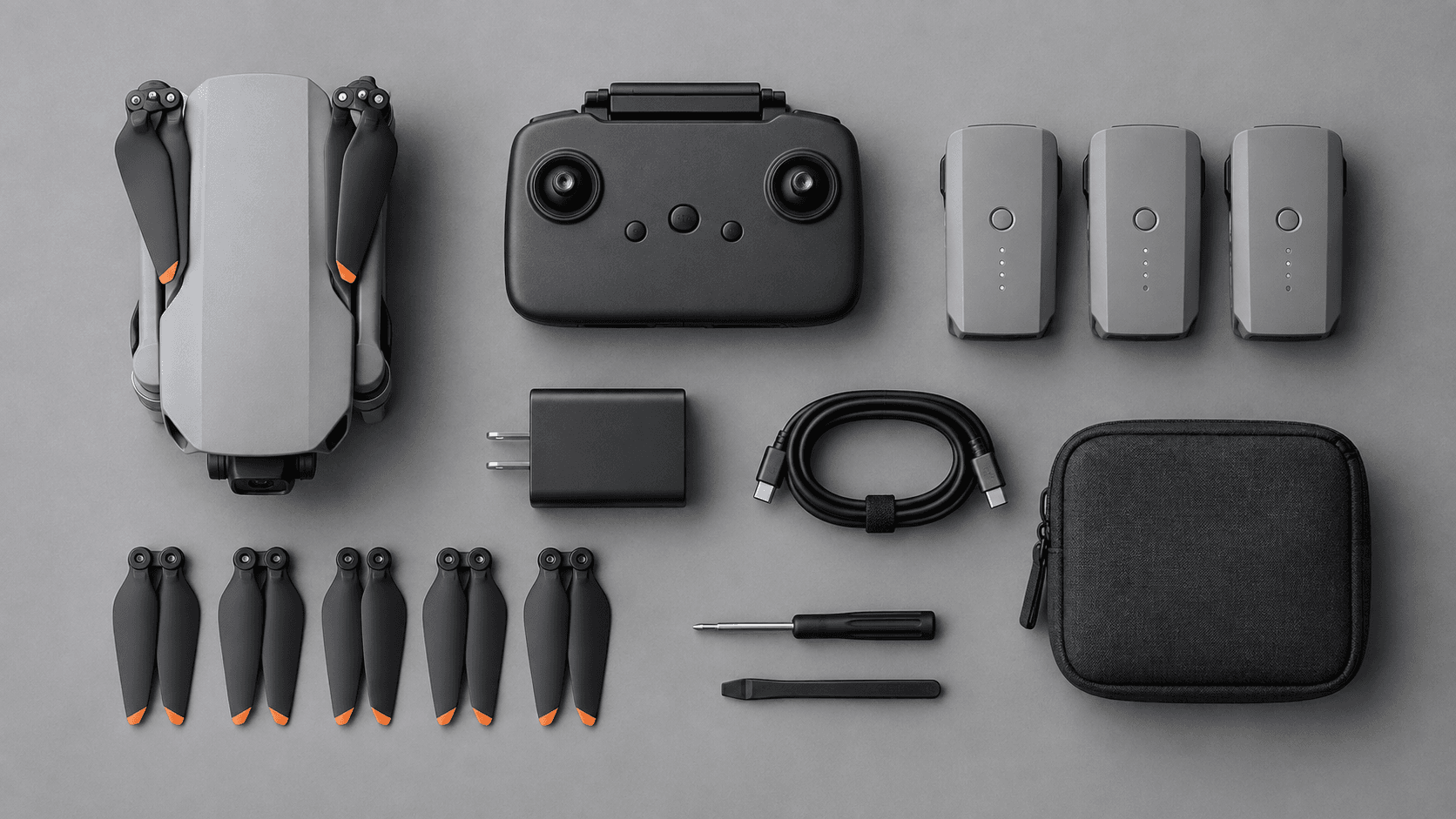
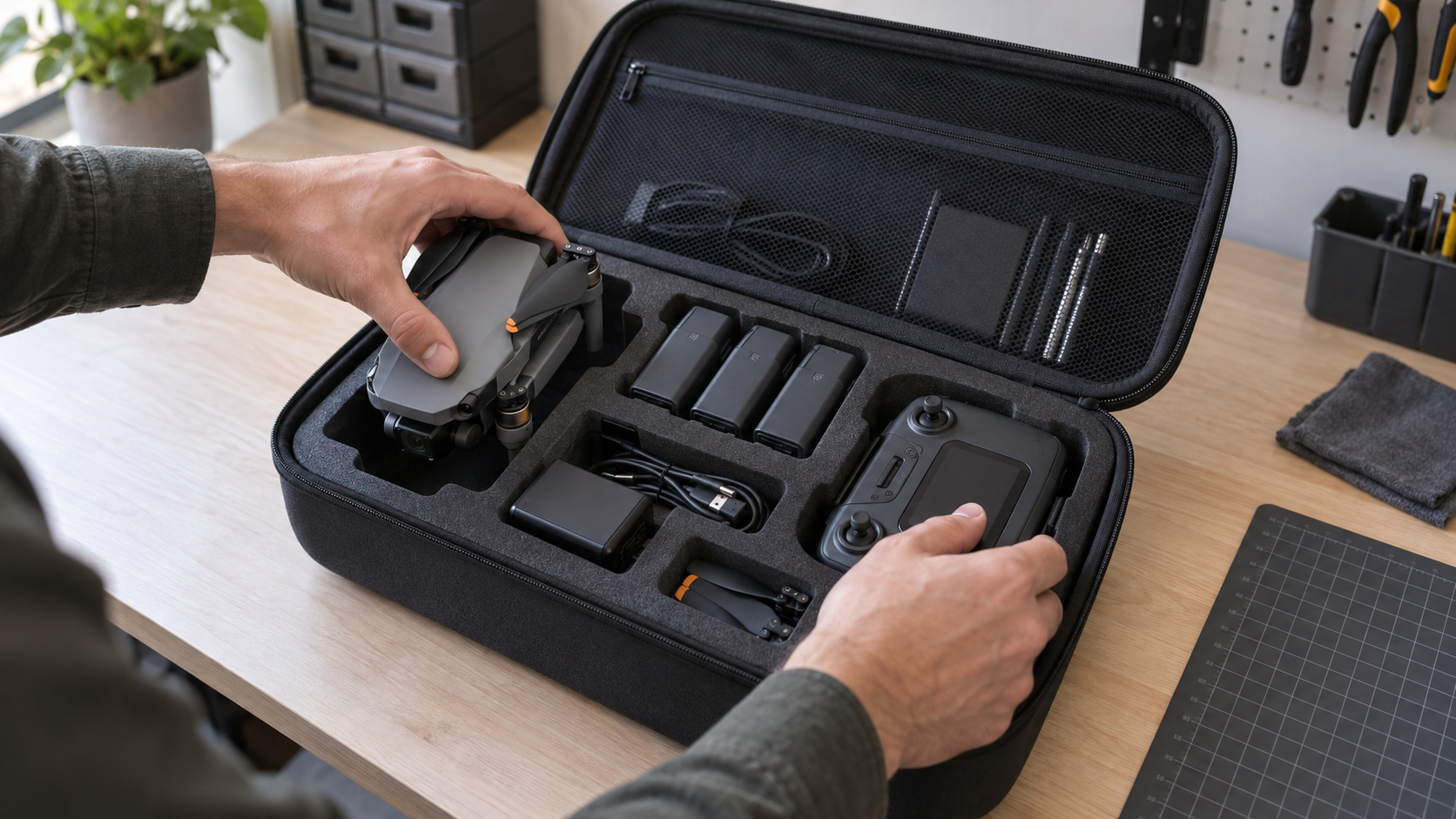
The layout of the drone chassis foam should begin with the actual kit, not with the shape of an empty box. Before a buyer submits a request for a custom EVA drone chassis, the team needs to understand which components need to be housed inside the box, the frequency of use for each component, which components need to be separated, and what aspects need to be checked on the first sample.
For B2B projects, it's not just about neat organization. Layout affects how the drone body is placed in the case, how the battery and propellers are separated, how the controller is disassembled, where small tools are stored, and whether the sample can be viewed without guessing its intended use.
This guide focuses on layout planning, supplier consultation, and sample review. It cannot replace project-specific testing, certification, flight safety guidelines, or established protection standards.
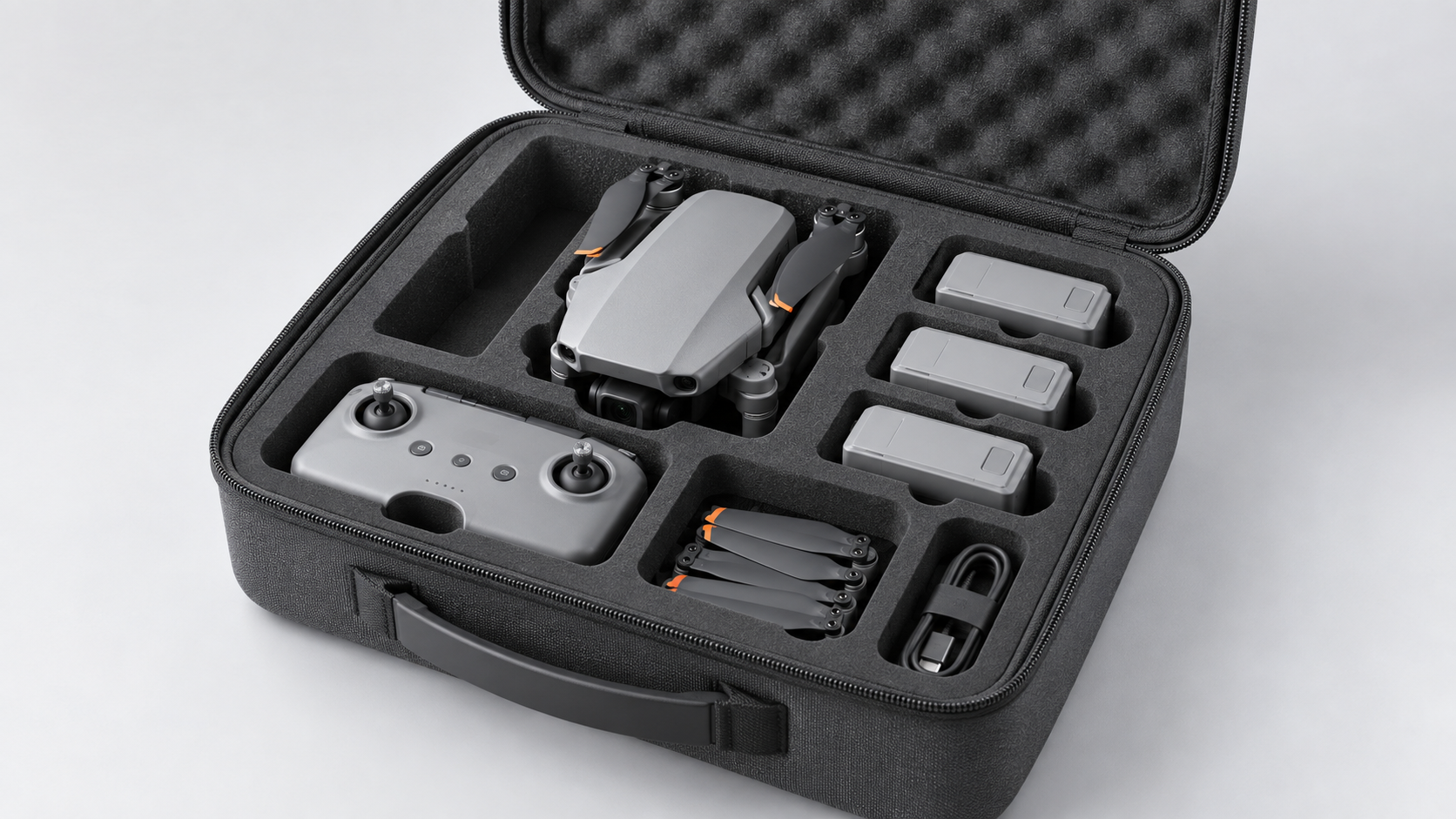
Start with the drone kit, not the shape of the shell.
The first thing to determine is the accessories list. The two drone cases may look similar, but their internal space requirements are quite different. One project may only need to accommodate a small drone, a remote controller, and a charging cable. The other project may need multiple batteries, spare propellers, tools, filters, instructions, adapters, or retail packaging inserts, etc.
First, list all the items that must be carried with the drone:
- drone fuselage
- Controller or remote control
- backup battery
- Charger and cable
- propeller or propeller guard
- small tools
- Memory card, adapter, filter or other accessories
- Paper inserts, user guides, or packaging cards
- Marking and Packaging Requirements
Each item should be measured according to its actual packaging. Folded arms, mounted propellers, protective covers, cables, and soft bags will all change the space required inside the case. If the buyer only provides the external dimensions of the drone, the first sample may show insufficient space after actual packaging.
The kit list should also indicate fragile surfaces, loose parts, and components that should not be pressed against each other. This does not prove that the chassis will definitely meet the protection goals, but only provides the design team with more comprehensive reference information before the initial layout design.
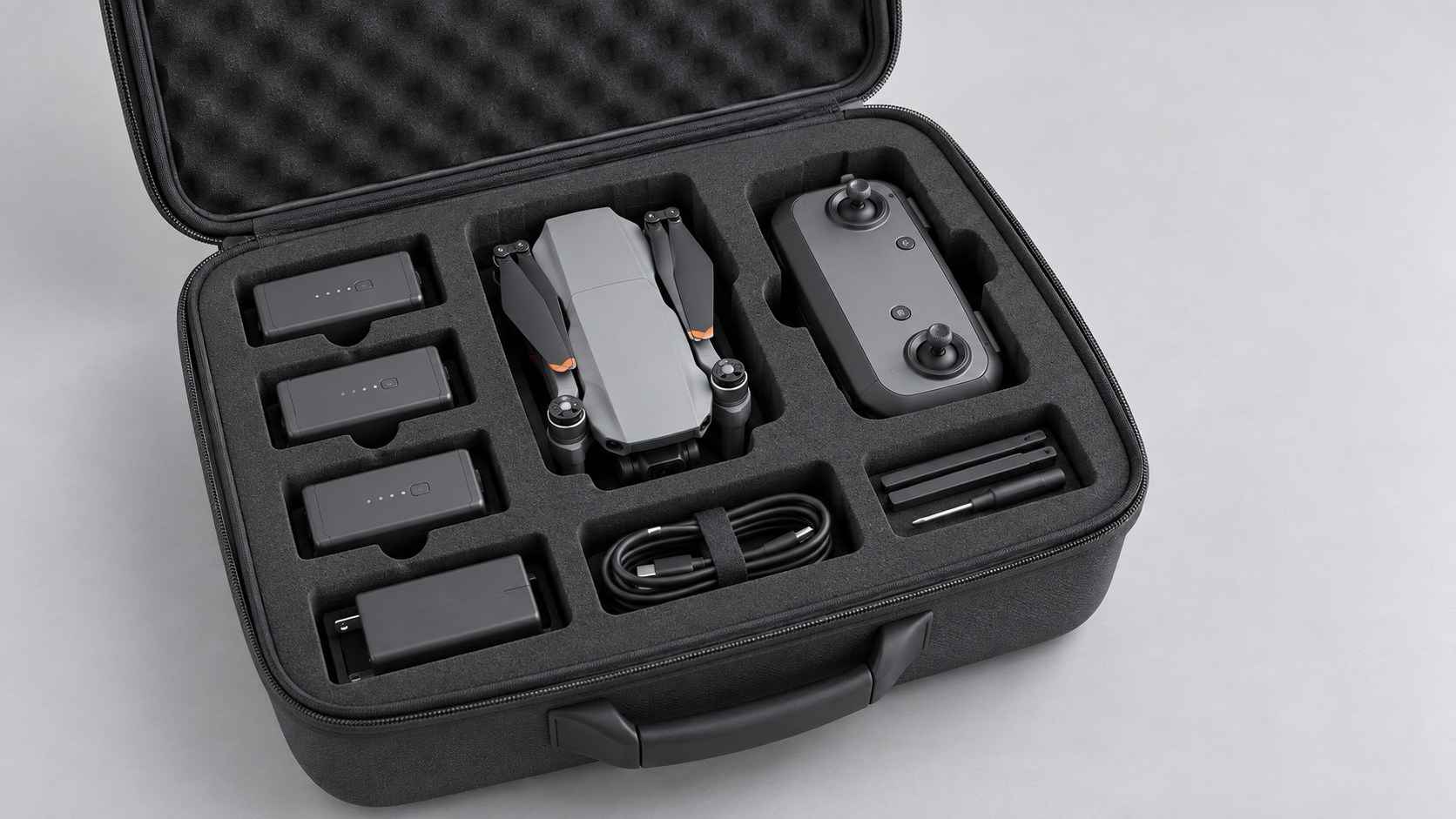
Before selecting a cavity, draw an access sequence diagram.
A well-designed drone housing layout will better suit how the device is used. Before determining the housing depth or foam shape, please plan the order in which items will be retrieved and placed.
Ask which items should be retrieved first. In many drone kits, the remote controller and batteries need to be more easily and quickly accessed than spare cables or instructions. Buyers may want the drone body centered, the remote controller near the opening, the batteries in a stable location, and small accessories placed where they won't fall out when the box is opened.
Access frequency will change the optimal layout choice:
| thing | Frequently Asked Questions | Layout meaning |
|---|---|---|
| drone fuselage | Is it removed every time you open the box? | Keep the cavity easy to grip and avoid excessive contact. |
| controller | Do users need quick setup? | Place it in a location where you can reach it without having to lift other parts first. |
| Battery | How many spare parts are in the tool kit? | Clearly separate them and confirm the expected direction. |
| propeller | Were they installed, removed, or packaged as spare parts? | Use a designated area to prevent small parts from being crushed by larger items. |
| Charger and cable | Are the cables loose or bundled? | Use pockets, straps, or grooves, depending on the approved design. |
| small tools | Do they need to be on site? | Prevent them from entering the drone or battery area. |
Before creating the first prototype, the access order should be reviewed. If the layout forces users to remove three accessories before even reaching the controller, the chassis may look neat, but it will still slow down the setup process.
Determine the actual function of the foam padding.
Foam linings can serve multiple purposes, and not every project requires the same functionality. For example, in a drone case, foam can help secure the fuselage, separate the battery, reduce movement, neatly display kits, or support small accessories. These functions should all be clearly stated in the project description.
For example, foam cavities around the drone fuselage might primarily serve for positioning. Battery areas may require isolation and clear orientation. Charging areas may need more comprehensive protection than cushioning. For certain accessories, mesh pockets, elastic straps, molded supports, or raised support structures might be more suitable than solid foam cavities.
This is important because "adding foam" is not the whole requirement. The buyer should specify the intended use of the foam:
- Fix an item in one place
- Separate the two items that should not touch.
- Make removal easier
- Reduce visible movement during normal operation.
- Present the kit in a simpler way
- Reserve space for instruction manuals, cards, or accessory packs.
Foam lining should not be considered proof of waterproofing, shock resistance, or regulatory compliance. These properties require separately defined requirements and evidence. The layout summary only documents the functions that the internal structure should support.
For more general liner selection, buyers can also refer to Pengtour's EVA foam liner guide . For drone projects, the liner should still be compared with the actual kit and samples.
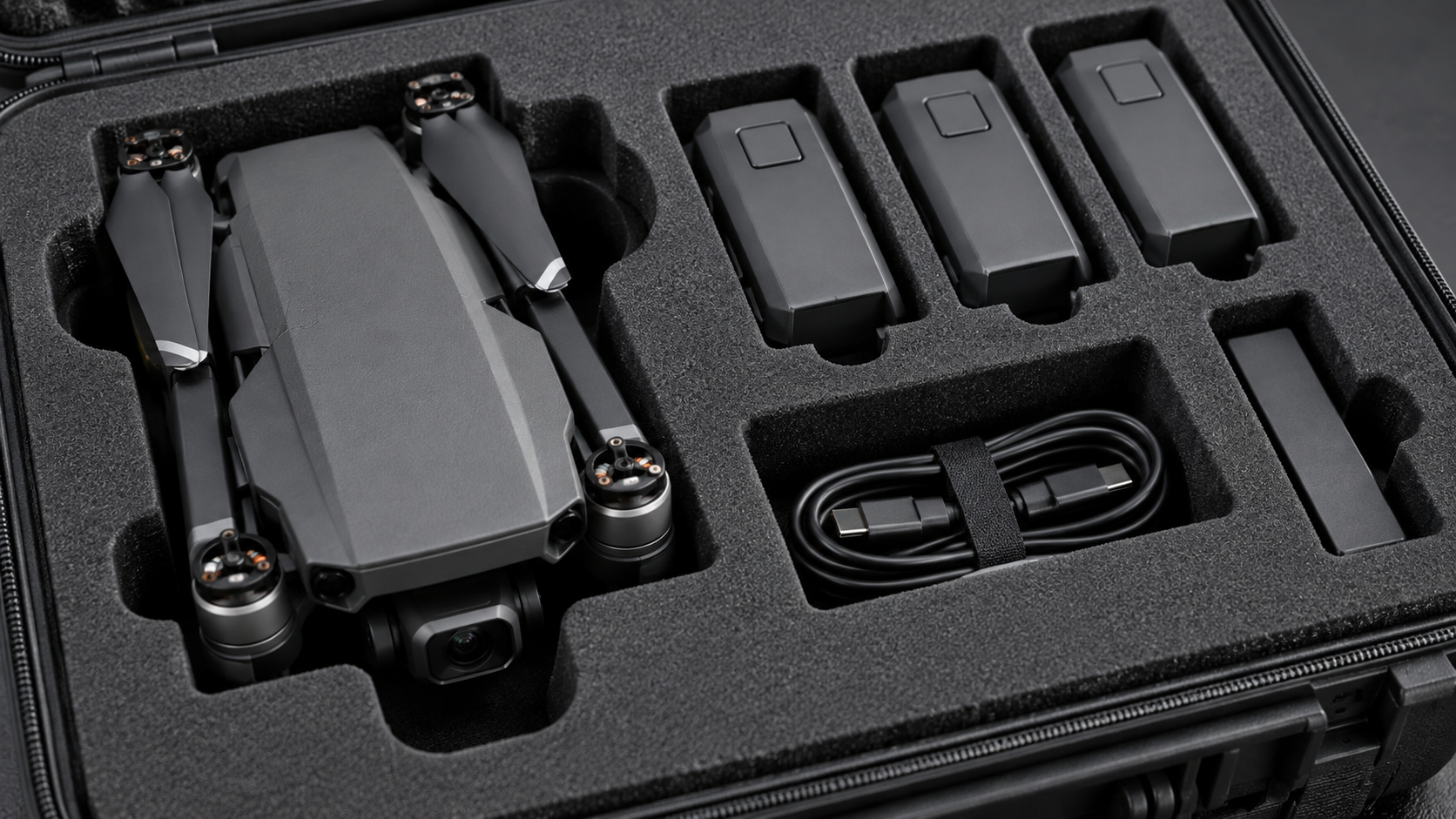
Input matrix using drone housing layout
The layout input matrix helps buyers transform fragmented requirements into auditable briefs. It also reduces the likelihood that suppliers will design based on hypothetical kits rather than actual kits.
| thing | Size and packaging condition | Access frequency | Support or separation requirements | Layout decision | Buyer's opinion required | Initial sampling inspection |
|---|---|---|---|---|---|---|
| drone fuselage | Folded or assembled state | high | Positioning, gap, gripping channel | Main cavity or molded support | Actual sample or accurate size | Installation, disassembly, pressure points, clearance |
| controller | Whether or not a stick is included | high | Easy to remove, surface separation | Cavity, pocket or shoulder strap area | Control layout and accessory status | The operation can be performed without lifting other objects first. |
| Battery | Quantity and direction | high | Separation and clear positioning | Single cavity or group of regions | Battery quantity and packaging rules | There was no confusing direction or loose movement. |
| propeller | Included or individually packaged | medium | Thin sheet protection and preparation | Thin cavity or accessory part | Spare quantity and packaging shape | Not bent, not compressed, not placed under heavy objects |
| Charger and cable | Bundled or loose | medium | contain | Pockets, shoulder straps, or recesses | Cable harness dimensions | No liquid will spill when the box is opened. |
| Tools and accessories | Bulk or in small bags | Low to medium | organize | Small cavities, pockets, or elastic areas | Item List | Easy to count and does not migrate to the main cavity |
The matrix should include unknowns. If the number of batteries, cable bundle dimensions, or propeller mounting method are not yet finalized, mark them as unresolved rather than prematurely forcing a layout. Explicit unknowns are better than hidden assumptions.
When making broader bag planning, buyers can compare it with a general suitcase design guide and then narrow down their input on drone kits.
When reviewing the first sample, focus on fit, ease of use, and modifications.
The first sample should be reviewed against the approved layout outline. Sample review is not limited to visual inspection; it should also verify that the case conforms to the toolkit list, order of use, and internal design scheme agreed upon before sampling.
Use a simple evaluation status for each project:
| checkpoint | go through | Revision is needed | Verification required |
|---|---|---|---|
| Each item in the toolkit has its designated location. | All necessary items are suitable for placement within the planned area. | One or more items lack a clear storage location. | The final equipment list has not yet been confirmed. |
| The drone fuselage can be easily disassembled. | Users can naturally grasp and lift it. | Too narrow alveolar bone or difficult to operate | Final packaging status uncertain |
| Controller access and setting order matching | It can be removed before lower priority accessories. | It was obscured by cables, batteries, or the drone's fuselage. | User workflow has not yet been confirmed. |
| The batteries are separate and can be counted. | Both the quantity and direction are very clear. | Battery area disorder or instability | The number of batteries may vary. |
| Cables and tools remain in place. | They can be placed in pockets, shoulder straps, or compartments. | Small items will be moved to other areas. | Incomplete parts list |
| The opening and closing mechanism and the feel of carrying it are consistent with the project. | The zipper, handle, and box balance meet the sample requirements. | The opening, handle, or balance needs adjustment. | Load and transport objectives need to be reviewed separately. |
| The logo and packaging should be aligned. | The decoration and packaging were carried out in accordance with the approved plan. | The location, surface treatment, or packaging needs to be modified. | The brand or packaging has not yet been finalized. |
Sample review should distinguish between routine fit observations and test results. If the buyer requires specific drop tests, waterproof tests, load tests, or compliance documentation, these must be stated separately and supported by documentation. A neat foam layout does not prove these test results.
How Pengtour supports drone case study projects
Pengtu collaborates with overseas B2B buyers to undertake customized EVA protective case projects, including some drone protective case projects. The project team reviews the drone kit, dimensions, packaging status, expected usage order, shell orientation, internal layout, foam lining, lining, zippers, handles, logo, packaging orientation, and sample requirements.
The specific structure depends on the project. A drone case may use an EVA structural core, an outer fabric or surface material, an inner lining, a foam lining, molded or raised supports, an inner pocket, elastic straps, zippers, handles, a logo, and appropriate packaging. Not every case requires all components.
Pengtu can assess and customize dimensions, structures, material selection, colors, logos, packaging, develop samples, mass production, and provide export support based on project requirements. Feasibility, material selection, sample requirements, and the final scope of services must be confirmed before production.
Next, please prepare a list of drone kits, including component dimensions, number of batteries, access order, accessory list, brand requirements, packaging orientation, and any items requiring separate verification. Then submit these details through the quotation request page so we can review the project based on clear input.
Frequently Asked Questions
What information should buyers prepare before designing the foam layout for a drone's casing?
Prepare a complete kit list, including dimensions, packaging status, order of use, accessories list, number of batteries, propeller packaging method, brand requirements, packaging orientation, and any individual testing or validation needs. If any item is not yet finalized, mark it as "Unresolved" in the briefing.
Should all drone cases use foam lining?
No. Foam linings may help with positioning, separation, display, or control of movement, but some accessories may be better suited to pockets, straps, molded supports, raised supports, or other approved structures. The specific choice depends on the drone kit and project requirements.
How should spare batteries and propellers be stored separately inside a drone's casing?
The layout should clearly indicate the location and orientation of the batteries and propellers. Clearly defined battery locations generally make inventory and inspection easier. The propeller should not be placed under heavy objects or in areas prone to bending during normal handling. The final structure still requires sample review.
What aspects should be checked for the first sample before production?
Check that all components are complete, that the drone body and remote controller can be disassembled in the correct order, that the battery and accessories are placed in the correct positions, that the zippers and handles function properly after loading the sample, and that the markings and packaging details meet the requirements. Record each item as "Pass," "Requires Modification," or "Requires Verification."