

Quick Answer
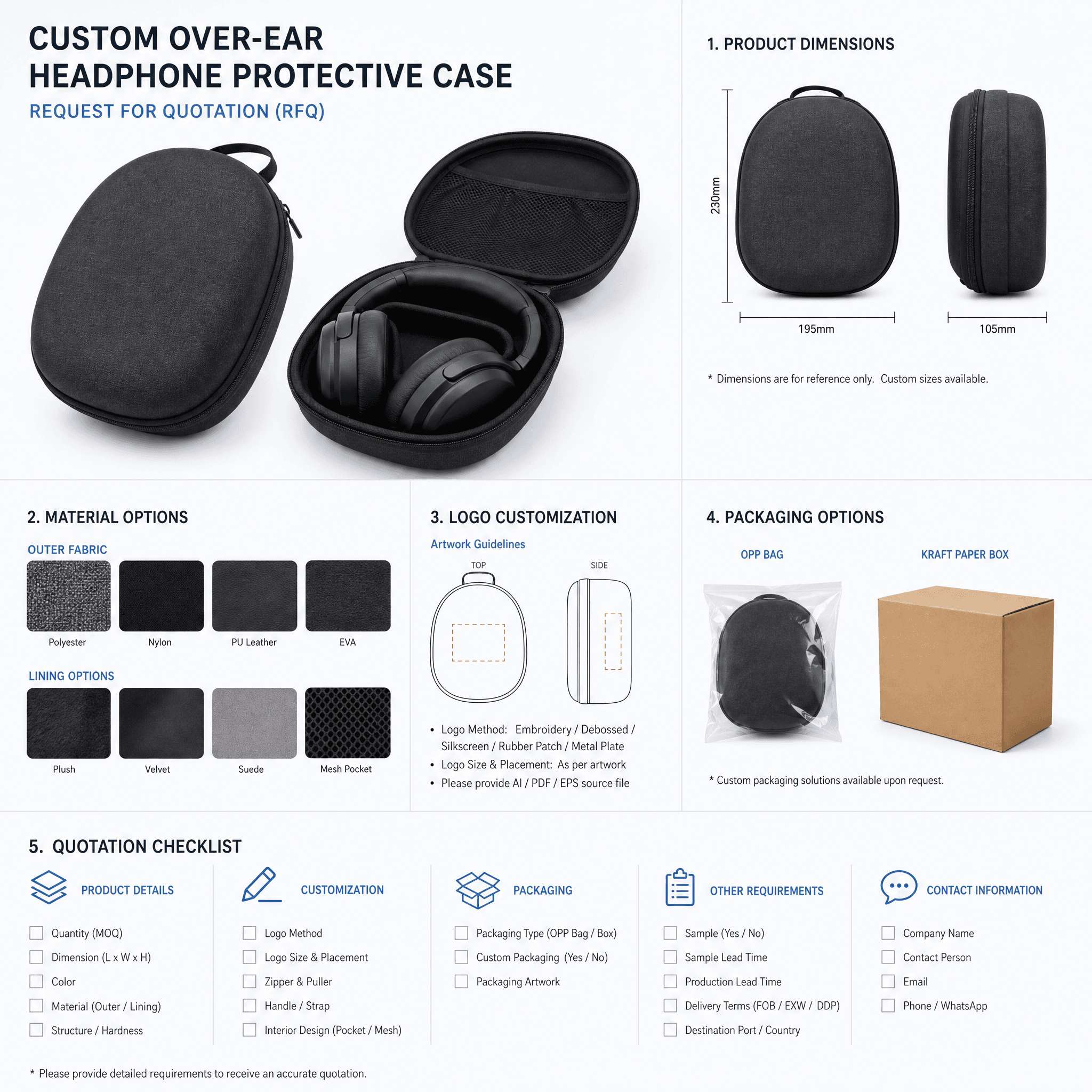
Custom headphone case pricing depends on the case dimensions, exterior and lining materials, internal structure, logo process, packaging, order quantity, and sample requirements. A complete headphone case RFQ checklist helps the factory prepare a more accurate initial quotation and reduces avoidable price revisions during sample development.
Dimensions, reference images, material requirements, structure details, and estimated quantity can usually support a preliminary quotation. However, the final production price should be confirmed only after the physical headphone, sample, materials, colors, logo, packaging, and order specifications have been approved.
Key Takeaways
- Dimensions, materials, internal structure, branding, packaging, and quantity all affect custom headphone case pricing.
- Packaging method, target price, and intended use are frequently missing from initial buyer inquiries.
- Reference images and dimensions can support an initial quotation, but final 3D modeling normally requires the physical headphone.
- For standard headphone case projects, MOQ is generally around 100 pieces per style, subject to materials, structure, process, and color allocation.
- Sample and tooling charges are normally listed separately and may be credited or refunded for qualifying bulk orders.
- Material changes, size increases, internal structure revisions, and packaging changes may trigger repricing.
- Final production pricing should be based on an approved sample and confirmed specifications.
What Information Is Needed for an Initial Headphone Case Quote?
An accurate quotation starts with a clear product specification. A product photo and estimated order quantity may support an early budget discussion, but they are rarely enough for a reliable OEM quotation.
The factory needs to understand what will be placed inside the case, how the headphone will be used, the required level of protection, and how the finished product will be packaged.
Headphone Case RFQ Checklist
RFQ item Information the buyer should provide Why it affects the quotation Headphone identification Brand, model number, purchase link or reference photos Helps verify the product shape and availability Product dimensions Overall length, width, height and folded dimensions Determines case size, molded depth and material consumption Intended use Daily storage, travel, retail bundle or promotional packaging Influences protection and packaging requirements Exterior material Oxford fabric, polyester, PU or another specified material Affects cost, appearance and processing Interior material Velvet, soft fabric, foam or another lining Affects surface protection and assembly Internal structure Molded cavity, cushioning, pocket or retaining strap Affects modeling, material use and labor Logo Artwork, preferred size, location and expected appearance Determines the appropriate branding process Quantity Total quantity and color allocation Affects MOQ, material preparation and scheduling Packaging OPP bag, kraft paper box or another format Adds packaging material and packing labor Target price Preferred cost range or project budget Helps match the specification to the commercial target Sample requirement Whether a sample is required before production Affects development time and separate fees From our factory-side RFQ reviews, three details are frequently left unspecified: packaging method, target price, and intended use.
These omissions do not always prevent a preliminary quotation, but they reduce its accuracy. An OPP bag and a kraft paper retail box have different costs. A travel case may also require stronger internal cushioning than a case intended only for daily storage.
When these details are confirmed after the first quotation, the proposed specification and price may need to be reviewed again.
Which Details Have the Biggest Impact on Custom Headphone Case Pricing?
Two headphone cases may appear similar in photographs but have different costs because of their dimensions, molded depth, lining, zipper, branding, packaging, and assembly requirements.
Overall dimensions
The external size affects the consumption of exterior fabric, EVA structural material, lining, zipper, and packaging. It can also affect the molded profile, case depth, cutting layout, internal cushioning thickness, and shipping-carton capacity.
A significant size increase may require the structure and tooling to be reviewed again. Buyers should therefore provide actual product measurements rather than estimate the required case size from photographs alone.
Exterior and lining materials
The buyer may specify the materials directly or ask the factory to recommend a configuration based on appearance, use, and target price.
Common exterior choices include polyester, Oxford fabric, nylon, PU, and other laminated materials. Interior choices may include velvet, soft fabric, multispandex, or additional cushioning materials.
Changing the material after quotation may affect:
- Raw-material cost
- Laminating requirements
- Surface appearance
- Logo compatibility
- Cutting and sewing difficulty
- Minimum material purchasing quantity
A quotation prepared for one material configuration should not automatically be treated as valid after the exterior fabric, lining, or zipper specification changes.
Internal cushioning and layout
The internal structure determines how accurately the headphone is positioned and how much development work is required.
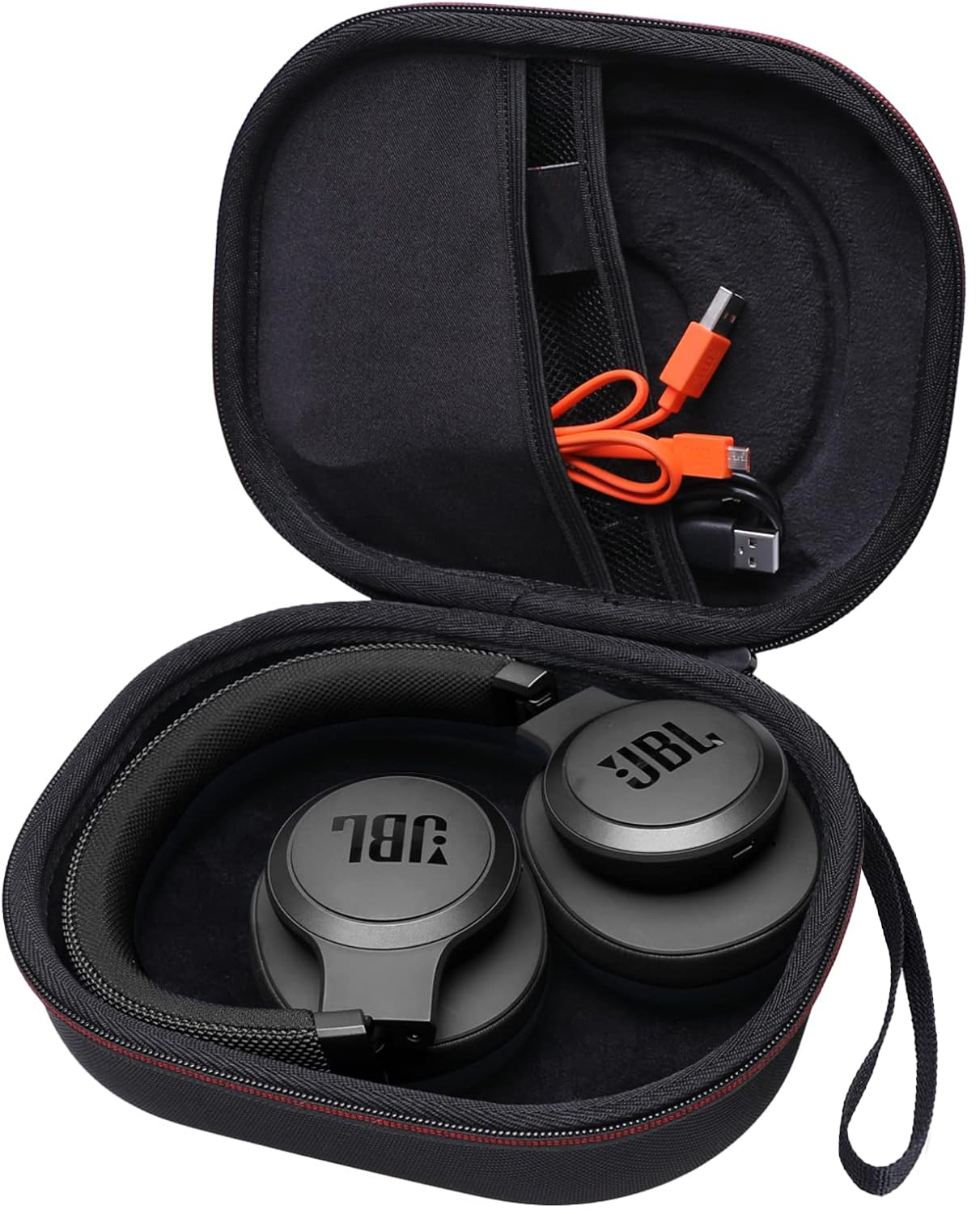
A basic storage case may use a relatively simple lined interior. A travel-oriented case may require stronger cushioning, additional support around the earcups or headband, and better separation between the headphone and its accessories.
The quotation may change when the buyer requests:
- A deeper molded cavity
- Thicker cushioning
- Additional foam components
- A cable or adapter compartment
- A mesh pocket
- A retaining strap
- A different headphone orientation
For more detailed structural guidance, review our foam insert and inner layout design guide.
Zipper, logo, and hardware
A specified zipper brand, customized puller, rubber patch, metal plate, embossed logo, or printed logo may require different materials, tools, and setup work.
Buyers do not always need to decide the final logo process before requesting a quotation. A clear logo file is usually sufficient for the factory to evaluate suitable options based on the case material, shape, expected effect, and project budget.
The logo size, position, color, and process should be approved through a rendering or physical sample before mass production.
Packaging
Packaging affects material cost, packing labor, carton size, and shipping volume.
An OPP bag can be a cost-controlled option when the rigid EVA case already provides sufficient structural protection. A kraft paper box may be preferred when the product requires retail presentation, printed information, shelf display, or additional protection during distribution.
Changes that may affect the quotation
Requested change Can the quotation change? Main reason Exterior material replacement Yes Material and processing cost change Larger case dimensions Yes Increased material use and possible tooling review Internal layout revision Yes Modeling, cushioning and assembly change Zipper-brand upgrade Possibly Hardware cost changes Logo-process change Possibly Tooling, setup or sample cost changes Additional accessory compartment Yes More materials and construction work OPP bag changed to a retail box Yes Packaging and carton-volume changes Minor logo-position adjustment Depends May require a revised rendering or sample Material replacement, size increase, and internal structure modification are among the most common reasons for a new price review.
Why Packaging, Target Price, and Intended Use Matter
Packaging, budget, and intended use help determine whether the proposed case specification is suitable for the actual project.
Packaging method
An OPP bag may be appropriate when:
- The buyer wants to control packaging cost
- The case will be placed inside another master package
- The EVA shell already provides sufficient rigidity
- A full retail display box is not required
A kraft paper box may be more suitable when:
- The case will be sold as a complete retail product
- Printed branding or product information is required
- The outer surface needs additional protection
- The buyer wants a more complete product presentation
Target price
When no target price is provided, the factory can quote according to the materials, structure, and packaging specified by the buyer.
When a target price is available, the factory can evaluate whether the requested configuration fits the budget. If it does not, the overall material combination, internal structure, zipper, or packaging may need to be adjusted.
For example, a buyer may use simpler packaging to retain the preferred exterior material. Alternatively, the buyer may retain the retail box while adjusting a less critical component.
Any upgrade requested after the initial quotation should be shown as a separate cost change rather than hidden inside an unclear revised price.
Intended use
Common applications include:
- Daily storage
- Travel carrying
- E-commerce retail bundles
- Gaming headsets
- Bluetooth over-ear headphones
- Brand promotional packages
A case intended mainly for daily storage may prioritize organization, appearance, and convenient access.
A travel case normally requires more attention to stable positioning, internal cushioning, protection around the earcups, headband support, and prevention of surface scratches.
The use scenario helps avoid both insufficient protection and unnecessary construction cost.
When Is a Physical Headphone Required?
Reference images and measurements can support an initial quotation, but they may not provide enough information for final 3D modeling.
Headphones can include curved headbands, compressible ear cushions, rotating joints, and irregular profiles that are difficult to verify from basic dimensions alone.
The physical product allows the engineering team to confirm:
- Actual contact points
- Required clearance
- Product-removal space
- Headband and earcup position
- Internal cavity depth
- Accessory placement
If the exact headphone model is commercially available, the factory may purchase it after the buyer supplies the correct brand, model number, product variation, and purchase link.
If the model cannot be purchased locally, the buyer needs to send a physical unit for modeling and sample development.
For a wider explanation of dimensions, structure, materials, and development preparation, review the custom EVA headphone case OEM design requirements.
Sample Fees, Tooling Fees, and Headphone Case MOQ
For standard headphone case projects, MOQ is generally around 100 pieces per style. The final requirement may vary depending on materials, structure, logo process, hardware, and color allocation.
Multiple colors may sometimes share the total order quantity. However, the factory must evaluate whether the quantity allocated to each color supports material preparation and stable production.
Dividing a small order into too many colors may increase material waste or create inefficient production batches.
Sample charges
Sample charges are normally listed separately. They may cover material preparation, cutting, laminating, molding, sewing, branding, assembly, and inspection related to the sample.
For qualifying bulk orders, part or all of the sample fee may be credited or refunded after order confirmation, depending on the order value and project conditions.
Tooling charges
Tooling or mold charges are also normally listed separately. The requirement depends on the case size, molded profile, structure, and development method.
For qualifying bulk orders, part or all of the tooling fee may also be credited or refunded after order confirmation, depending on the order value and project conditions.
Any refund or credit arrangement should be confirmed in the formal quotation. It should not be understood as an unconditional free-sample or free-tooling policy.
Logo revisions
If the logo size, position, color, or process changes after the first sample, an additional charge may or may not be required.
The result depends on whether new tools, materials, artwork, or another physical sample are necessary.
Preliminary Quote vs. Final Production Quote
A quotation prepared from reference information is not always the same as the final price used for production.
Four quotation stages
| Quotation stage | Available information | Purpose |
|---|---|---|
| Budget estimate | Reference image, approximate size and expected quantity | Determines whether the project is commercially realistic |
| Initial quotation | Dimensions, materials, structure, logo, packaging and quantity | Provides a more detailed starting price |
| Sample-based review | Physical headphone, 3D model and sample results | Identifies revisions that may affect cost |
| Final production quotation | Approved sample and locked specifications | Forms the commercial basis for mass production |
Budget estimate
A budget estimate can help the buyer decide whether the project should continue, but it should not be treated as a final purchasing price because several specifications may still be uncertain.
Initial quotation
An initial quotation can include:
- Estimated unit price
- MOQ
- Sample charge
- Tooling charge
- Packaging
- Estimated development time
- Estimated production time
- Important conditions or exclusions
When the project information is complete, a standard initial quotation can usually be prepared within one working day.
This is an estimated response time, not an unconditional guarantee. Special materials, unclear specifications, or complex structures may require additional review.
Sample-based review
The sample stage verifies whether the dimensions, internal cushioning, zipper opening, logo, color, and packaging work together correctly.
The sample may show that:
- Additional clearance is required
- The cavity is too tight or too loose
- The case depth needs adjustment
- The zipper opening needs improvement
- The logo size is unsuitable
- The selected material appears different from the reference image
Specifications that change after sample review may require repricing.
Final production quotation
The final production quotation should be based on:
- Approved dimensions
- Approved sample
- Confirmed materials
- Confirmed internal structure
- Confirmed logo
- Confirmed color
- Confirmed packaging
- Final quantity and color allocation
This four-stage distinction is important because it prevents a preliminary estimate from being mistaken for a permanently fixed production price.
Step-by-Step RFQ and Sample Development Process
Step 1: Submit the RFQ information
Provide the headphone model, purchase link, dimensions, reference images, materials, internal structure, logo, quantity, packaging, target price, and intended use.
Step 2: Receive the initial quotation
After complete information is received, an initial quotation can usually be prepared within one working day for a standard project.
Step 3: Obtain the physical headphone
The factory purchases the exact model when it is commercially available, or the buyer sends a physical sample when it cannot be sourced locally.
Step 4: Complete 3D modeling
For a standard project, 3D modeling may take approximately three days after the physical headphone and structure requirements are confirmed.
The actual time depends on the product profile, internal layout, accessory requirements, and revision complexity.
Step 5: Produce the sample
Sample production may take approximately two days after the 3D model and structure are confirmed and all required materials are ready.
This estimate excludes:
- 3D-modeling time
- Material preparation
- Logo tooling
- Color approval
- Shipping
- Revision time
It should not be presented as a complete two-day sampling cycle.
Step 6: Review the sample
The sample should be checked for:
- Overall fit
- Ease of product removal
- Internal cushioning
- Earcup and headband position
- Accessory storage
- Zipper opening
- Logo size and location
- Color
- Packaging
Before releasing the order for production, buyers can use the custom headphone case sample approval checklist to record the final sample, materials, branding, packaging, and production references.
Step 7: Confirm production scheduling
For an order of approximately 100 pieces using standard materials and a regular structure, production may take around seven days after:
- The sample has been approved;
- The required materials are ready;
- The order has entered the production schedule.
The actual lead time varies with order quantity, material availability, color allocation, project complexity, and factory capacity.
How Color and Logo Approval Can Prevent Rework
Color matching is one of the more common points reviewed during sample approval. Differences may result from screen display, lighting, material texture, coating, and surface finish.
Buyers can provide:
- A color code
- A physical color card
- An approved material sample
- An existing product sample
- A reference image
A Pantone color reference can make color communication clearer, but the final appearance should still be confirmed with an actual material swatch or physical sample.
When only a reference image is available, the factory can first locate a close material color and then provide a swatch or sample for approval.
The logo should also be confirmed for process, dimensions, position, color, and orientation. A digital rendering can support the first review, while a physical sample is more reliable for textured materials and three-dimensional logo processes.
What Changes Can Trigger Repricing or New Modeling?
Not every revision has the same technical impact.
Changes that may not affect the complete case model include:
- Changing the zipper brand
- Adjusting a small hardware component
- Moving the logo slightly
- Revising a printed graphic
- Changing the outer packaging
The model may remain unchanged, but the quotation can still change when the new component or process has a different cost.
Changes more likely to require modeling or tooling review include:
- Increasing the external dimensions
- Changing the case depth
- Changing the headphone orientation
- Increasing cushioning thickness
- Adding a large accessory compartment
- Revising the main molded cavity
- Using a different headphone model
- Changing the overall shell shape
The engineering team should evaluate each change before confirming whether it requires only a specification update, a revised model, a tooling adjustment, or a new sample.
How to Submit a Complete Headphone Case RFQ
Before requesting a formal quotation, prepare:
- Headphone brand and exact model
- Purchase link or physical-sample availability
- Product and folded dimensions
- Reference images
- Exterior and lining materials
- Internal cushioning and accessory requirements
- Logo artwork
- Required quantity
- Color allocation
- Packaging method
- Target price
- Intended use
Buyers comparing different shell shapes and internal layouts can review our headphone case product options before finalizing the RFQ.To receive an initial project review, send your headphone case specifications together with the dimensions, reference images, quantity, material preferences, and packaging requirements.
Frequently Asked Questions
What information is needed for custom headphone case pricing?
The core information includes the headphone model, dimensions, reference images, materials, internal structure, branding, quantity, packaging, target price, and intended use. Missing details may not prevent an early estimate, but they can reduce quotation accuracy.
Can you quote from dimensions and reference images only?
Dimensions and reference images can support a preliminary quotation when the materials, structure, packaging, and quantity are also provided. Final modeling and sample development normally require the physical headphone.
Is a physical headphone required for 3D modeling?
The physical headphone is normally required to verify curved profiles, compressible ear cushions, rotating joints, clearance, and internal contact points. The factory may purchase an available model using the buyer’s exact model information or receive a physical unit from the buyer.
What is the MOQ for a custom headphone case?
For standard headphone case projects, MOQ is generally around 100 pieces per style. The final MOQ may vary depending on materials, structure, logo process, hardware, color allocation, and production requirements.
Are sample and tooling fees included in the unit price?
Sample and tooling charges are normally listed separately. For qualifying bulk orders, part or all of these fees may be credited or refunded after order confirmation, depending on the order value and project conditions.
Why can the price change after the initial quotation?
The price may change when the material, dimensions, internal structure, zipper, logo process, packaging, quantity, or color allocation changes. Sample review may also identify structural revisions that were not visible during the initial quotation stage.
Conclusion
A complete RFQ helps the factory prepare a more relevant headphone case proposal and reduces avoidable revisions.
The initial quotation should define the current materials, structure, quantity, packaging, sample charge, tooling charge, and important conditions. Final production pricing should then be confirmed after the physical product, sample, color, logo, and production specifications have been approved.