

Introduction
When developing high-value equipment such as medical devices, drones, test instruments, or consumer electronics, packaging is more than just a container—it is a critical part of product protection, logistics, and brand presentation.
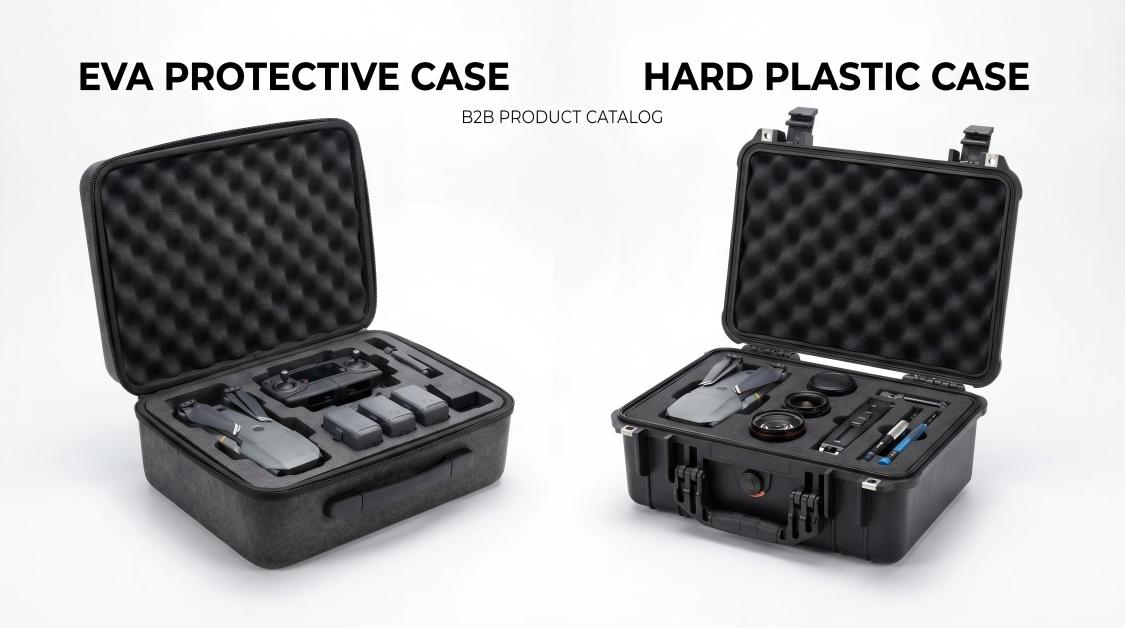
For product managers, engineers, and sourcing teams, the choice often comes down to two popular options: a thermoformed EVA protective case or an injection-molded hard plastic case.
Both materials have advantages, but they solve different problems. EVA cases are typically lighter, more customizable, and more cost-effective for mid-volume projects. Hard plastic cases offer higher rigidity and stronger crush resistance, which may be important for extreme-duty applications.
This guide compares the two across tooling cost, protection performance, weight, customization, water resistance, and production timelines to help you choose the most practical solution for your product.
For a comparison focused specifically on PVC and EVA protective-case trade-offs, see EVA vs PVC protective cases.
H2: EVA vs. Hard Plastic Case Material Overview
EVA and hard plastic represent two very different approaches to protective packaging.
An EVA protective case is typically made by laminating fabric such as PU or nylon onto EVA foam sheets, then thermoforming the materials into a semi-rigid outer shell. The result is a lightweight, durable case with a premium look and excellent customization potential.
A hard plastic case, usually made from materials such as ABS, PP, or HDPE, is injection molded into a fully rigid shell. These cases are designed for structural strength, stackability, and resistance to compression.
In simple terms:
- EVA cases are better when you want lightweight protection, better branding, and lower tooling cost.
- Hard plastic cases are better when you need maximum rigidity, heavy-duty stacking, or extreme structural strength.
For many brands, the decision comes down to balancing protection, cost, appearance, and speed to market.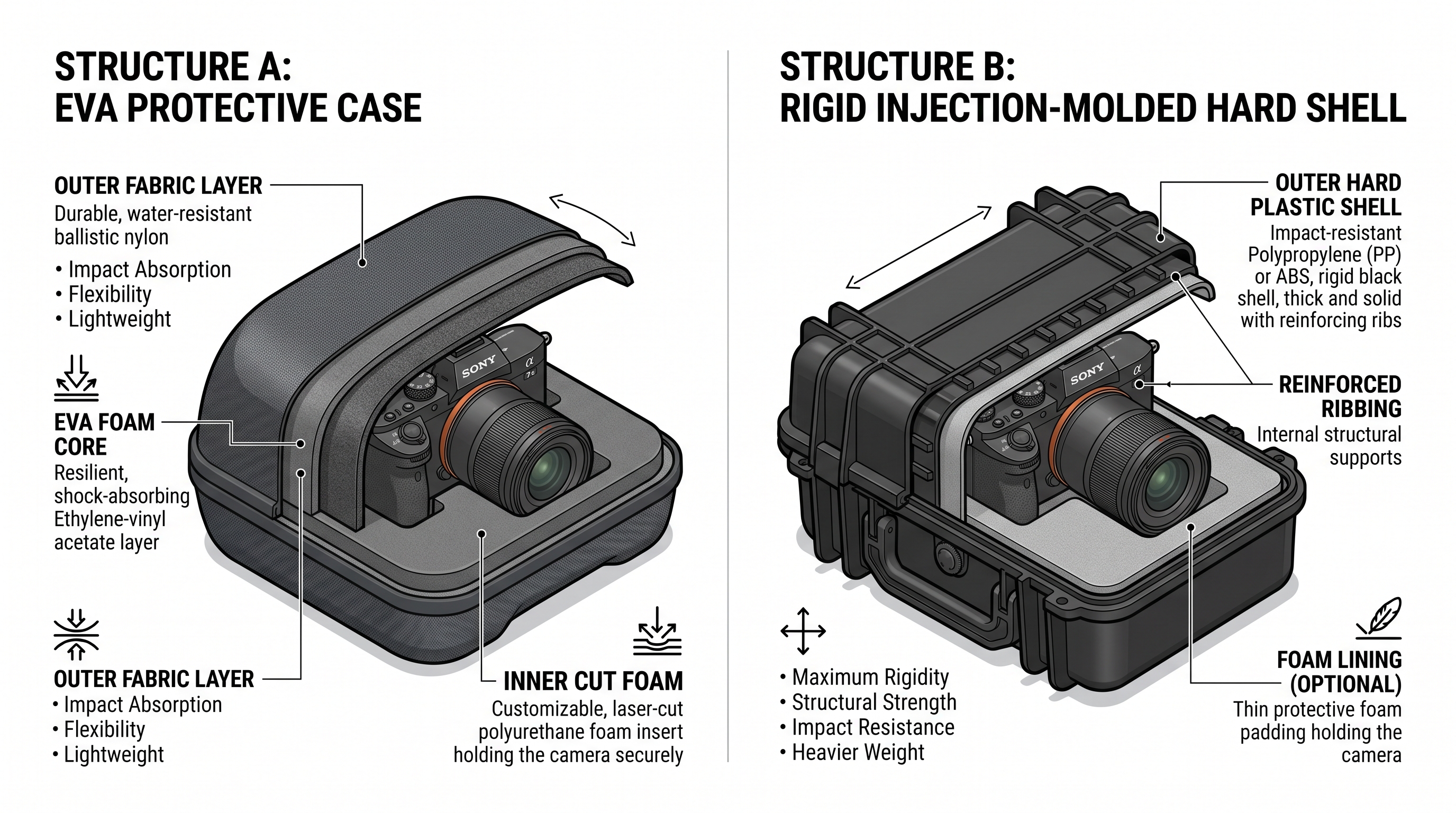
H2: Manufacturing Process & Tooling Costs
For B2B buyers and hardware startups, upfront tooling cost is often the deciding factor.
EVA case manufacturing typically uses aluminum molds, which are significantly more affordable than injection molds and faster to produce. Depending on the size and complexity of the design, EVA tooling may start from a few hundred dollars and can often be ready in about 5–7 days.
By contrast, hard plastic cases usually require steel injection molds. These molds involve a much higher initial investment and a longer production timeline, often taking several weeks to complete. For complex designs, tooling costs can rise even further.
That is why EVA is often the more practical option for pilot runs, product validation, and mid-volume orders. If you are launching a new product and need to keep development risk low, custom EVA case production offers a much lower barrier to entry.
Hard plastic cases can become more cost-efficient at very large production volumes, but only after the higher mold cost has been amortized over enough units.
Key takeaway:
- EVA: lower tooling cost, faster lead time, better for small to mid-volume orders
- Hard plastic: higher tooling cost, slower lead time, better for large-scale production
H2: Impact Resistance & Structural Integrity
Protection performance is one of the most important factors in case selection.
Hard plastic cases are generally stronger in terms of crush resistance. Their rigid shell structure can withstand stacking pressure, shipping compression, and rough industrial handling. In environments where the case may be exposed to heavy external force, hard plastic has a clear advantage.
However, rigidity can also be a drawback. Because hard plastic does not flex much, impact energy may be transferred directly to the contents inside if the internal padding is not designed properly.
EVA cases, on the other hand, are excellent at absorbing shock. The closed-cell foam structure helps dissipate impact energy during drops and vibrations, making EVA a strong choice for products that need everyday protection during transport and handling.
For many real-world shipping and travel scenarios, EVA provides better practical impact protection because it cushions the device instead of simply resisting compression.
Key takeaway:
- Hard plastic: better crush resistance
- EVA: better shock absorption and drop protection
H2: Weight & Portability
Weight has a direct impact on shipping cost, user experience, and product positioning.
Injection-molded hard plastic cases are usually heavier because they rely on thicker rigid walls. This can increase air freight charges, international shipping costs, and handling difficulty.
EVA cases are much lighter while still providing semi-rigid protection. This makes them a strong option for portable devices, consumer electronics, travel gear, and field equipment.
A lightweight protective case not only improves portability but also helps reduce dimensional shipping costs in many logistics scenarios. For brands trying to optimize landed cost, the weight advantage of EVA can be significant.
Key takeaway:
- EVA: lighter, easier to carry, more shipping-friendly
- Hard plastic: heavier, but more rigid
H2: Aesthetics, Customization & Branding
If your product is sold in retail, DTC, or premium B2B channels, packaging appearance matters.
Hard plastic cases usually have a rugged, industrial look. Customization is possible, but it is often limited to molded logos, basic colors, or external labeling.
EVA cases offer much more flexibility in appearance and branding. The outer surface can be wrapped in a variety of fabrics, including PU, nylon, and recycled materials. You can also add features such as embossed logos, silk-screen printing, custom zipper pullers, contrast stitching, and color-matched interiors.
This makes EVA especially attractive for brands that want the case itself to reinforce product value. A well-designed custom EVA case can create a more premium unboxing experience and improve perceived product quality.
Key takeaway:
- EVA: stronger branding potential, more design flexibility
- Hard plastic: more limited aesthetic customization
H2: Water & Weather Resistance
Water resistance is another area where the right choice depends on the use case.
Hard plastic cases with proper gasket sealing can provide excellent protection against water ingress. In applications that require very high water resistance or even submersion protection, hard plastic is often the better option.
That said, a waterproof EVA case is more than sufficient for many everyday and outdoor applications. With waterproof PU fabric, heat-sealed seams, and water-resistant zippers, EVA cases can provide strong protection against rain, splashes, and accidental spills.
For most portable electronics, medical accessories, and field equipment, EVA offers a practical balance between water resistance, weight, and appearance.
Key takeaway:
- Hard plastic: best for extreme water resistance and submersion use cases
- EVA: suitable for rain, splashes, and general weather protection
H2: Industry Applications & Use Cases
The best material depends on how and where the product will be used.
EVA cases are commonly used for:
- Medical devices
- Portable diagnostic tools
- Drones and drone accessories
- Consumer electronics
- Cameras and photography accessories
- Gaming peripherals
- Test and measurement instruments
EVA works especially well when the product needs organized internal foam, good portability, and a professional look.
Hard plastic cases are commonly used for:
- Military and tactical equipment
- Heavy industrial tools
- Rugged outdoor gear
- Equipment exposed to stacking or compression
- Applications requiring maximum shell rigidity
In many product categories, EVA is the preferred choice for modern portable equipment because it offers a better balance of protection, weight, and branding.
H2: Eco-Friendliness & Sustainability
Sustainability is becoming a bigger factor in packaging decisions, especially for global brands and environmentally conscious buyers.
Traditional hard plastics are usually petroleum-based and can be difficult to position as an eco-friendly packaging solution.
EVA cases can be more flexible from a sustainability perspective. Many manufacturers now offer exterior fabrics made from recycled PET materials, and some are exploring more responsible foam formulations and manufacturing methods.
If sustainability is important to your brand, a custom EVA case with recycled fabric options may be a stronger fit than traditional rigid plastic packaging.
Key takeaway:
- EVA: more opportunities for recycled fabrics and sustainable presentation
- Hard plastic: durable, but generally less flexible for eco-positioning
H2: Which Case Should You Choose?
If you are still deciding between EVA and hard plastic, the best choice usually depends on your product priorities.
Choose EVA if you need:
- Lower tooling investment
- Faster time to market
- Lighter weight
- Better branding and customization
- Portable protection for electronics or medical devices
- A practical solution for pilot runs or mid-volume production
Choose hard plastic if you need:
- Maximum crush resistance
- Heavy-duty stacking strength
- Strong shell rigidity
- Extreme environmental protection
- Very large production volumes that can justify mold cost
In most B2B product launches, EVA is the more flexible and cost-efficient option. Hard plastic becomes more attractive when your application demands higher structural rigidity or when production volume is high enough to offset tooling investment.
H2: Frequently Asked Questions
Q1: What is the cost difference between EVA and hard plastic cases at 1,000 units?
At around 1,000 units, EVA cases are often more cost-effective because tooling investment is lower and production lead time is faster. Final unit price depends on case size, material thickness, fabric choice, printing, interior foam complexity, and packaging requirements. Hard plastic cases usually involve a much higher upfront mold cost, which makes them less attractive for smaller or mid-volume runs.
Q2: Can I switch from hard plastic to EVA cases mid-production?
Yes, switching is possible. Since EVA tooling is relatively fast and affordable, many companies use it to test the market before committing to a more expensive hard plastic solution. In most cases, the internal foam layout and overall dimensions would need to be redesigned to match the new structure.
Q3: Which material is better for international shipping and air freight?
EVA is usually the more practical choice for international shipping and air freight because it is lighter than hard plastic. The reduced weight can help lower shipping costs and improve handling efficiency, especially for products that move frequently through logistics networks.
Final Thoughts
Choosing between EVA and hard plastic is not just a material decision—it is a business decision.
If your priorities are lower tooling cost, faster development, lighter weight, and stronger branding, EVA is often the better choice. If your product requires maximum rigidity, heavy stacking resistance, or extreme-duty protection, hard plastic may be more suitable.
For many B2B brands, EVA offers the ideal balance of protection, aesthetics, and cost efficiency.
If you are evaluating a custom protective solution for your product, our team can help you design the right EVA case based on your application, budget, and production goals.
To compare materials for a specific product, review our custom protective case development options before selecting the final structure and sample approach.